



Most content about improving accumulator betting focuses on which teams to pick — Not the full process of calculation, selection criteria, the leg count discipline etc..
There is also another category of loss that better process alone does not prevent and is rarely discussed.
It is the loss that happens when a bettor who has a sound process abandons it at a specific moment under a specific type of pressure.
These moments are predictable. They follow recognisable human patterns. And they tend to be the moments where the damage is worst — not because the stakes are highest, but because the emotional pressure to override the process is strongest precisely when the process is most needed.
Three of them come up consistently.
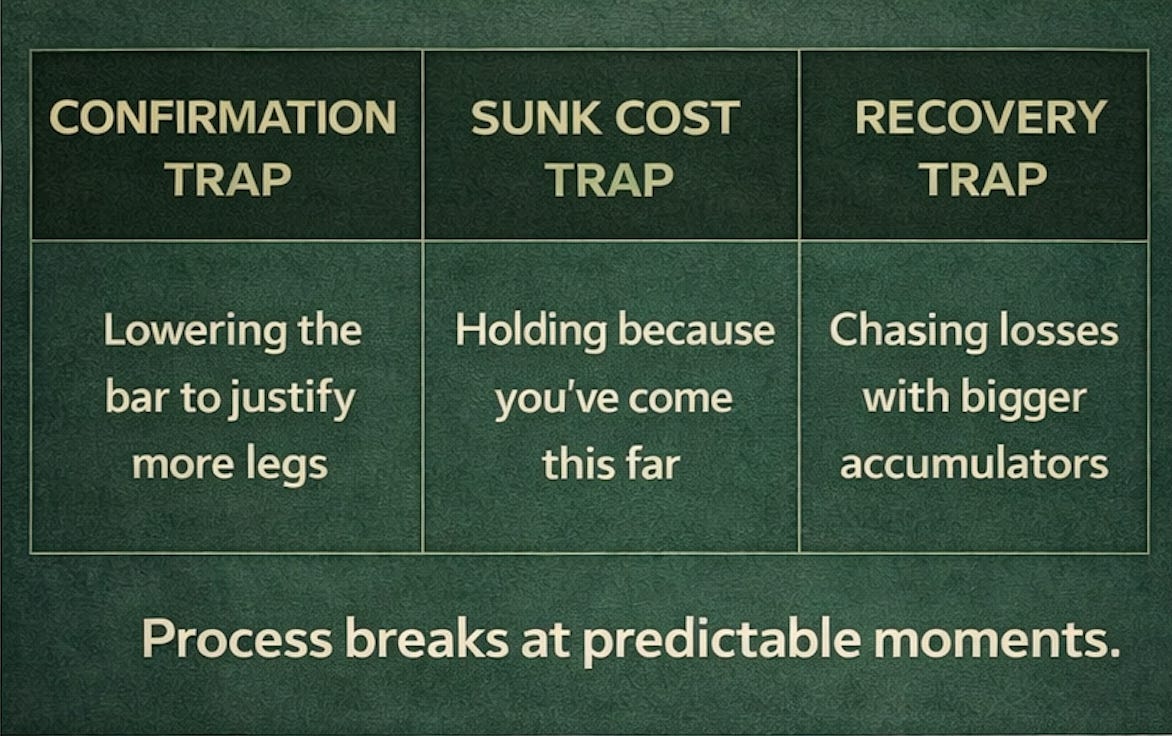
The confirmation trap
You have done the analysis. One game has come back clearly positive — the leg clears the threshold, the odds represent genuine value, the case is straightforward. A second game looks promising but borderline. A third feels strong but the data is thinner than you would like.
The confirmation trap is what happens next. The strong first selection creates a bias towards confirming the weaker ones. You have already decided you are building an accumulator this week. The first leg justified it. Now the question has subtly shifted from “does this leg clear the threshold” to “can I find a reason why this leg clears the threshold.”
Those are different questions. The second one produces a different answer more often than the first.
The result is an accumulator with one genuinely positive-expectation leg and two legs that cleared a lower bar than they should have — because the first leg created momentum towards building a combination rather than maintaining the filter.
The fix is process-level rather than willpower-level: assess each leg independently, in isolation, before any combination is considered. The question for every leg is always the same. It does not change because a strong first selection has already been identified.
The sunk cost trap
Three legs have landed. The fourth is live. The team you backed is not performing the way the analysis suggested they would — the xG is not going their way, the game has a different shape than expected, the likelihood of the result you need has clearly shortened.
The rational response is to trade out, accept a reduced return, and move on. The emotional response is to hold — because you have already “invested” three correct selections, because cashing out feels like abandoning something you built, because the potential return is still visible and the current payout feels inadequate given how far you have come.

The sunk cost trap is powerful precisely because it masquerades as patience and conviction. You are not being irrational, you tell yourself. You are backing your analysis. You are not cashing out early just because the game is difficult.
But the three legs that have already landed are not relevant information for the decision you are making now. The only relevant information is the current probability of the fourth leg winning and whether the available cash-out represents fair value against it. Everything else is noise.
The bettors who handle this consistently well make the decision in advance. The conditions under which they will cash out, the conditions under which they will hold, are defined before the accumulator is placed. When the moment arrives, the decision has already been made. There is nothing left to feel conflicted about.
The recovery trap
You have had a difficult run. Three accumulators in a row have not landed. The losses are not catastrophic - you have been staking sensibly - but they are accumulating, and the natural human response to a losing run is the desire to recover ground.
The recovery trap is the accumulator placed not because the legs are strong but because the combined odds are high enough to make the losses back in one hit. More legs than the process would normally justify. Selections that clear a lower threshold than usual. A combination built around what the return needs to be rather than what the data supports.
This is where the most damage tends to happen. Not in the steady losses of a run where the process is sound but variance is negative. In the one or two large bets placed under emotional pressure to recover - bets that the process, applied correctly, would never have produced.
The recovery trap is also the hardest to see clearly in the moment, because the desire to recover ground feels like confidence. It presents itself as conviction. The tells are in the construction of the bet: if the odds of the combination were the starting point rather than the output of the process, the trap has already been sprung.
The common thread
All three traps share a structure.

The solution in each case is the same: decisions made in advance, in conditions of low emotional pressure, are better than decisions made in the moment under high emotional pressure. Pre-defined rules for leg inclusion, exit conditions, and staking limits are not a constraint on good judgement. They are what good judgement looks like when implemented properly.