


Betting Knowledge Series — Lesson 12
How to Adapt When the Market Catches Up: The Evolution of an Edge
Introduction
Every profitable strategy eventually stops working.
That’s not failure. It’s evolution.
Markets mature, bookmakers upgrade models, data becomes sharper, and the edge that once gave you a clear advantage slowly disappears.
The traders who survive aren’t the ones who find one perfect idea. They’re the ones who keep refining imperfect ones.
This lesson shows how to evolve your edge. How to measure when it’s fading, how to adapt to new data, and how to rebuild faster than the market can correct you.
1. The Lifecycle of an Edge
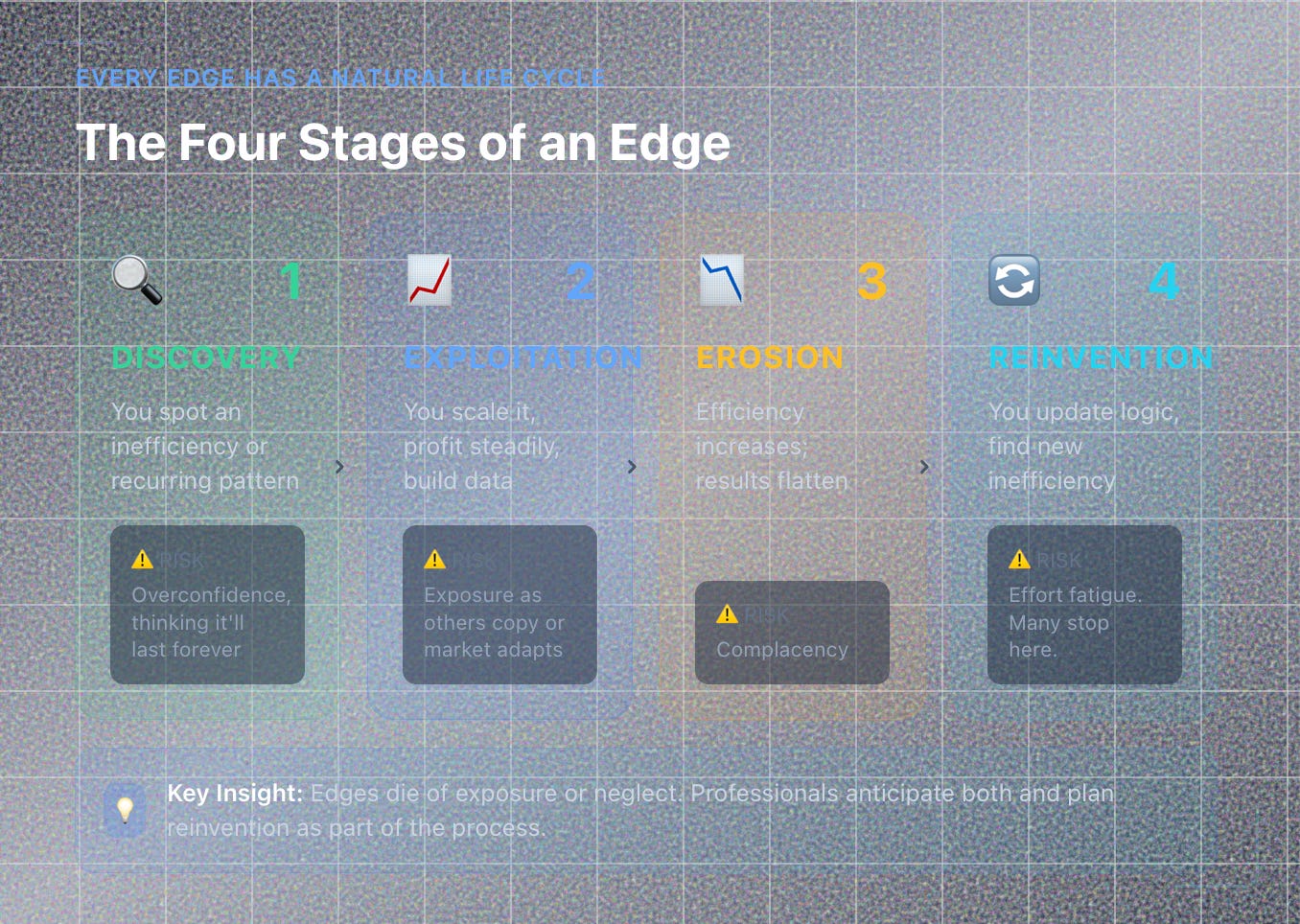
Every edge has a natural life cycle:
Stage Description Risk Discovery You spot an inefficiency or recurring pattern. Overconfidence, thinking it’ll last forever. Exploitation You scale it, profit steadily, build data. Exposure as others copy or market adapts. Erosion Efficiency increases; results flatten. Complacency. Reinvention You update logic, find new inefficiency. Effort fatigue. Many stop here.
Edges die of exposure or neglect.
Professionals anticipate both and plan reinvention as part of the process.
2. Recognizing Edge Decay
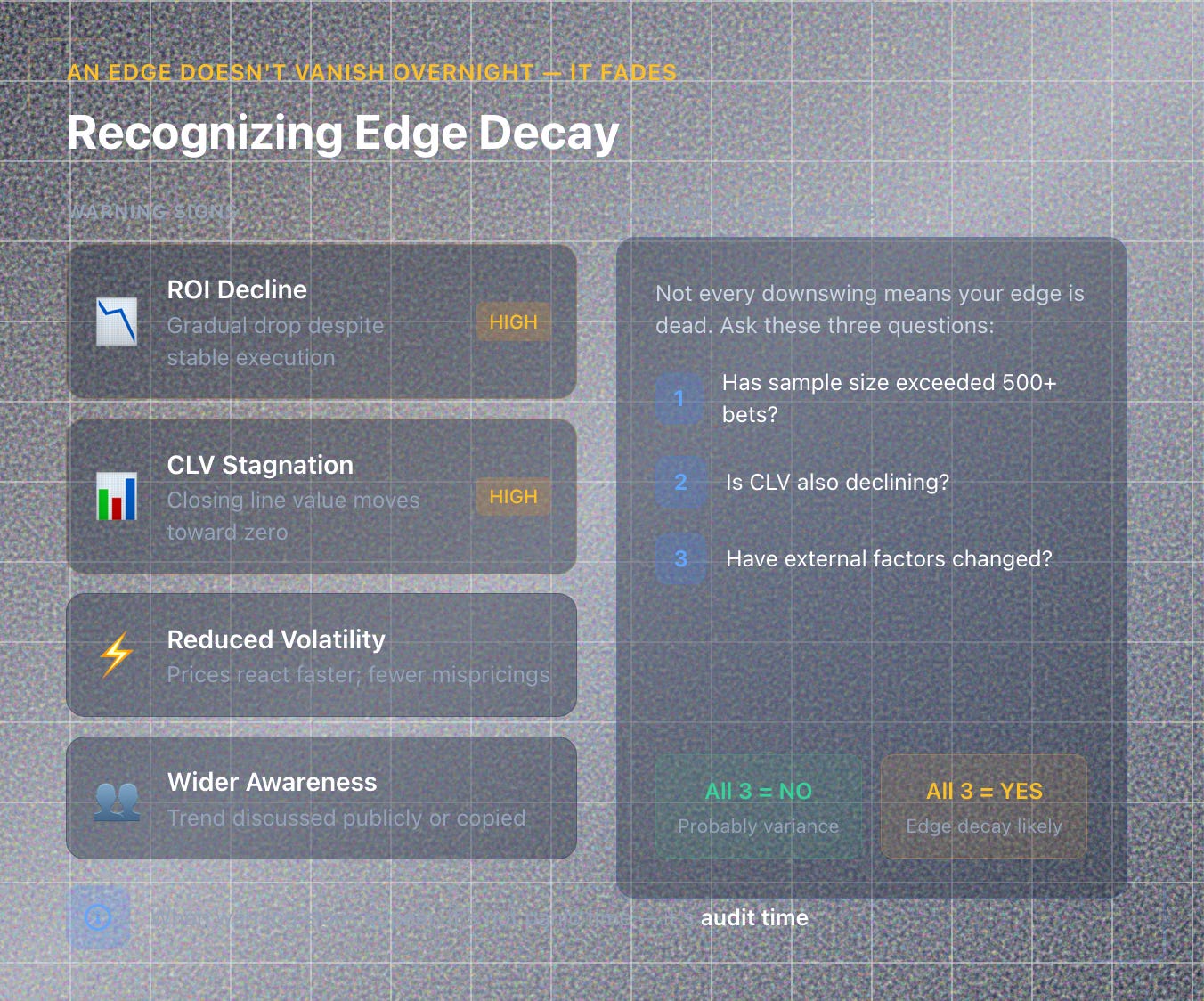
An edge doesn’t vanish overnight. It fades.
These are the warning signs:
ROI Decline: Gradual drop despite stable execution.
Closing Line Stagnation: CLV moves toward zero.
Reduced Volatility: Prices react faster; fewer mispricings.
Wider Market Awareness: Trend discussed publicly or copied.
When these appear, it’s not panic time. It’s audit time.
3. Distinguish Between Variance and Decay
Not every downswing means your edge is dead.
Variance mimics decay in the short term.
Ask three questions:
Has sample size exceeded 500+ bets?
Is CLV also declining?
Have external factors (data models, tactics, liquidity) changed?
If all three say yes, edge erosion is likely real.
If not, it’s probably just variance.
4. The Market Learns Fast
In today’s ecosystem, inefficiencies rarely last long.
Data providers publish models.
Bookmakers adopt machine learning.
Communities crowd-source trends.
What was private insight yesterday becomes public average today.
That’s why speed and adaptability matter more than brilliance.
The market learns, but it learns slowly from its edges. Your job is to always be one iteration ahead.
5. How to Reinvent an Edge
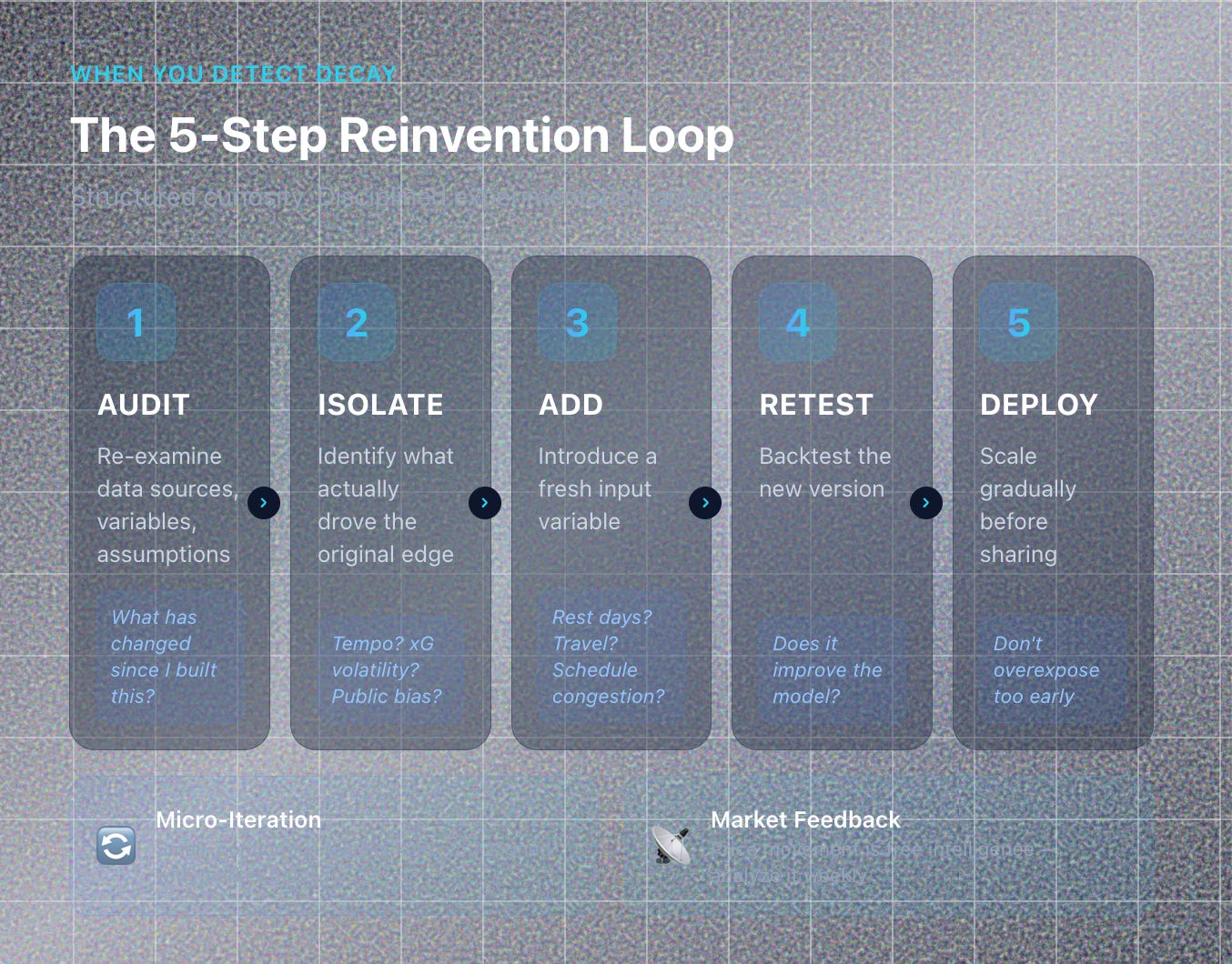
When you detect decay, follow this five-step reinvention loop:
1️⃣ Audit:
Re-examine data sources, variables, and assumptions.
Ask, “What has changed in the market since I built this?”
2️⃣ Isolate Core Principle:
Identify what actually drove the original edge (tempo? xG volatility? public bias?).
3️⃣ Add New Variable:
Introduce a fresh input (like rest days, travel, player usage, schedule congestion).
4️⃣ Retest and Recalibrate:
Backtest the new version; measure improvement.
5️⃣ Deploy Quietly:
Scale gradually before sharing or overexposing.
Reinvention is structured curiosity. Disciplined experimentation guided by data.
6. Adaptation Through Micro-Iteration
You don’t need to overhaul your system every season.
Often, the best evolution is micro-iteration. Small, continuous tweaks that keep you aligned with market behavior.
Examples:
Adjusting entry window (like 20–30 min → 25–35 min).
Re-weighting xG growth thresholds.
Updating liquidity filters to exclude over-efficient matches.
These subtle changes maintain freshness without disrupting the model’s DNA.
7. Use the Market as Feedback
Markets are your mirror.
If lines consistently move against you pre-kickoff, something’s off.
If they move in your favor but ROI drops, margins have tightened.
Price movement is free intelligence. Analyze it weekly.
The market tells you where your assumptions are losing accuracy.
8. The Power of Continuous Learning
The best traders act like scientists.
They don’t defend old ideas. They test new ones relentlessly.
Develop a learning rhythm:
Read research on new analytics (xThreat, possession value, expected passes).
Study how pros model probability.
Revisit historic data annually.
Talk to peers who challenge your thinking.
Stagnation is more dangerous than losses. You can recover from losses. Not from irrelevance.
9. Diversify Systems, Not Focus
Once your main edge is stable, build small side projects exploring adjacent markets:
If you trade 1H goals, test 2H regression models.
If you use xG, add xA (expected assists) as complementary signal.
If you trade match odds, study in-play momentum or live goal timing.
Each mini-system teaches you something about the ecosystem.
Some will fail. One might evolve into your next major edge.
10. The Professional Evolution Mindset
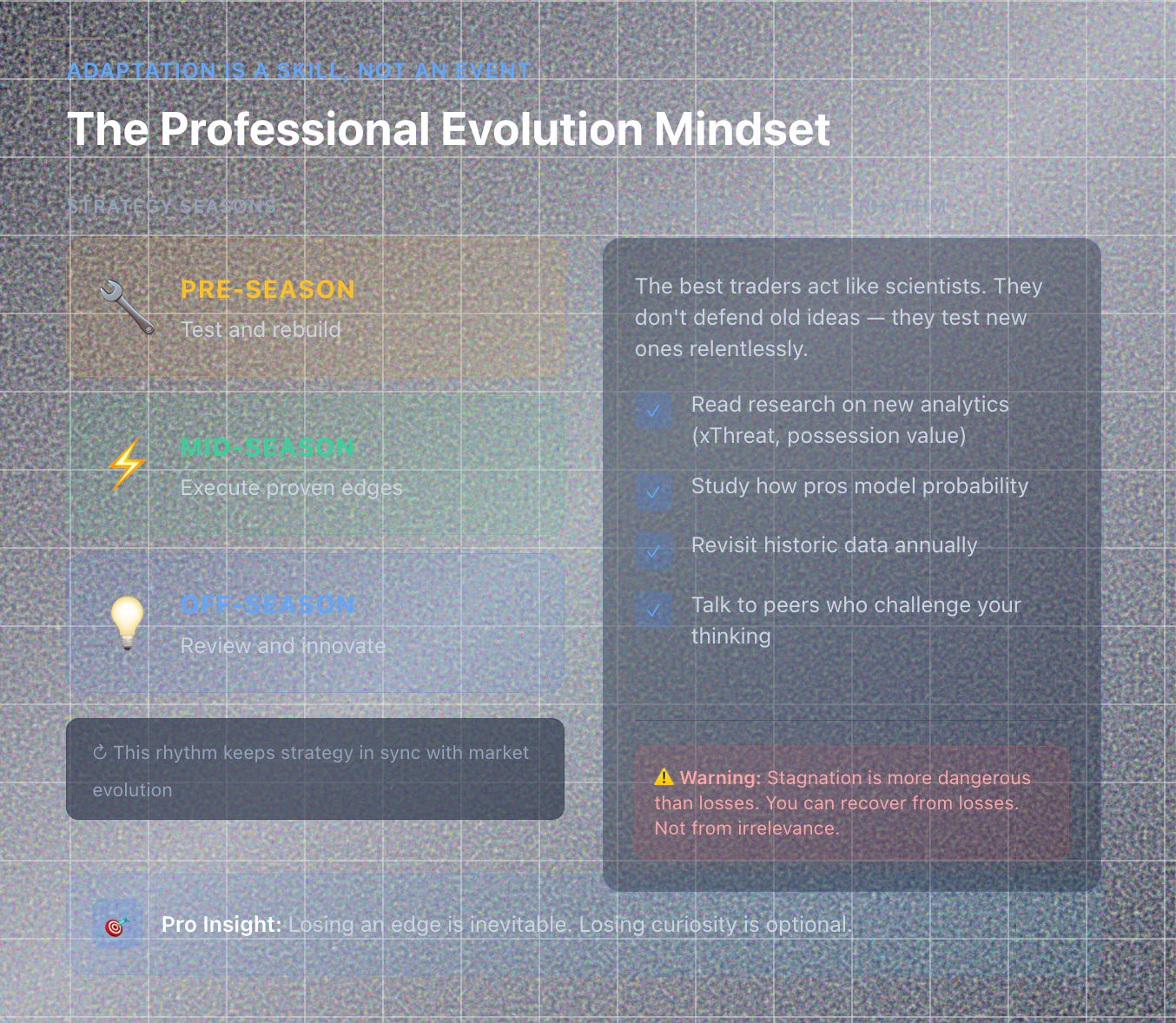
Pros know that losing an edge is inevitable, but losing curiosity is optional.
They treat the process like seasons in sport:
Pre-season: Test and rebuild.
Mid-season: Execute proven edges.
Off-season: Review and innovate.
This rhythm keeps their strategy in sync with market evolution.
Adaptation is a skill, not an event.
Key Takeaways
✅ Every edge has a life cycle: discovery → exploitation → erosion → reinvention.
✅ Declining ROI + neutral CLV = probable edge decay.
✅ Adaptation works best through small, consistent tweaks.
✅ The market is both competitor and teacher. Listen to its feedback.
✅ Continuous learning prevents stagnation.
✅ Curiosity is your permanent edge. Methods are temporary.
Next Lesson
📘 Lesson 13: Building Multiple Edges — How Professionals Create Portfolios of Strategies
We’ll explore how top bettors run more than one profitable model at once, balance risk between systems, and build a diversified “trading portfolio” that smooths variance and compounds profit.