


Betting Knowledge Series — Lesson 17
Introduction
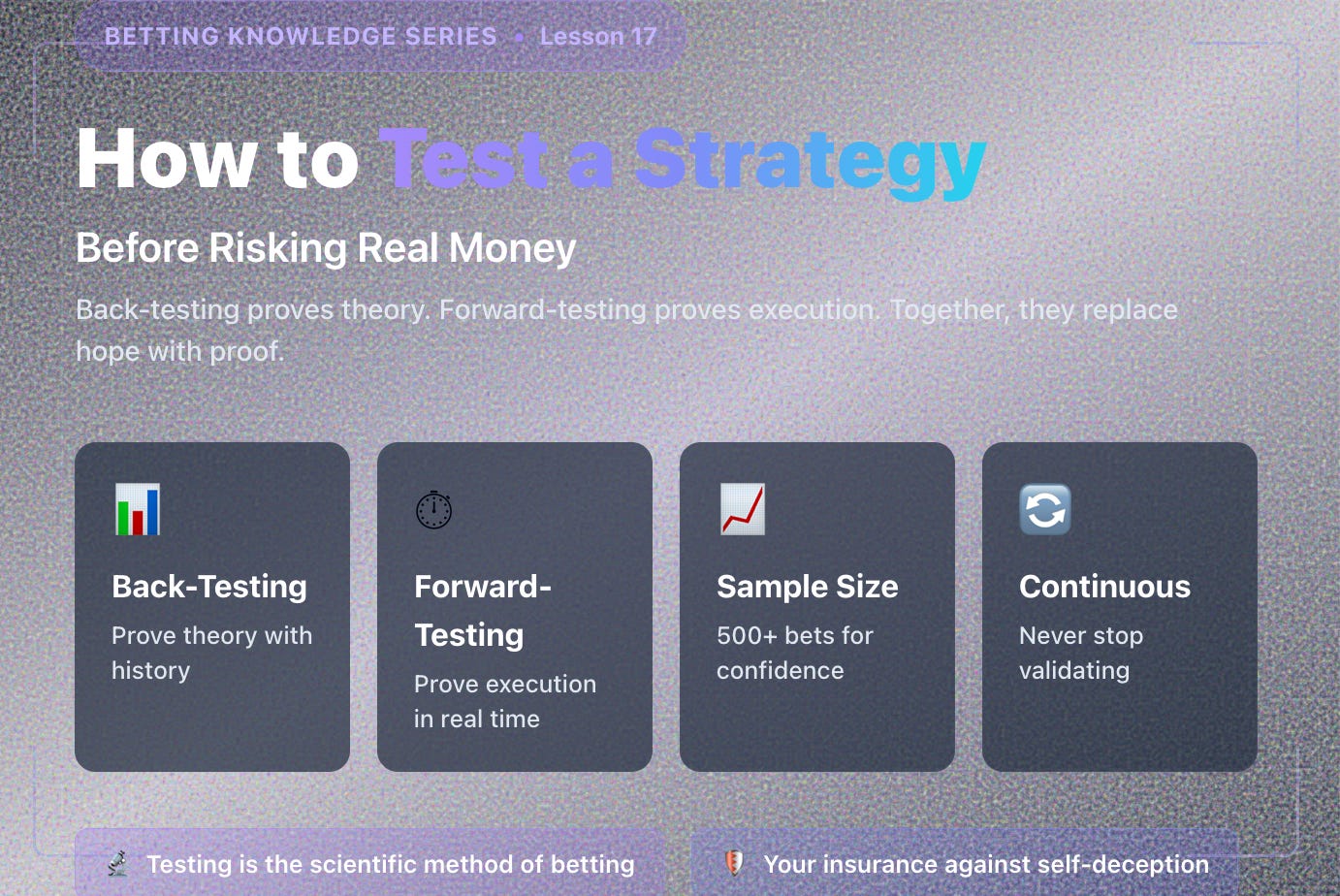
Every profitable bettor shares one trait:
They test before they trade.
Back-testing turns raw ideas into verified logic.
Forward-testing turns verified logic into real-world confidence.
Together, they form the scientific method of betting. A process that replaces “hope” with proof.
They test before they trade.
Back-testing turns raw ideas into verified logic.
Forward-testing turns verified logic into real-world confidence.
Together, they form the scientific method of betting. A process that replaces “hope” with proof.
1. Why Testing Matters
Most people build a strategy, see a few wins, and go all-in.
That’s emotion masquerading as validation.
Testing does three things:
Confirms edge: Shows whether an idea truly beats randomness.
Reveals volatility: Tells you what drawdowns to expect.
Protects capital: Saves you from staking on flawed assumptions.
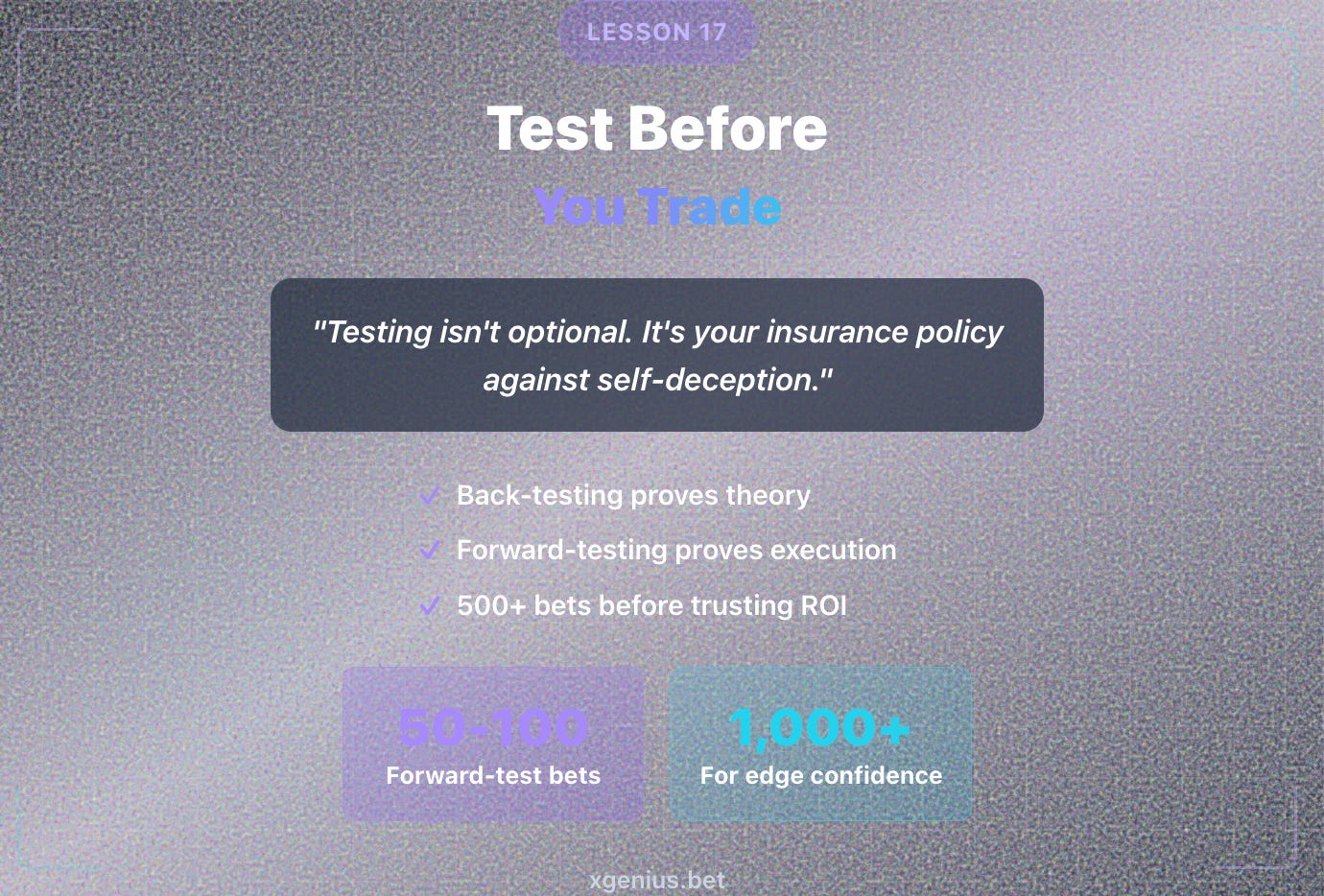
Testing isn’t optional. It’s your insurance policy against self-deception.
2. The Scientific Framework
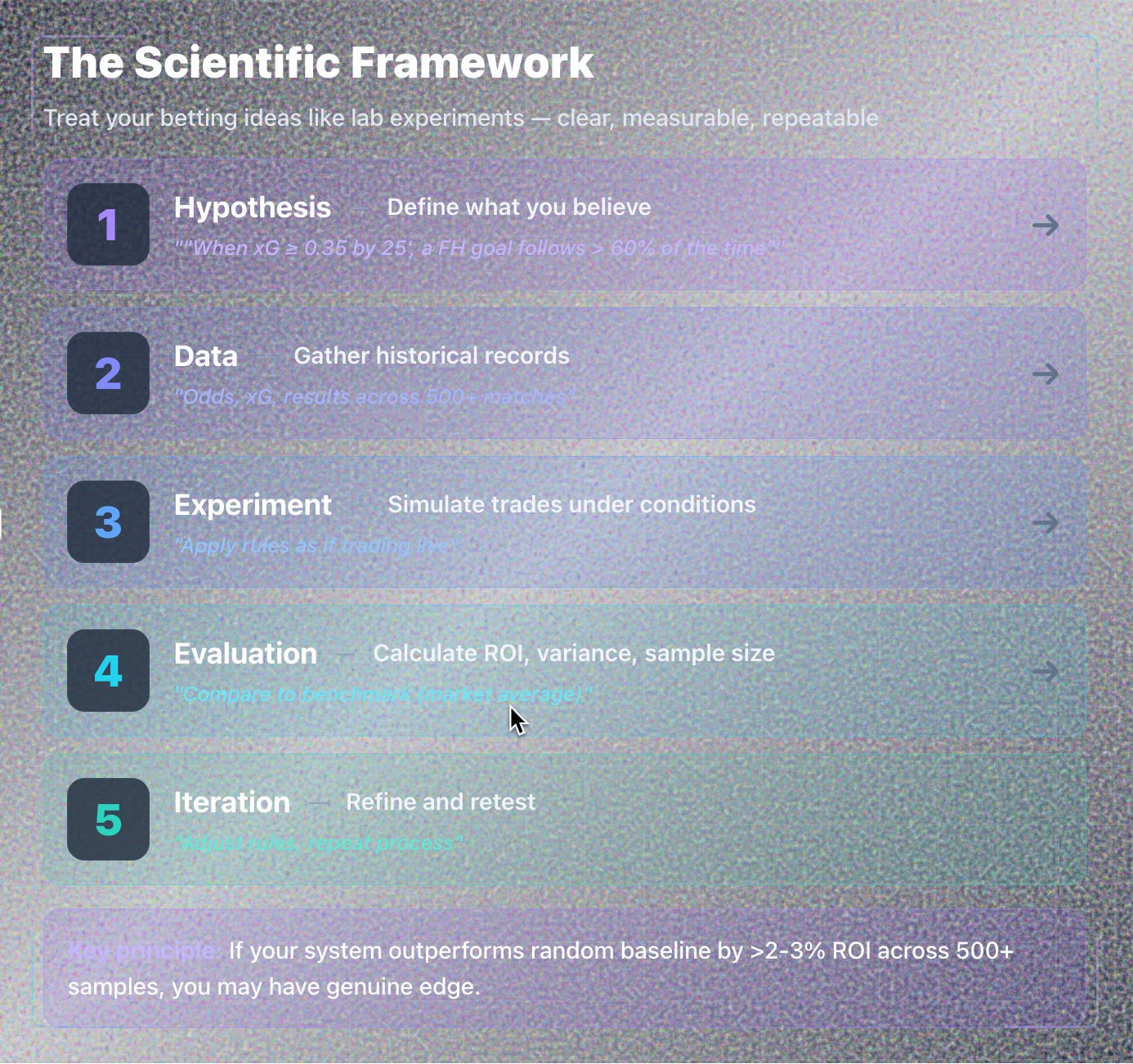
Every testing process follows five steps:
1️⃣ Hypothesis: Define what you believe (like “When xG ≥ 0.35 by 25’, a first-half goal follows > 60% of the time”).
2️⃣ Data: Gather historical records to measure it.
3️⃣ Experiment: Simulate trades under those conditions.
4️⃣ Evaluation: Calculate ROI, variance, and sample size.
5️⃣ Iteration: Refine and retest.
Treat your betting ideas like lab experiments. Clear, measurable, repeatable.
3. Back-Testing Basics
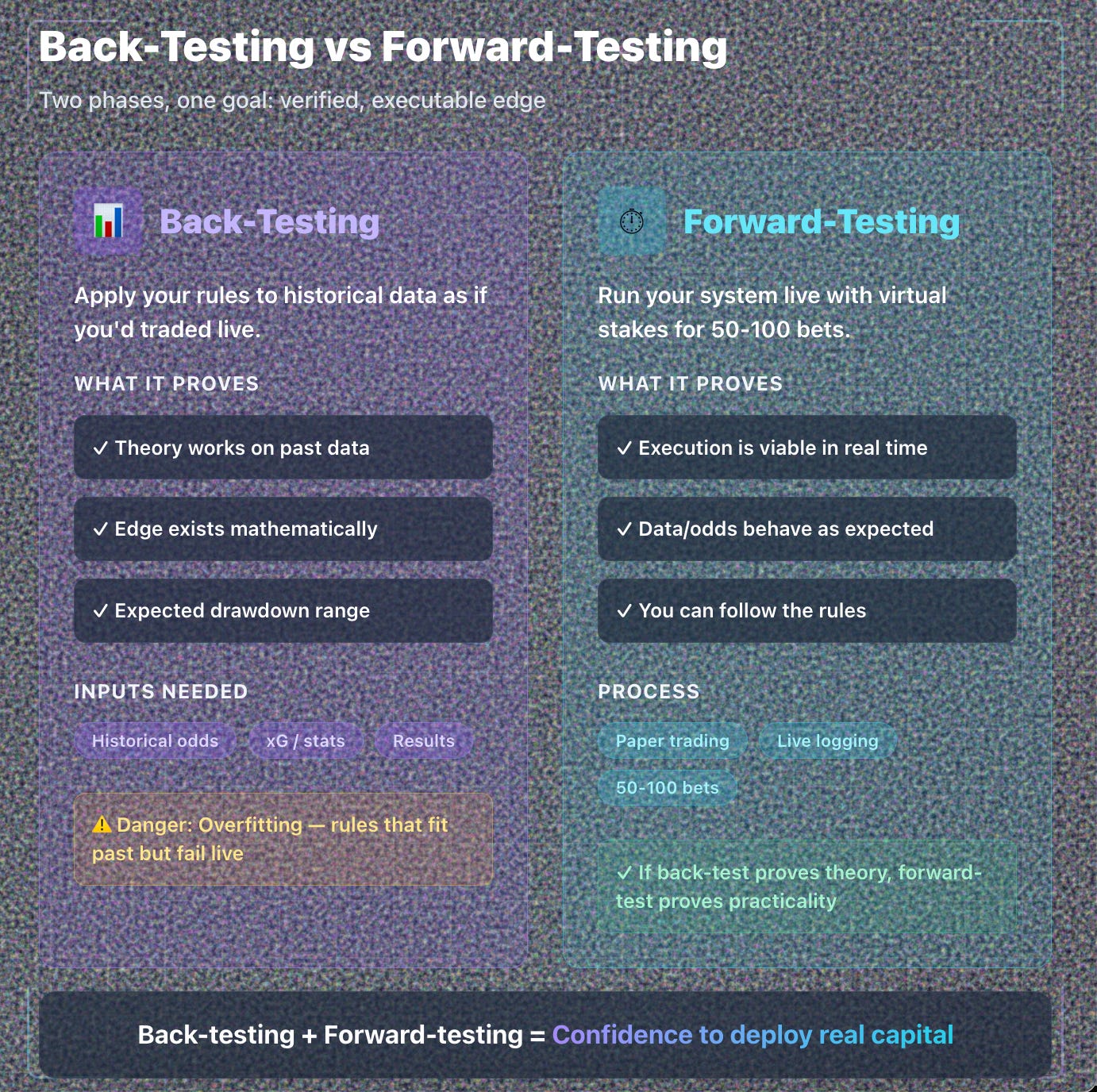
Back-testing means applying your rules to historical data as if you’d traded live.
It tells you how the system would have performed in the past.
Inputs Needed:
Historical odds (open, close).
xG or performance stats.
Results (goals, outcomes).
Process:
Filter all matches that fit your entry rules.
Record implied probabilities and actual results.
Calculate ROI, hit rate, and drawdown.
Compare to benchmark (market average).
If your system outperforms random baseline by > 2–3% ROI across 500+ samples, you may have genuine edge.
4. Avoiding Back-Testing Bias
The danger of back-testing is that it’s too perfect.
You already know outcomes, so it’s easy to design rules that fit the past.
That’s called overfitting. When a system performs brilliantly historically but fails in live markets.
Avoid it by:
Keeping rules simple (≤ 5 core variables).
Testing across multiple seasons, not one.
Using “out-of-sample” data (see below).
Measuring predictive accuracy, not perfection.
5. Out-of-Sample Testing
Split your data into two parts:
Dataset Purpose In-Sample Used to design and tune the strategy. Out-of-Sample Kept hidden to test how the strategy performs on unseen data.
If performance collapses on the unseen set, your rules were curve-fit to history.
If results stay stable, your logic has true predictive power.
6. Forward-Testing (Paper Trading)
Forward-testing takes your system into the present, but with virtual stakes.
You run it live for 50–100 bets, logging entries exactly as you would in real money conditions.
This phase confirms two things:
Execution viability: Can you actually follow the rules in real time?
Data latency: Do live odds or feeds behave as expected?
If back-testing proves theory, forward-testing proves practicality.
7. Sample Size and Statistical Confidence
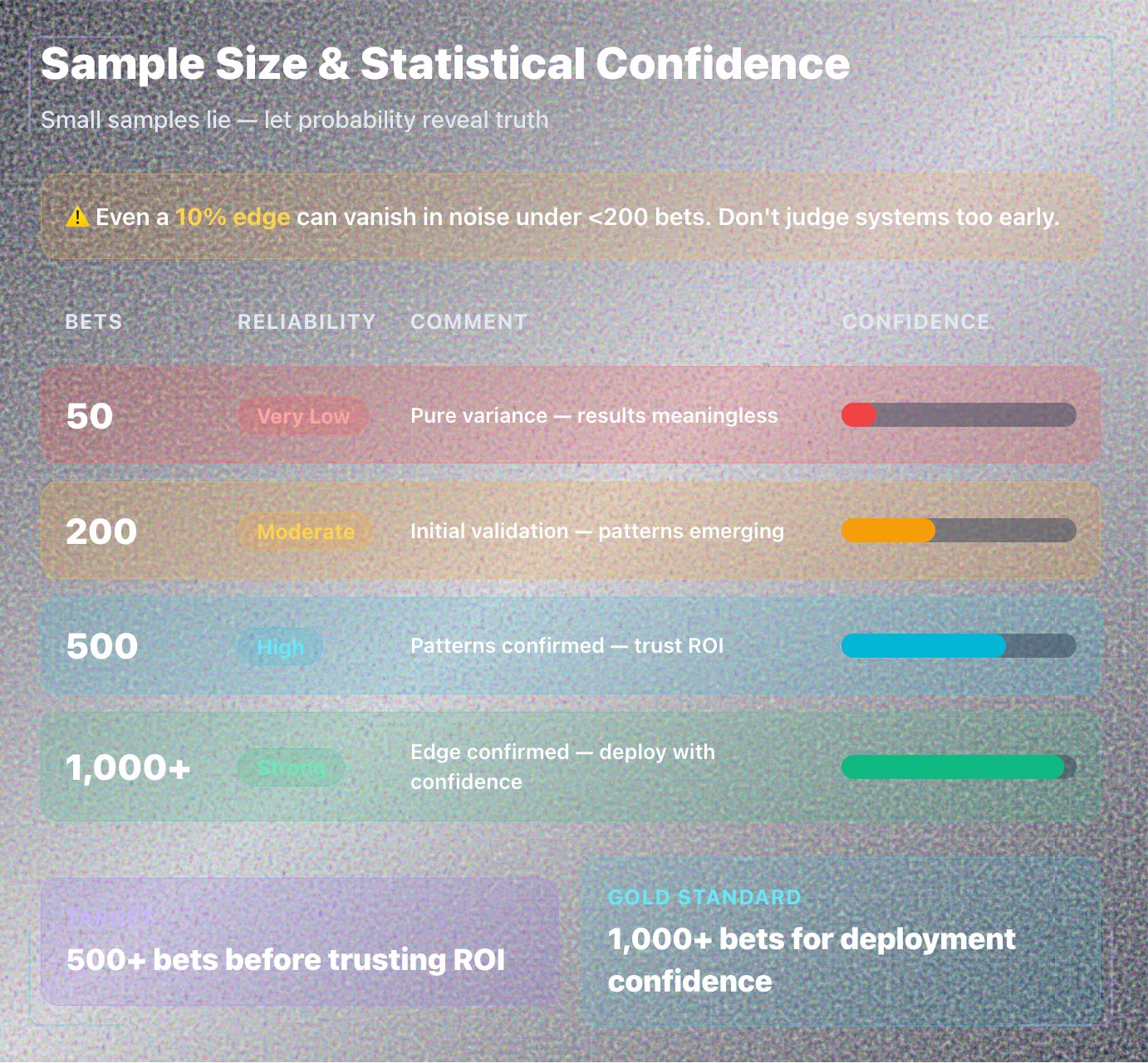
Small samples lie.
Even a 10% edge can vanish in noise under < 200 bets.
Rough guide to confidence:
Bets Reliability Comment 50 Very low Pure variance 200 Moderate Initial validation 500 High Patterns emerge 1,000+ Strong Edge confirmed
Don’t judge systems too early. Let probability reveal truth.
8. Evaluating Back-Test Results
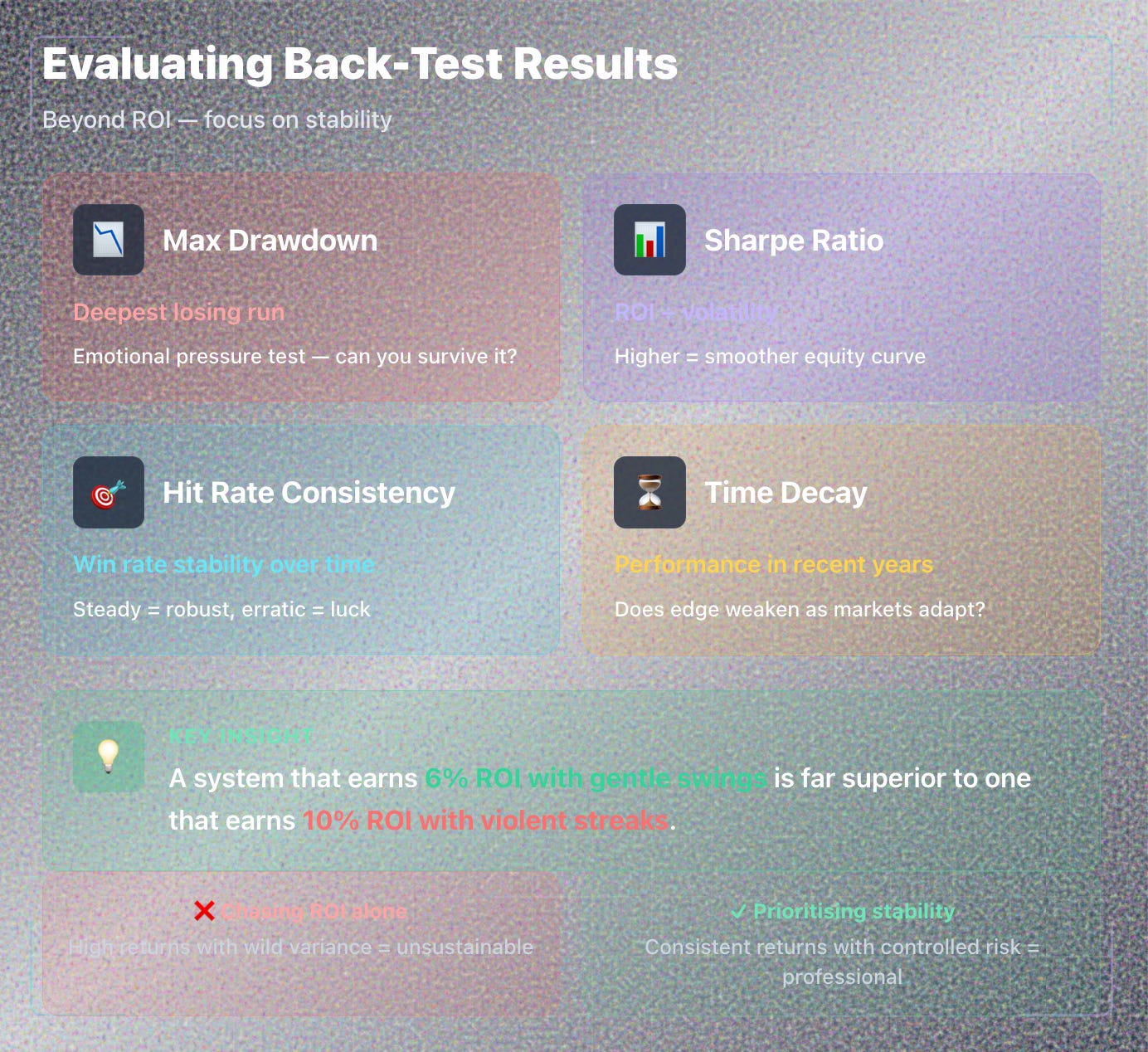
Beyond ROI, focus on stability:
Max Drawdown: Deepest losing run. Emotional pressure test.
Sharpe Ratio: ROI ÷ volatility; higher = smoother.
Hit Rate Consistency: Steady = robust, erratic = luck.
Time Decay: Does performance worsen over recent years?
A system that earns 6% ROI with gentle swings is far superior to one that earns 10% ROI with violent streaks.
9. Transitioning to Live Deployment
Once both tests align:
Start with small live stakes (0.5–1% bank).
Mirror testing discipline: same filters, same logging.
Track CLV and ROI for > 200 bets before scaling.
Keep back-testing updated yearly to ensure continued validity.
Treat deployment as another experiment, not a victory lap.
10. Continuous Testing Culture
Professionals never stop testing.
They maintain a rolling calendar:
Quarterly: Audit current systems versus updated data.
Annually: Rebuild models with fresh seasons.
Ongoing: Forward-test new hypotheses in a separate Test Bank (Lesson 15).
Testing isn’t an event. It’s the rhythm of professional evolution.
Key Takeaways
✅ Back-testing proves a theory using history; forward-testing proves execution in real time.
✅ Overfitting is the silent killer. Always verify on unseen data.
✅ Aim for 500+ bets before trusting ROI.
✅ Measure stability (drawdown, Sharpe) as much as profit.
✅ Deployment is just the next test phase.
✅ Continuous testing keeps edges alive and egos small.
Next Lesson
📘 Lesson 18: Building a Personal Database — Collecting, Cleaning & Structuring Your Own Data
We’ll show you how to source reliable historical stats, clean them for analysis, and create your own lightweight database. The foundation of every serious bettor’s toolkit.