


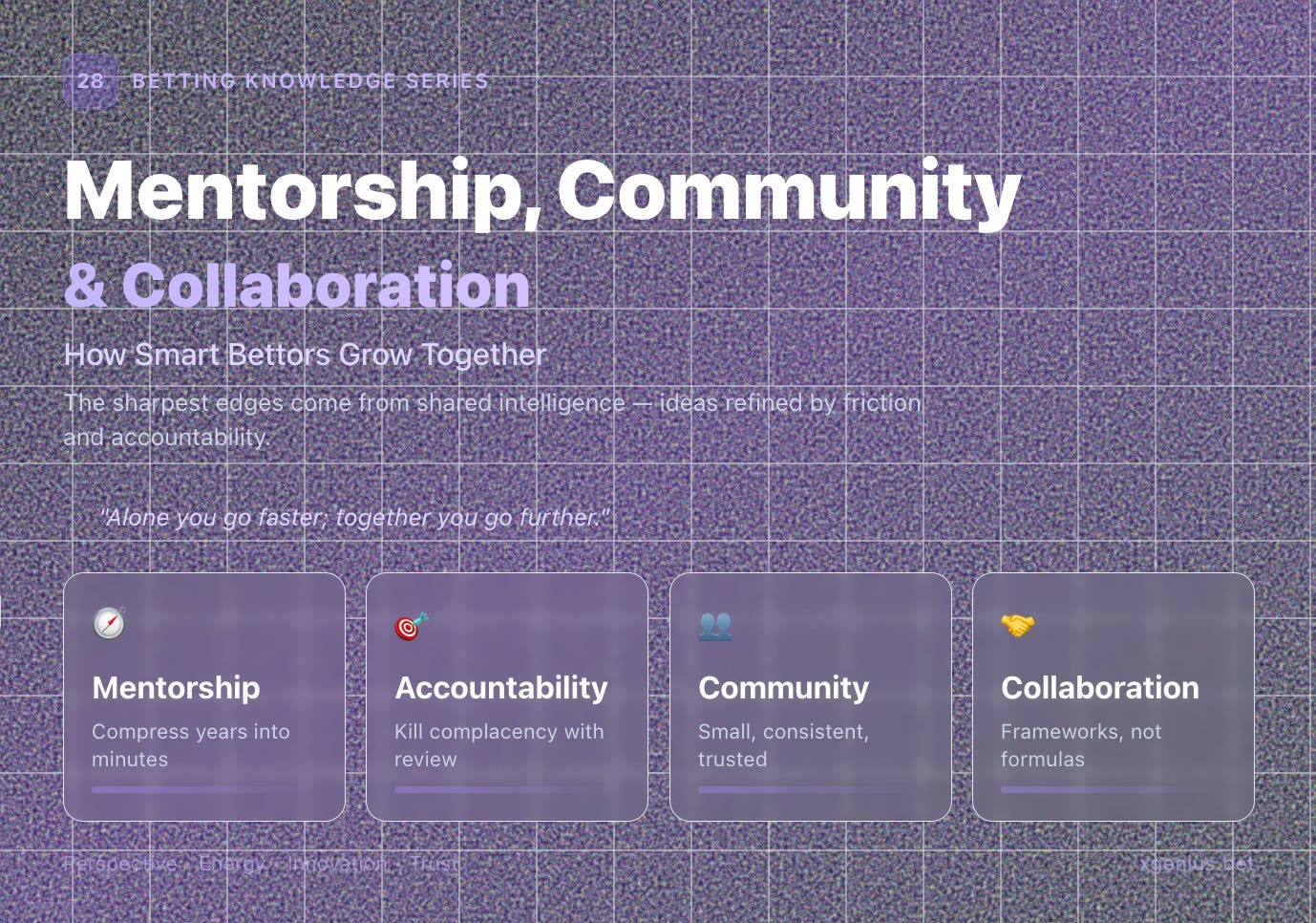
Mentorship, Community & Collaboration: How Smart Bettors Grow Together
Betting Knowledge Series — Lesson 28
Mentorship, Community & Collaboration: How Smart Bettors Grow Together
Introduction
Behind every professional trader is a network of thinkers, challengers, and teachers.
Betting looks solitary from the outside, but the sharpest edges come from shared intelligence. Ideas refined by friction and accountability.
This lesson explores how to find mentors, build constructive peer groups, and collaborate without compromising your independence or edge.
1. Why You Need Other People
Solo traders suffer three predictable problems:
Tunnel vision – they stop seeing flaws in their systems.
Emotional fatigue – no outlet for variance frustration.
Information lag – they miss new data or technology trends.
A good network solves all three: it gives you perspective, energy, and early access to innovation. I’ve watched solo traders spin their wheels for months on problems that a single conversation could have solved.
“Alone you go faster; together you go further.”
2. The Power of Mentorship
A mentor compresses years of mistakes into minutes of insight.
What a real mentor offers:
Honest feedback on logic and discipline.
Guidance through drawdowns and scaling.
Access to tools, contacts, or mindset frameworks you didn’t know existed.
How to find one:
Communities like analytics forums or exchange groups.
Industry events, data-science or betting conferences.
Quiet outreach: respectful, specific messages showing you’ve done the work.
Mentorship works best when you bring value too. Curiosity, analysis, or technical skills. Nobody wants to mentor someone who just wants answers handed to them.
3. Types of Mentors
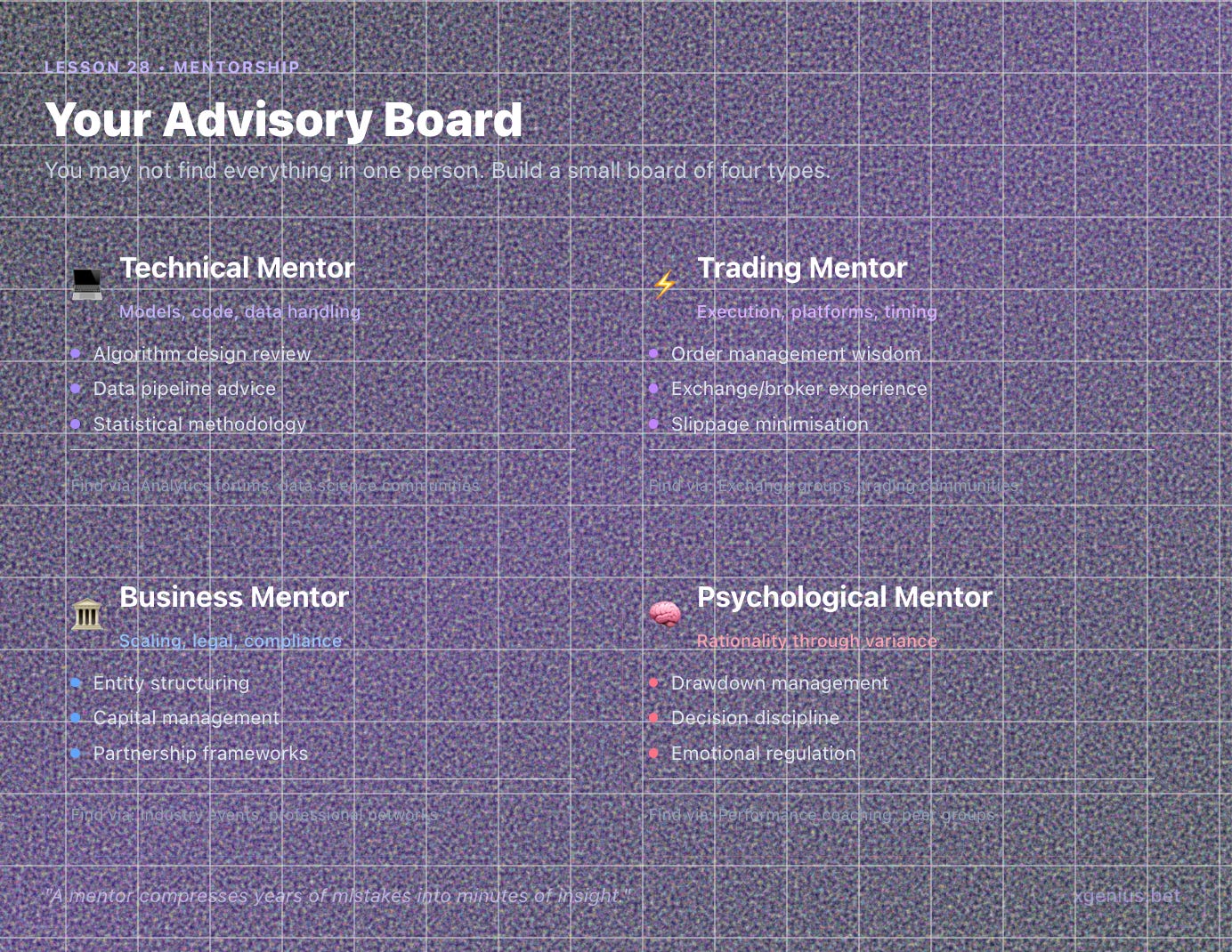
You may not find all in one person. Build a small “advisory board” instead.
Technical Mentor: helps with models, code, data handling.
Trading Mentor: shares execution wisdom, platform experience.
Business Mentor: guides scaling, legal, compliance.
Psychological Mentor: keeps you rational during variance.
Different people serve different roles. That’s fine.
4. The Accountability Effect
Having peers or mentors who review your data kills complacency.
A 15-minute monthly check-in where you explain results forces discipline.
If you can’t justify a decision out loud, it probably wasn’t logical.
Accountability doesn’t punish. It prevents drift. The best traders I know all have someone they report to, even when they don’t technically have to.
5. Building a Professional Community
Start small:
Join private Slack/Discord groups for traders or data analysts.
Create a “study circle” of 3–5 people with aligned goals.
Meet weekly or fortnightly to discuss systems, testing, and psychology.
Set rules:
✅ Confidentiality.
✅ Constructive criticism only.
✅ Shared documentation (Google Docs, Notion).
Consistency matters more than size. One reliable group beats 1,000 silent followers.
6. Collaboration Without Compromising Edge
The fear of “giving away secrets” keeps many traders isolated.
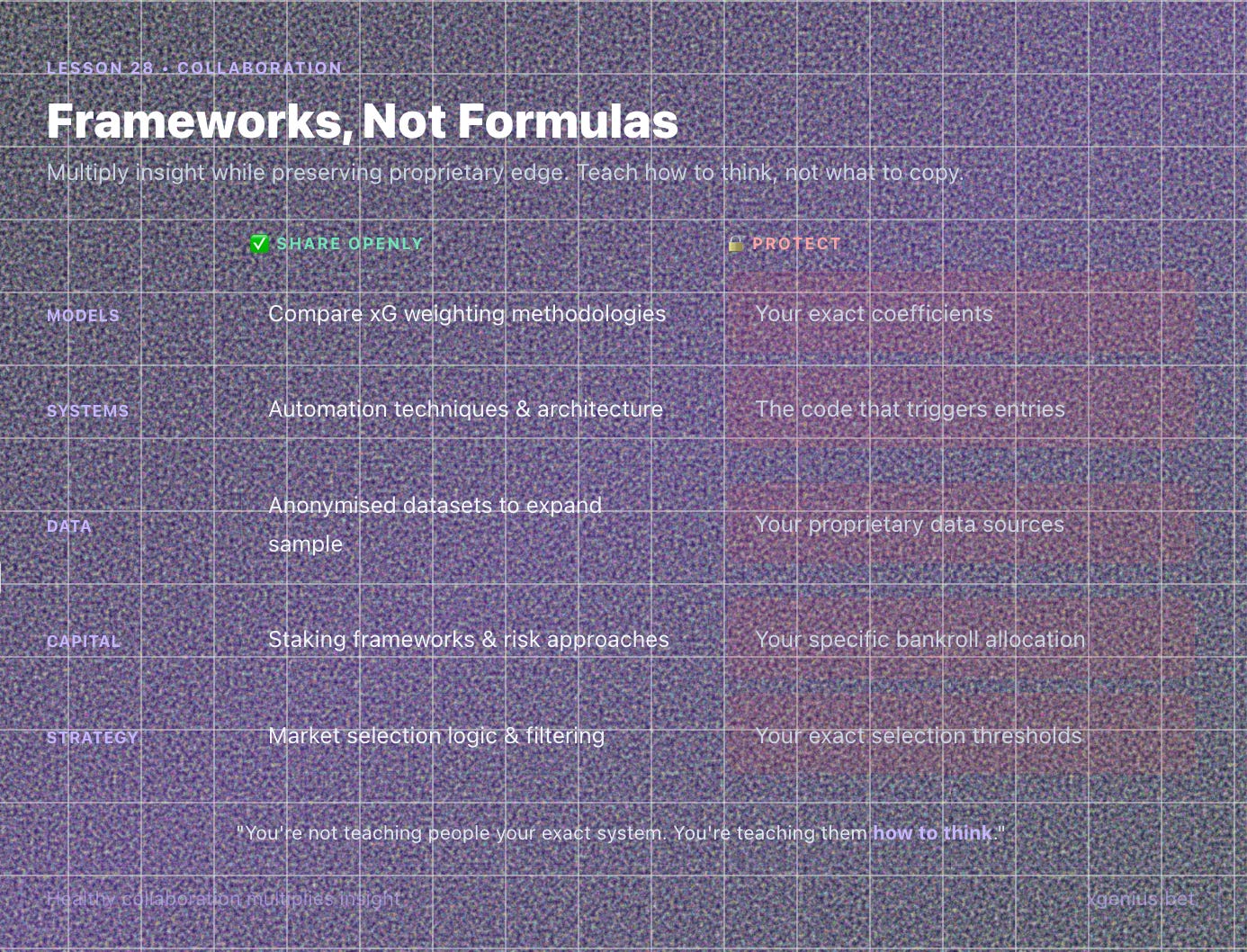
True collaboration means sharing frameworks, not formulas.
Examples:
Compare methodologies for xG weighting, not your exact coefficients.
Share automation techniques, not the code that triggers entries.
Exchange anonymized datasets to expand sample size.
Healthy collaboration multiplies insight while preserving proprietary edge. You’re not teaching people your exact system. You’re teaching them how to think.
7. Networking for Opportunity
Professional networks open practical doors:
Broker or API introductions.
Access to private liquidity pools.
Invitations to research partnerships or syndicates.
Early notice of platform or regulation changes.
Approach networking like value betting. Look for mutual edge, not extraction.
Contribute before you ask. The people with the best networks are usually the ones who helped others first.
8. The Mentor-Mentee Relationship in Practice
As a mentee:
Be punctual and prepared.
Track progress between sessions.
Ask questions that show implementation, not dependency.
As a mentor (when it’s your turn):
Focus on process, not picks.
Teach structure and discipline.
Protect your time; set clear boundaries.
Teaching others strengthens your own logic. The surest way to deepen understanding. You don’t really know something until you can explain it simply.
9. Avoiding Echo Chambers
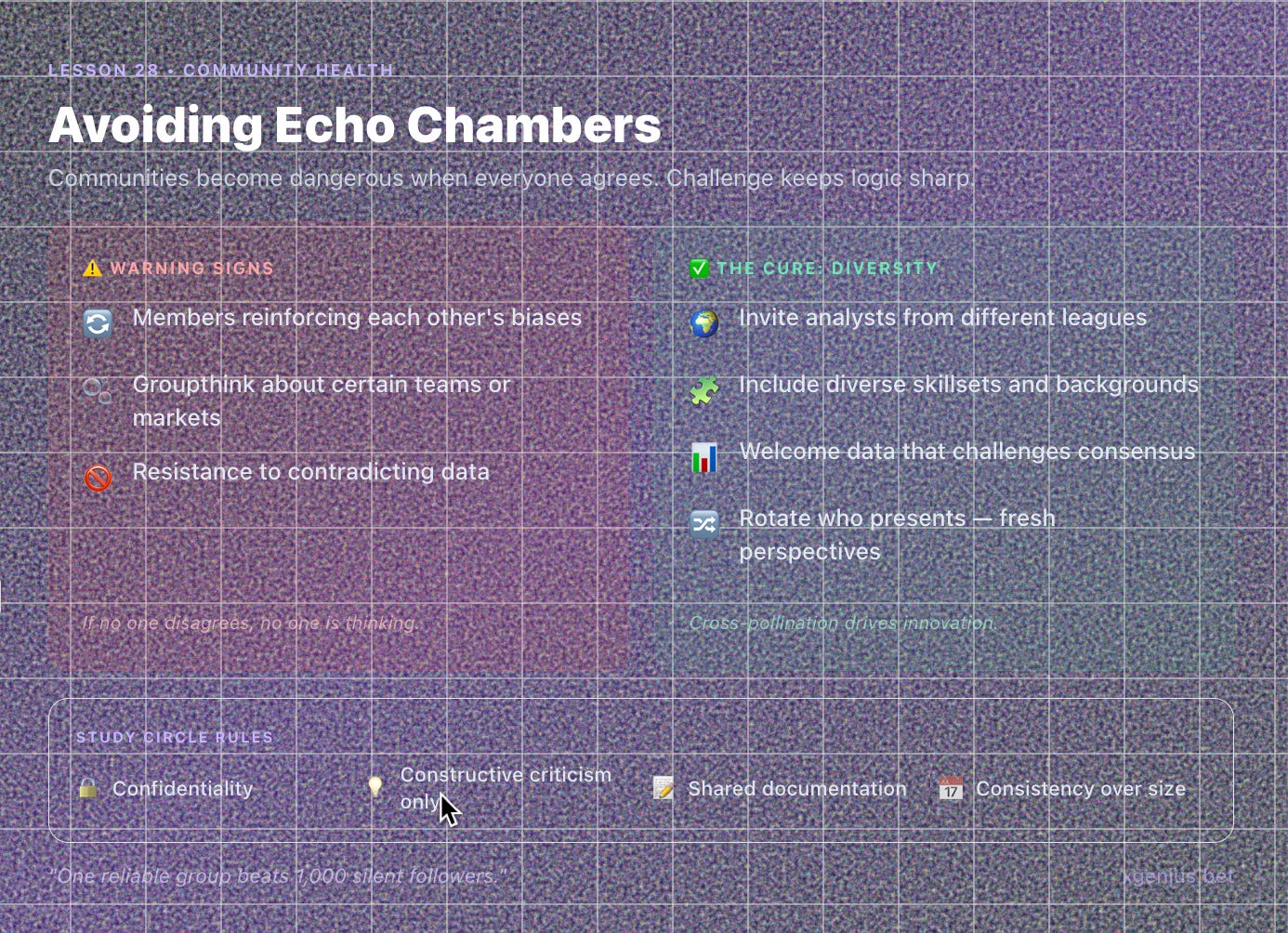
Communities can become dangerous when everyone agrees.
Challenge is what keeps logic sharp.
Signs of echo-chamber decay:
Members reinforcing each other’s biases.
Groupthink about certain teams or markets.
Resistance to data that contradicts the narrative.
Cure it with diversity: invite analysts from different leagues, skillsets, or countries.
Cross-pollination drives innovation. Some of the best insights come from people who think completely differently than you do.
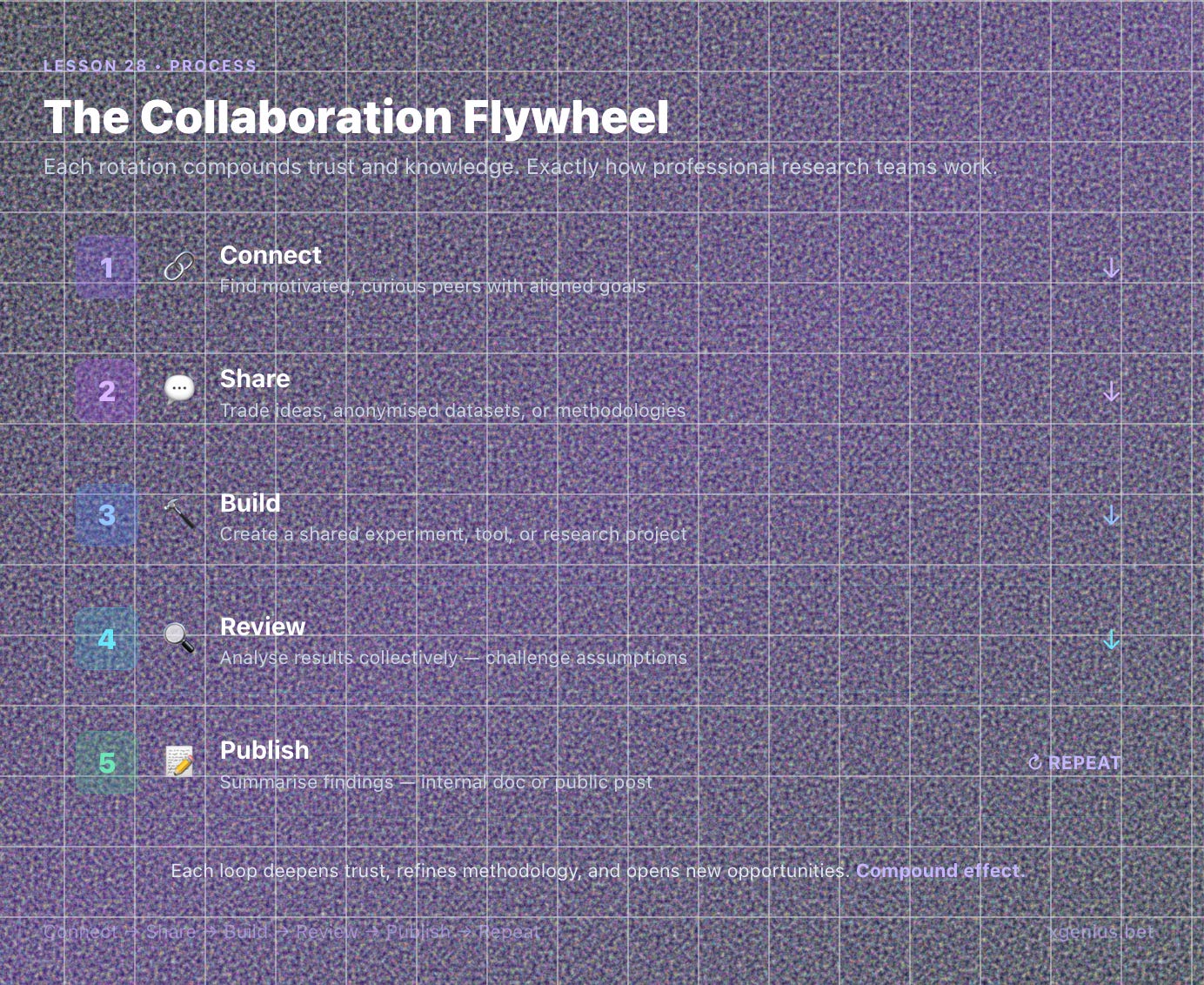
10. The Collaboration Flywheel
Sustainable collaboration follows a loop:
1️⃣ Connect – find motivated, curious peers.
2️⃣ Share – trade ideas or small datasets.
3️⃣ Build – create a shared experiment or tool.
4️⃣ Review – analyse results collectively.
5️⃣ Publish / Present – summarise findings (internal doc or public post).
Each rotation of the loop compounds trust and knowledge. Exactly how professional research teams work.
Key Takeaways
✅ Mentors compress experience; peers provide accountability.
✅ A small, consistent group beats large, passive communities.
✅ Share frameworks, not secrets. Collaborate safely.
✅ Diversity of thought prevents groupthink.
✅ Teaching multiplies understanding.
✅ Networks open real-world opportunities beyond markets.
Next Lesson
📘 Lesson 29 – From Knowledge to Influence: Sharing Insights & Building Thought Leadership
We’ll explore how to communicate your expertise through writing, speaking, or publishing. To create reputation, attract partnerships, and turn authority into opportunity.