


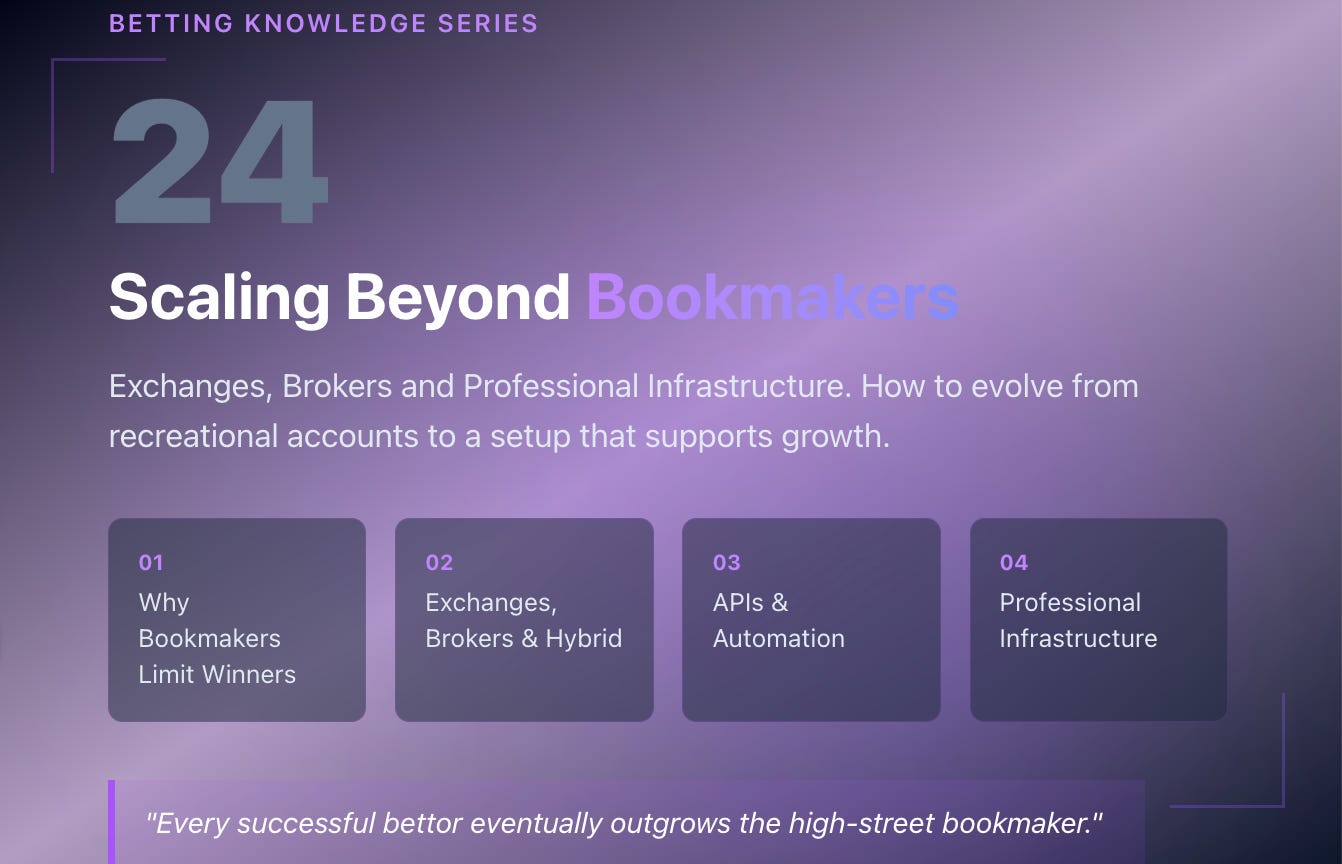
Betting Knowledge Series — Lesson 24
Scaling Beyond Bookmakers: Exchanges, Brokers & Professional Infrastructure
Introduction
Every successful bettor eventually outgrows the high-street bookmaker.
Consistent winners hit limits, face account closures, and lose access to meaningful stakes.
To operate like a professional, you need to move where the pros trade. Places built for liquidity, anonymity, and automation.
This lesson explains how to evolve from recreational accounts to a professional trading setup that supports growth instead of restricting it.
1. Why Bookmakers Limit Winners
Bookmakers are risk managers, not investors.
Their model depends on taking balanced action and earning the margin between odds and reality.
When a customer consistently takes prices before they shorten, that customer becomes a liability. It’s just math from their perspective.
Typical bookmaker responses:
Reducing maximum stakes.
Offering worse odds.
Closing the account entirely.
Understanding this isn’t personal makes it easier to plan your next step. It’s economics, nothing more.
2. The Three Professional Pathways
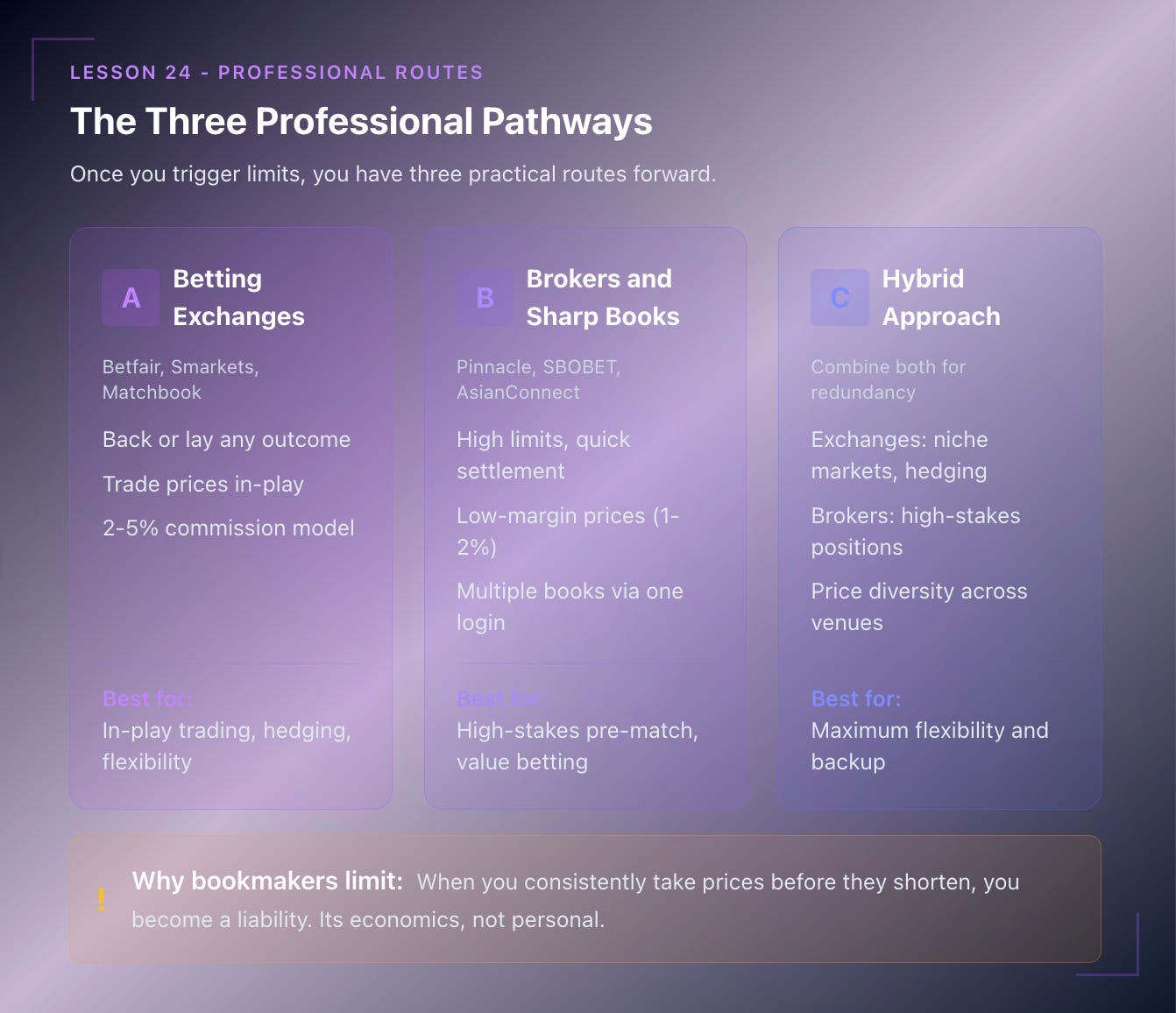
Once you start triggering limits, you have three practical routes:
A. Betting Exchanges (Betfair, Smarkets, Matchbook)
B. Brokers & Sharp Books (Pinnacle, SBOBET, AsianConnect)
C. Hybrid Approach (combine both for redundancy)
Each pathway offers different advantages and responsibilities.
3. Betting Exchanges – The Trader’s Playground
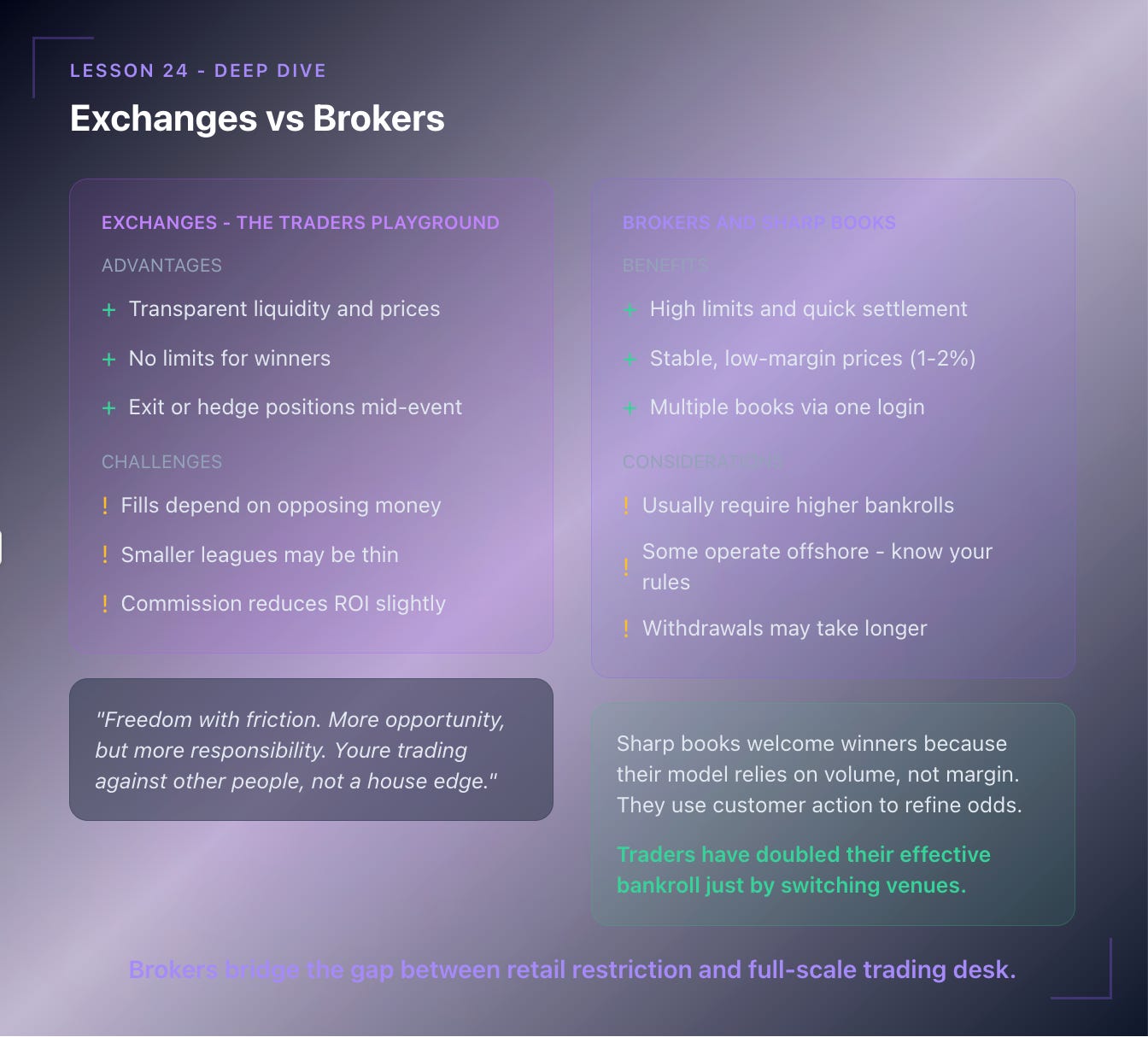
Exchanges replaced the bookmaker margin with a commission model (2–5%).
You can:
Back outcomes (bet for).
Lay outcomes (bet against).
Trade prices in-play like a financial market.
Advantages
✅ Transparent liquidity and prices.
✅ No limits for winners.
✅ Ability to exit or hedge positions mid-event.
Challenges
⚠ Requires patience. Fills depend on opposing money.
⚠ Markets for smaller leagues may be thin.
⚠ Commission reduces ROI slightly.
For serious bettors, exchanges are freedom with friction. More opportunity, but more responsibility. You’re trading against other people, not a house edge.
4. Brokers & Sharp Books
Brokers act as intermediaries giving you access to “sharp” bookmakers like Pinnacle, SBOBET, or AsianConnect.
These operators welcome winners because their model relies on volume, not margin. They use customer action to refine odds.
Benefits:
High limits and quick settlement.
Stable, low-margin prices (1–2%).
Access to multiple books via one login.
Considerations:
Usually require higher bankrolls.
Some operate offshore. Know your jurisdiction’s rules.
Withdrawals may take longer than local books.
For growing professionals, brokers bridge the gap between retail restriction and full-scale trading desk. I’ve seen traders double their effective bankroll just by switching venues.
5. Building a Hybrid Setup
Most pros combine exchanges + brokers:
Exchanges for: Low-liquidity niche markets, in-play trading, hedging.
Brokers for: High-stakes pre-match positions, low-margin value bets.
This hybrid approach gives liquidity, pricing diversity, and redundancy if one venue fails.
6. Automating Through APIs
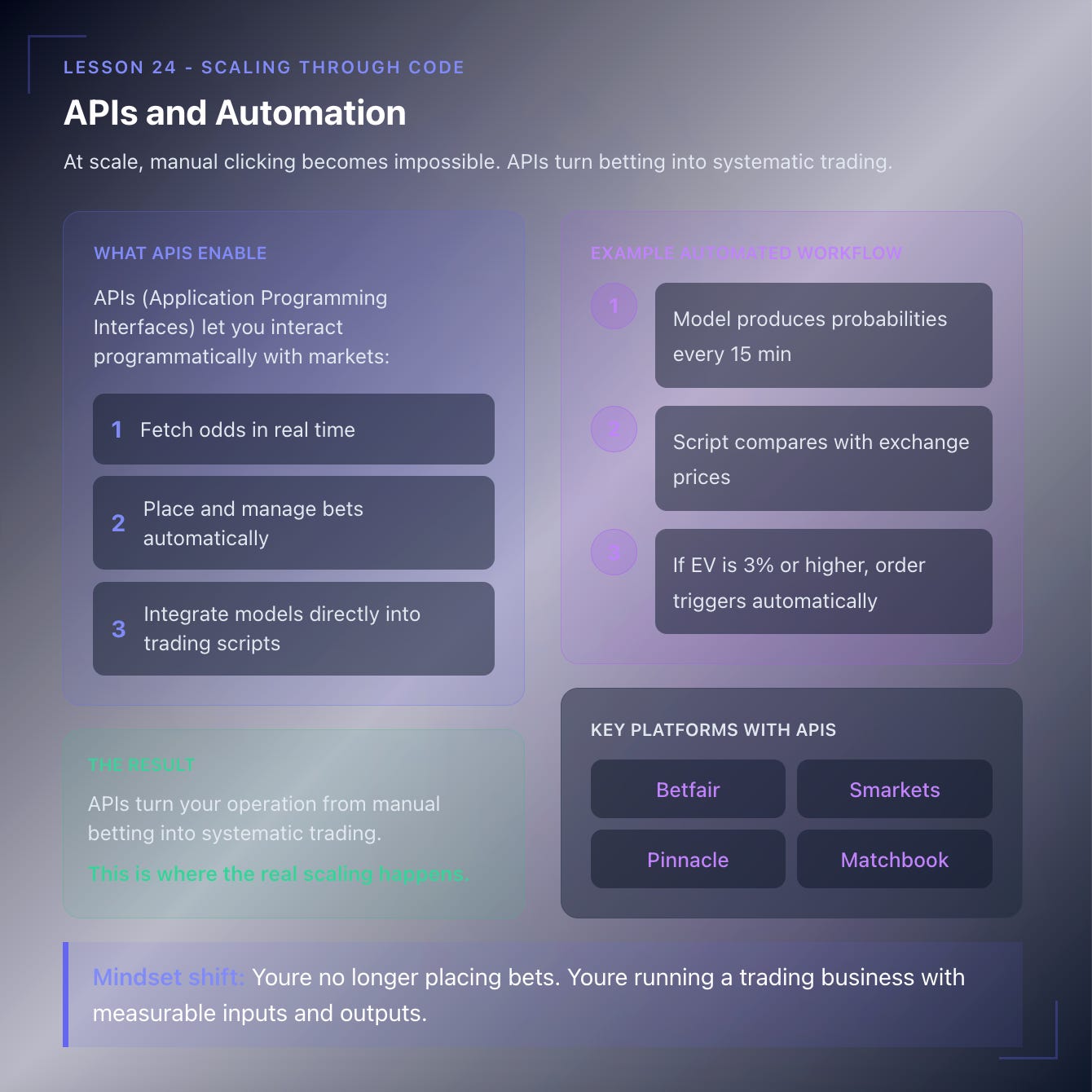
At scale, manual clicking becomes impossible.
APIs (Application Programming Interfaces) let you interact programmatically with markets:
Fetch odds in real time.
Place and manage bets automatically.
Integrate models directly into trading scripts.
Example workflow:
1️⃣ Model produces probabilities every 15 min.
2️⃣ Script compares with exchange prices.
3️⃣ If EV ≥ +3%, order triggers automatically.
APIs turn your operation from manual betting into systematic trading. This is where the real scaling happens.
7. Managing Multiple Accounts
With several accounts comes logistical complexity.
Establish an infrastructure checklist:
✅ Unique emails and secure passwords.
✅ Two-factor authentication on all platforms.
✅ A central balance sheet tracking funds across venues.
✅ Regular reconciliation of commissions and fees.
✅ Segregated wallets for each system (link to Lesson 15).
Organization preserves clarity and avoids exposure to operational errors. You don’t want to discover a missing £2,000 because you forgot which account it was in.
8. Regulatory and Tax Considerations
Professional scale means professional responsibility.
Check local laws regarding offshore brokers and reporting requirements.
Keep transparent records of deposits and withdrawals for tax audits.
Maintain a compliance folder with screenshots, IDs, and contracts.
Regulatory diligence protects both your capital and your credibility if you expand into partnerships or investor funding later. The last thing you need is a tax audit with no documentation.
9. Technical Infrastructure Essentials
To run efficiently across multiple venues, professionals invest in:
VPS (Virtual Private Server): low-latency connection for automated trading.
Redundant Internet Links: backup connection prevents downtime.
Time Synchronization: server clock accuracy provides correct timestamps.
Monitoring Tools: alerts for API errors, missed fills, or liquidity drops.
These small technical edges reduce friction and keep things consistent. The hallmark of serious operations.
10. The Professional Workflow Blueprint
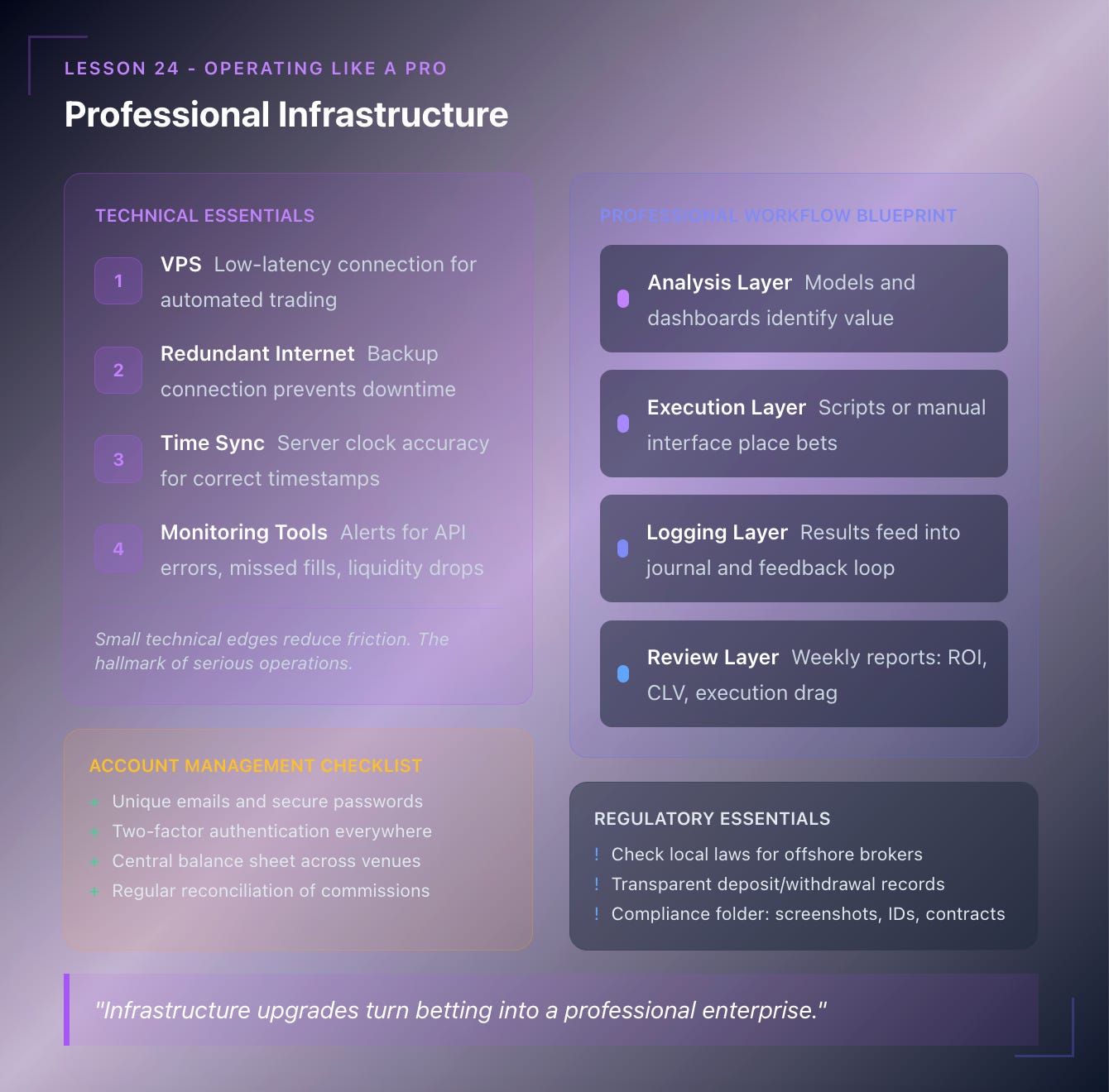
1️⃣ Analysis Layer: models and dashboards identify value.
2️⃣ Execution Layer: scripts or manual interface place bets via exchange/broker.
3️⃣ Logging Layer: results feed automatically into journal and feedback loop.
4️⃣ Review Layer: weekly reports summarize ROI, CLV, and execution drag across all venues.
You’re no longer “placing bets.” You’re running a trading business with measurable inputs and outputs. That shift in mindset matters more than most people realize.
Key Takeaways
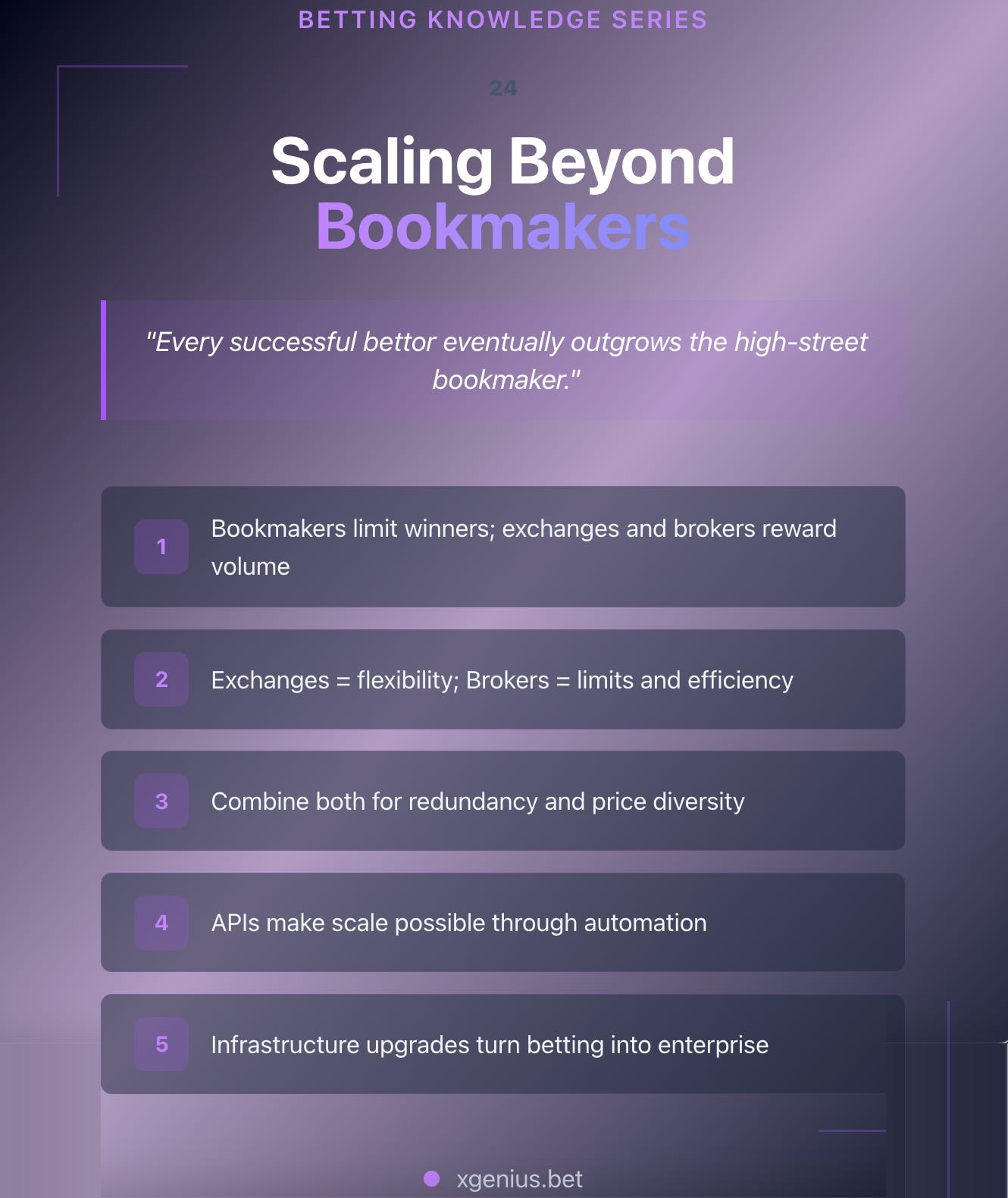
✅ Bookmakers limit winners; exchanges and brokers reward volume.
✅ Exchanges = liquidity and flexibility; brokers = limits and efficiency.
✅ Combine both for redundancy and price diversity.
✅ APIs make scale possible through automation.
✅ Maintain security, compliance, and clear accounting.
✅ Infrastructure upgrades turn betting into a professional enterprise.
Next Lesson
📘 Lesson 25 – The Business of Betting: Operating Like a Trading Desk
We’ll zoom out from systems to structure. Showing you how professionals organize workflow, manage capital flow, track performance KPIs, and run betting as a sustainable business rather than a hobby.