


Betting Knowledge Series — Lesson 22
Scaling Up: How to Increase Volume and Profit Without Breaking Discipline
Introduction
Most bettors dream of “going bigger.”
More bets. Larger stakes. Faster growth.
But scaling is a technical process. Think of it as engineering, not a milestone you hit because you feel ready.
When you do it right, it multiplies profit safely. When you get it wrong, it magnifies volatility and exposes every single weakness in your system. I’ve seen people blow up accounts this way.
Introduction
Most bettors dream of “going bigger.”
More bets. Larger stakes. Faster growth.
But scaling is a technical process. Think of it as engineering, not a milestone you hit because you feel ready.
When you do it right, it multiplies profit safely. When you get it wrong, it magnifies volatility and exposes every single weakness in your system. I’ve seen people blow up accounts this way.
This lesson shows how professionals scale intelligently. We’ll cover structure, metrics, and timing so growth feels smooth instead of stressful.
1. Why Scaling Requires Structure
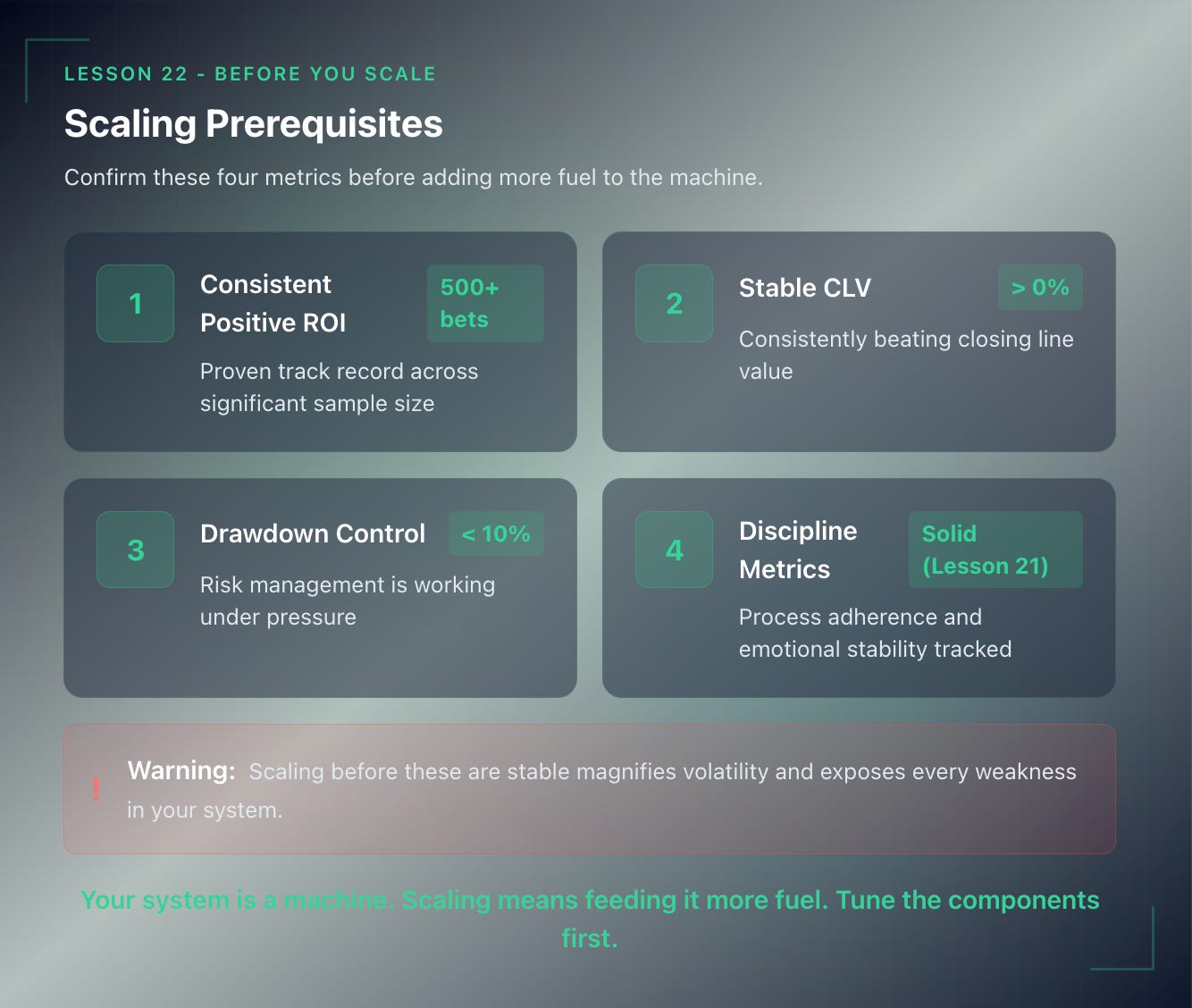
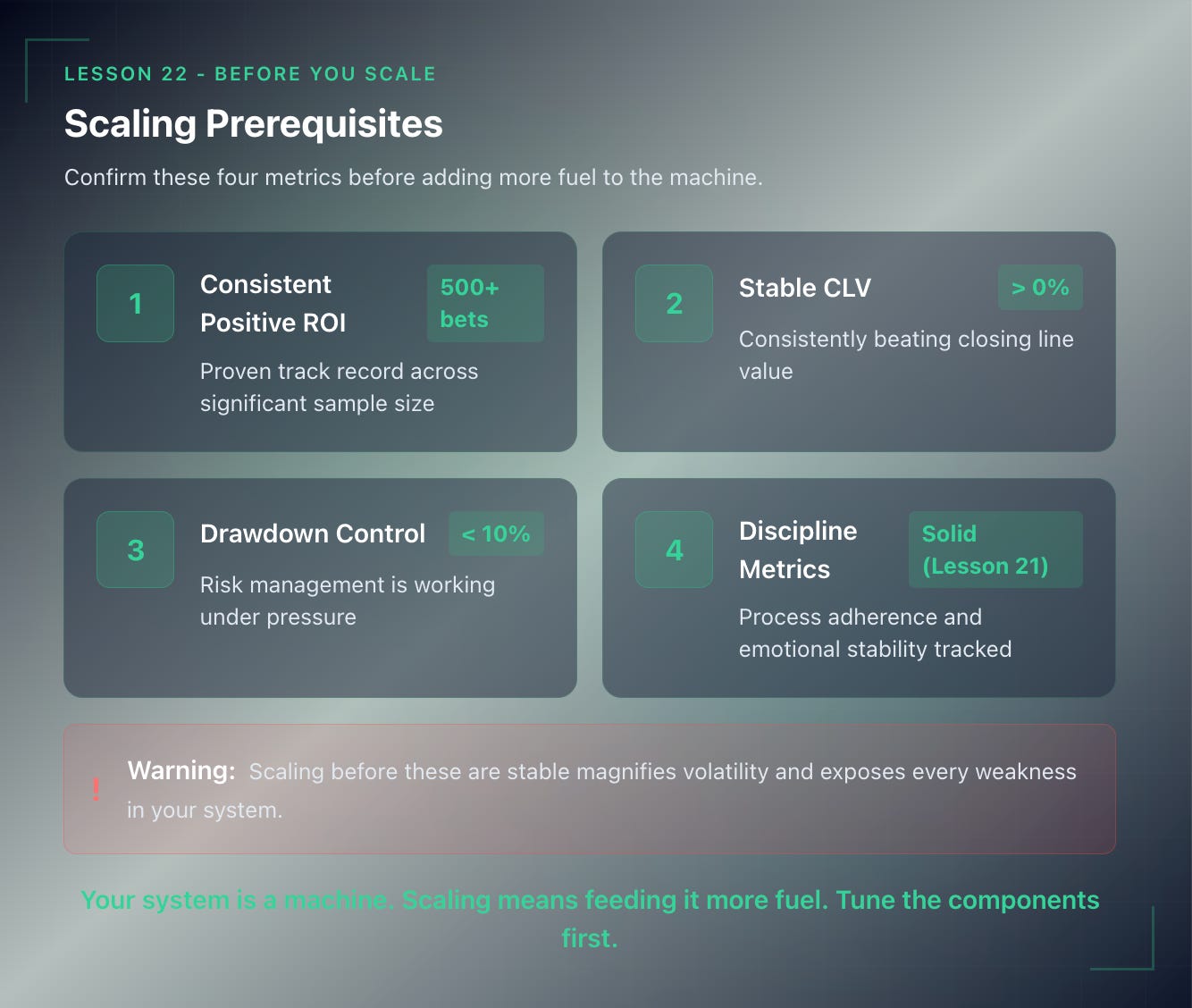
Your system is a machine.
Scaling means feeding that machine more fuel. That’s stakes, markets, data.
If the components aren’t tuned, the machine overheats. Bankroll management, emotional control, model accuracy—all of these need to be working before you add more load.
Before scaling, confirm:
✅ Consistent positive ROI over 500+ bets.
✅ Stable CLV > 0%.
✅ Drawdown < 10%.
✅ Discipline metrics solid (Lesson 21).
Scaling should reward proven consistency. Not impatience.
2. The Compounding Equation
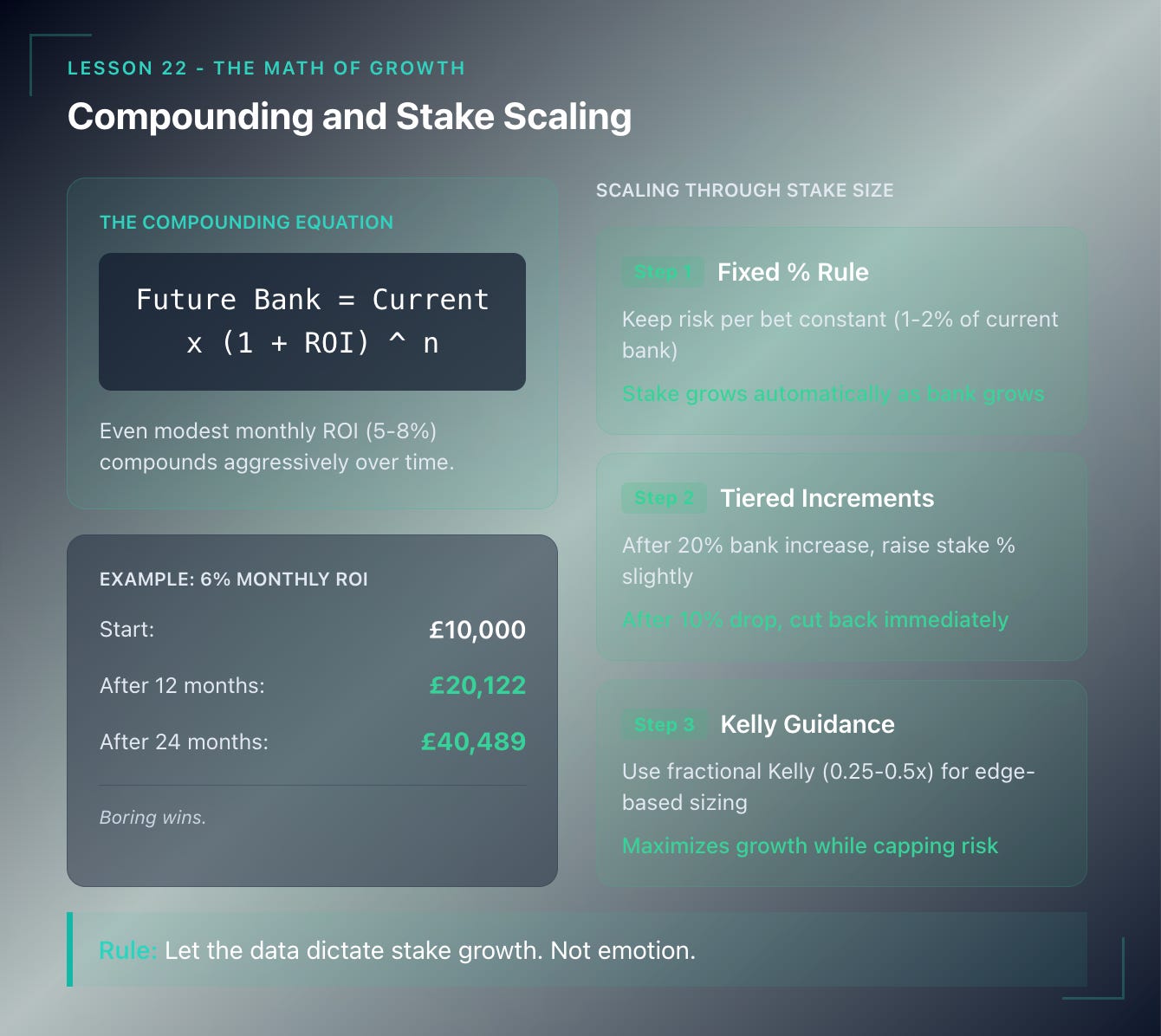
Growth in betting comes from compounding. You don’t double stakes overnight and hope for the best.
\text{Future Bank} = \text{Current Bank} \times (1 + \text{ROI})^{n}
Even modest monthly ROI (5–8%) compounds aggressively over time.
Scaling sensibly means letting this equation work while slowly widening exposure. Perhaps that’s boring to some people. But boring wins.
3. Scaling Through Stake Size
Step 1 – Fixed % Rule
Keep risk per bet constant. Like 1–2% of current bank.
Your absolute stake grows automatically as the bank grows. Simple math.
Step 2 – Tiered Increments
After every 20% bank increase, raise stake % slightly (1% → 1.25%).
After a 10% drop, cut back.
This keeps volatility aligned with confidence. You’re adjusting based on actual results, not feelings.
Step 3 – Kelly Guidance (Advanced)
Use fractional Kelly (0.25–0.5 Kelly) for edge-based sizing.
It maximizes growth while capping risk.
Rule: Let the data dictate stake growth. Not emotion.
4. Scaling Through Volume
More bets don’t always mean more profit.
Volume helps only if quality remains stable. I’ve watched traders increase their bet count and watch their edge disappear because they started forcing plays.
Ask before increasing trade count:
Can my model process more fixtures accurately?
Is liquidity sufficient at higher volumes?
Do execution errors rise when trading faster?
If performance metrics degrade, scale back. Wait until efficiency returns.
5. Scaling Across Systems
Portfolio scaling (Lesson 13) means increasing capital in the best systems first.
Reallocate from stagnating systems to compounding ones.
Growth is about capital efficiency. You don’t distribute equally just to be fair to your spreadsheets.
6. Scaling Across Markets
Once your core edge is stable, expand sideways.
Move into related leagues where the same logic applies. Replicate models on similar data environments, like La Liga → Serie A.
Avoid unfamiliar markets until back-tested. You’re not exploring for fun. You’re replicating proven processes.
Scaling across correlated markets can multiply exposure. Verify correlation first (Lesson 14).
7. Liquidity and Market Depth
Big stakes only matter if you can get matched cleanly.
Check:
Average matched volume at your target odds.
Price impact of your stake (slippage).
Market open/close windows.
For most football traders, liquidity peaks 15–30 minutes pre-kick-off. Schedule accordingly.
Professionals treat liquidity as a capacity constraint. Scale only within it.
8. Operational Scaling
Bigger operations require stronger infrastructure:
Automation: Dashboards and scripts manage volume efficiently.
Redundancy: Multiple data sources prevent downtime.
Process Docs: Written playbooks standardize execution.
Delegation: If you work in a team, define clear roles (research, trading, review).
Operational strength means that growth increases throughput. Not stress. There’s a difference.
9. Emotional Scaling
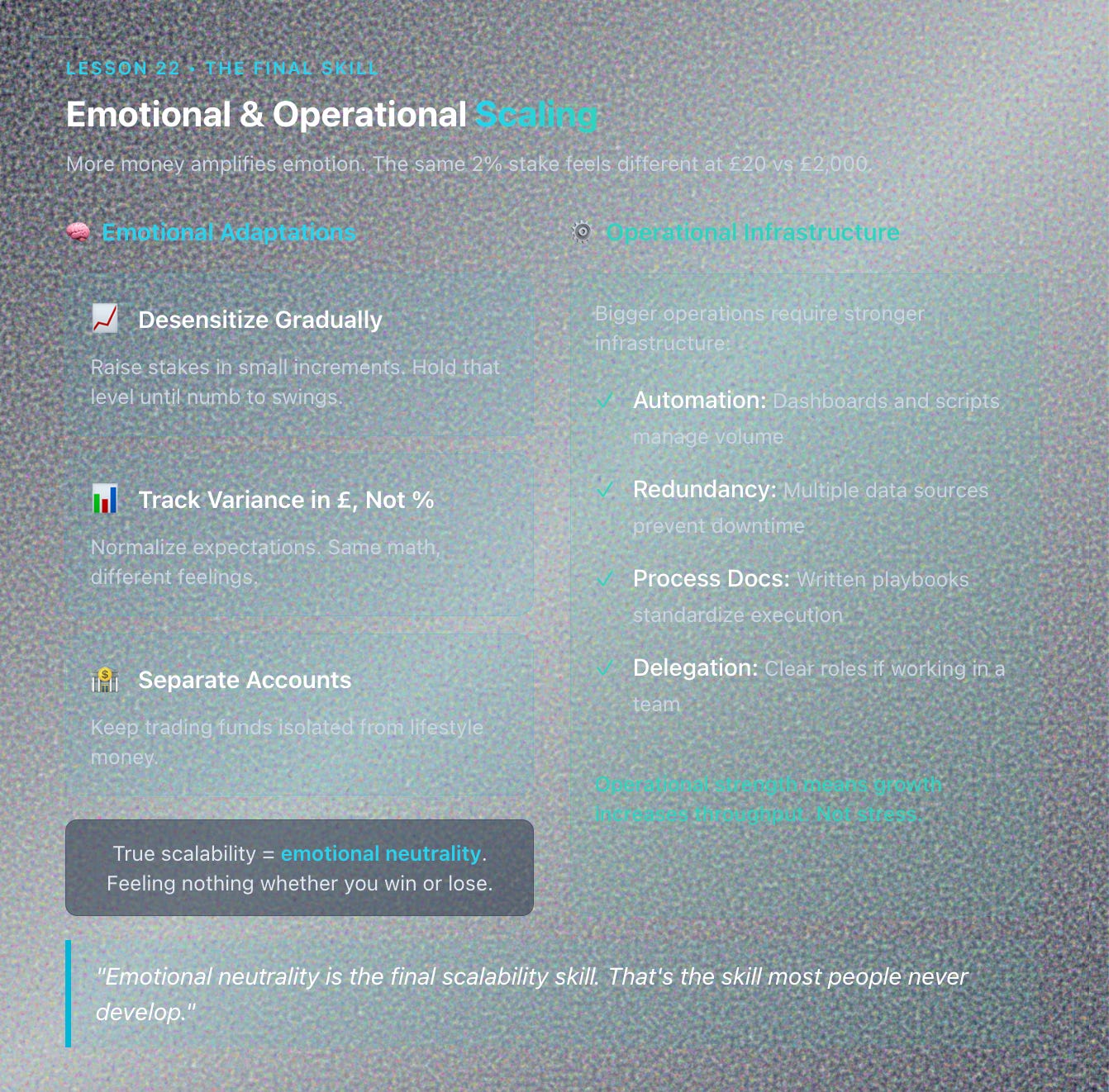
More money amplifies emotion.
The same 2% stake feels different when it’s £20 vs £2,000. Your brain knows the difference even if the math is identical.
To adapt:
Desensitize gradually: raise stakes in small increments and hold that level until numb to swings.
Track variance in £ not %: normalize expectations.
Separate accounts: keep trading funds isolated from lifestyle money.
True scalability comes from emotional neutrality. Feeling nothing whether you win or lose. That’s the skill most people never develop.
10. The Professional Growth Plan
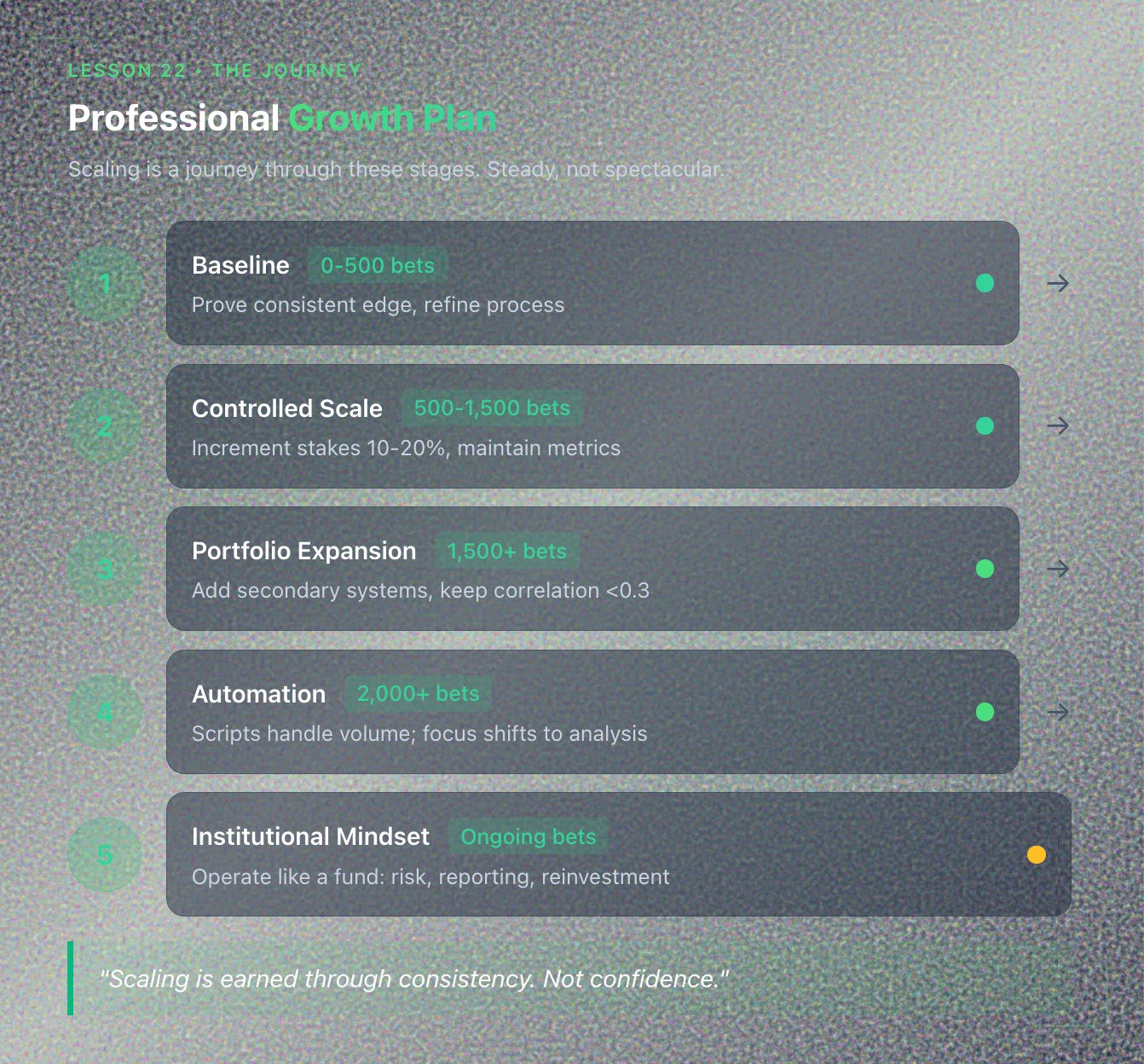
1️⃣ Baseline Phase (0–500 bets)
→ Prove consistent edge, refine process.
2️⃣ Controlled Scale (500–1,500 bets)
→ Increment stakes 10–20%, maintain metrics.
3️⃣ Portfolio Expansion (1,500+)
→ Add secondary systems or leagues, keep correlation < 0.3.
4️⃣ Automation Phase (2,000+)
→ Scripts handle volume; focus shifts to analysis.
5️⃣ Institutional Mindset
→ Operate like a small fund: risk, reporting, reinvestment.
Scaling is a journey through these stages. Steady, not spectacular.
Key Takeaways
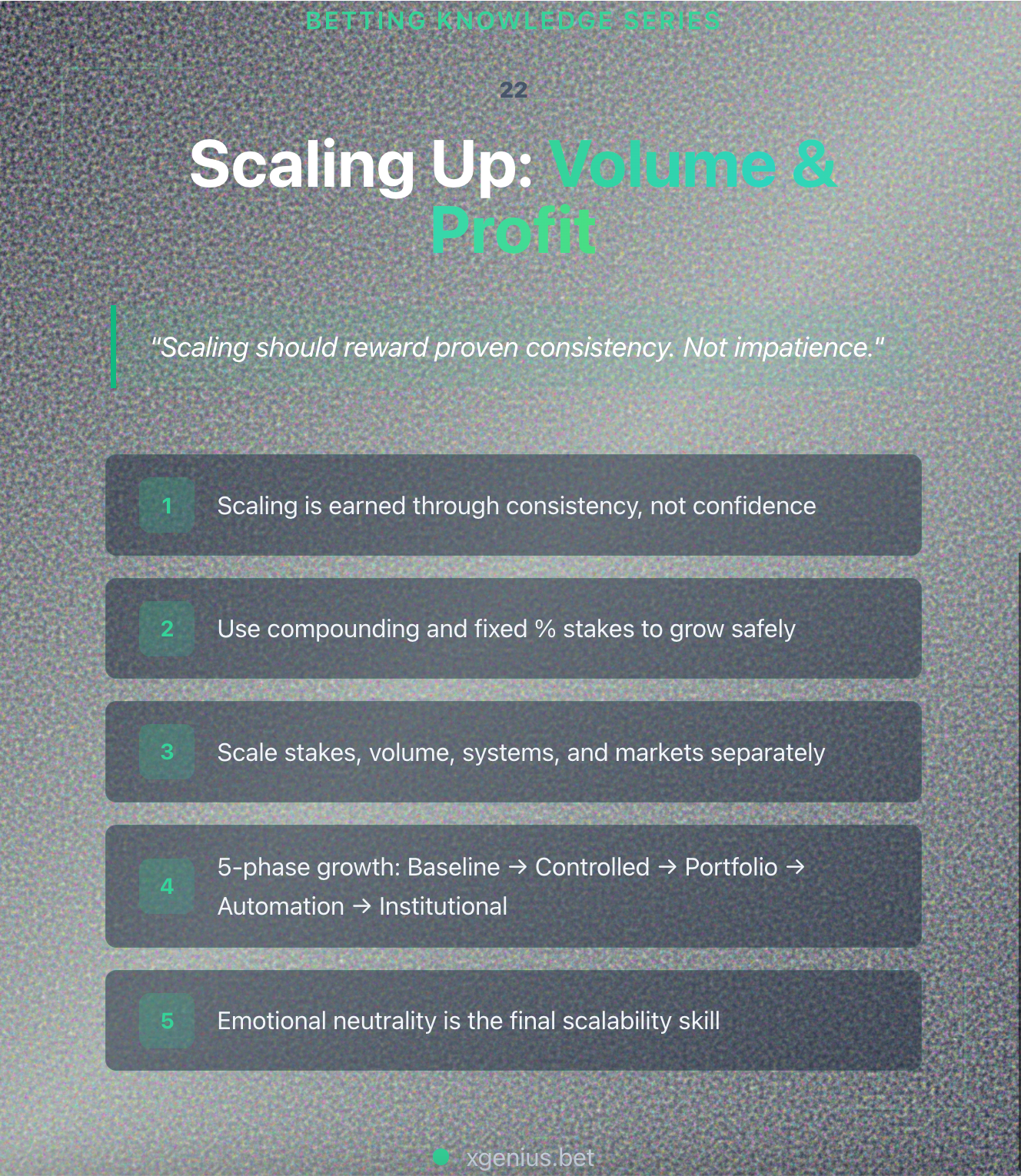
✅ Scaling is earned through consistency. Not confidence.
✅ Use compounding and fixed % stakes to grow safely.
✅ Increase volume only if quality and liquidity allow.
✅ Reallocate capital toward strongest systems.
✅ Upgrade operations before stakes.
✅ Emotional neutrality is the final scalability skill.
Next Lesson
📘 Lesson 23 — Liquidity, Execution & Slippage: How Market Mechanics Impact Your True ROI
We’ll dissect how liquidity depth, order size, and execution timing affect realized returns, and show you how to protect profit margins when scaling into larger markets.