


Betting Knowledge Series — Lesson 12
Where Edges Hide and Disappear: Understanding Market Efficiency
Introduction
You’ve probably heard the phrase “the market is always right.”
That’s both true and misleading.
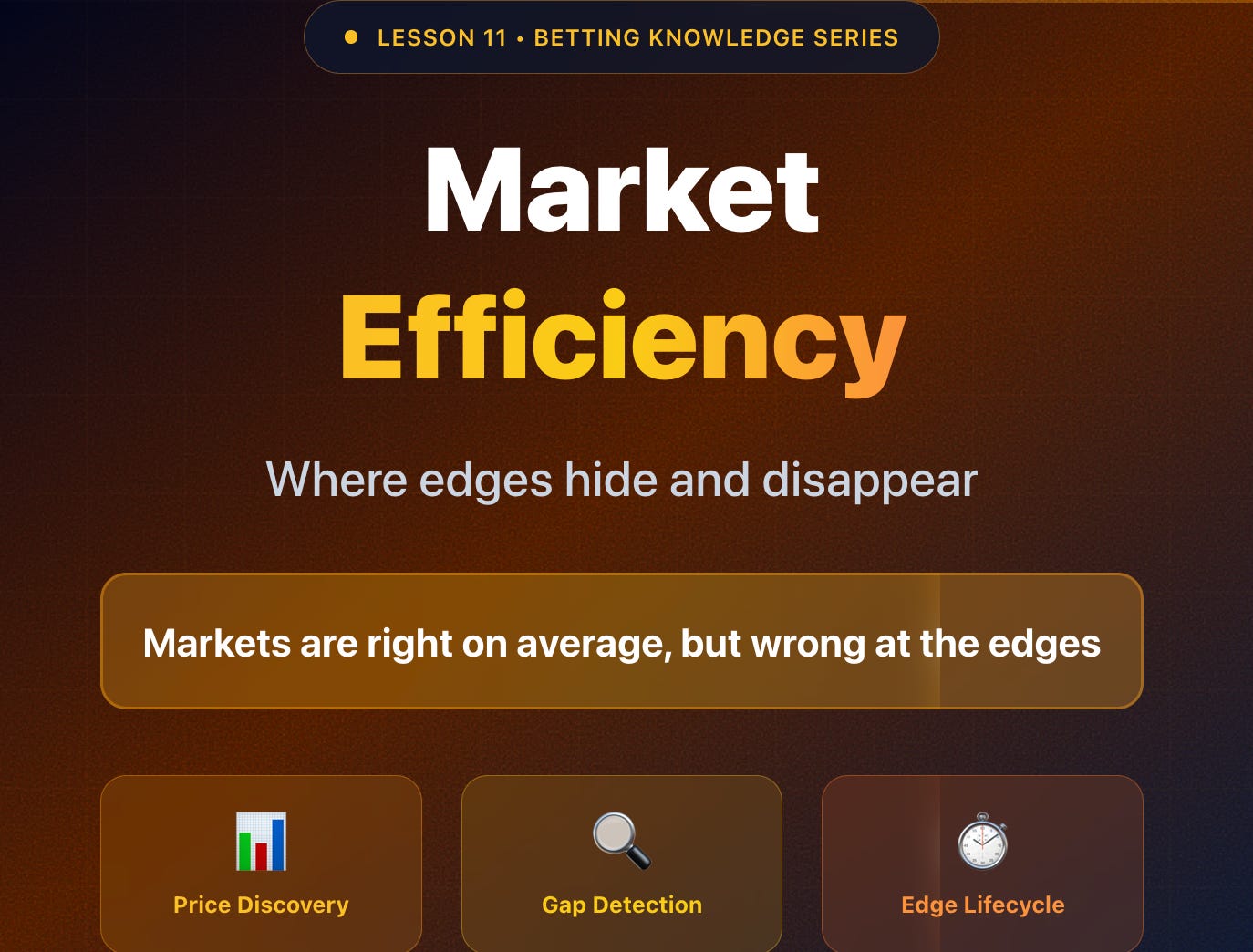
Markets are right on average, but wrong at the edges.
Your job as a bettor isn’t to fight the market. It’s to recognize when its efficiency slips.
That’s where value lives.
Introduction
You’ve probably heard the phrase “the market is always right.”
That’s both true and misleading.
Markets are right on average, but wrong at the edges.
Your job as a bettor isn’t to fight the market. It’s to recognize when its efficiency slips.
That’s where value lives.
In this lesson, we’ll break down what market efficiency really means, how odds are formed, and how to spot the rare moments when price and probability drift apart.
1. What Is Market Efficiency?
A market is efficient when all available information is already reflected in the odds.
Every stat, injury, trend, and bit of sentiment is priced in, leaving no consistent way to profit without inside knowledge or risk.
In theory, if a market were perfectly efficient, no bettor could win long term.
Efficiency is a spectrum, not a binary state.
Some markets are near-perfect (like Premier League match odds), while others (smaller leagues, niche props, or in-play situations) contain exploitable inefficiencies.
2. How Odds Are Created
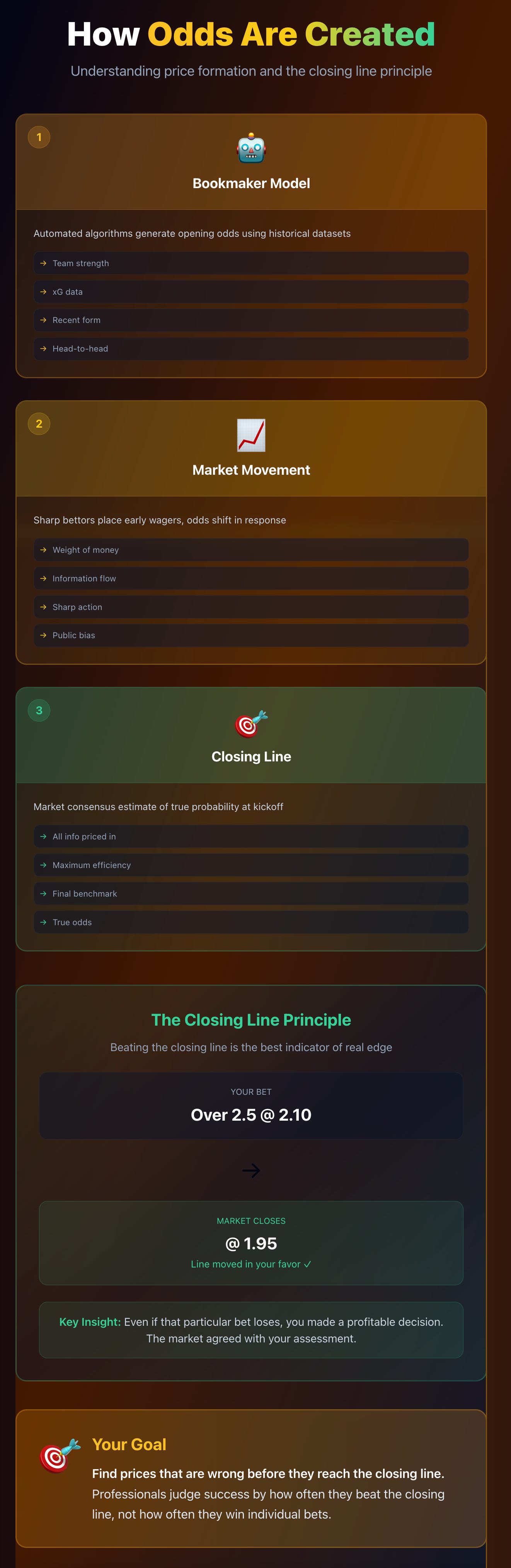
Understanding efficiency starts with understanding price formation:
Bookmaker Model: Automated algorithms generate opening odds using massive historical datasets (team strength, xG, recent form, etc.).
Market Movement: When the market opens, bettors (especially sharp ones) place early wagers. Odds shift in response to weight of money and information. This is price discovery.
Closing Line Efficiency: By kickoff, odds settle at the “closing line,” the market’s consensus estimate of true probability.
Your goal is to find prices that are wrong before they reach that closing line.
3. The Closing Line Principle
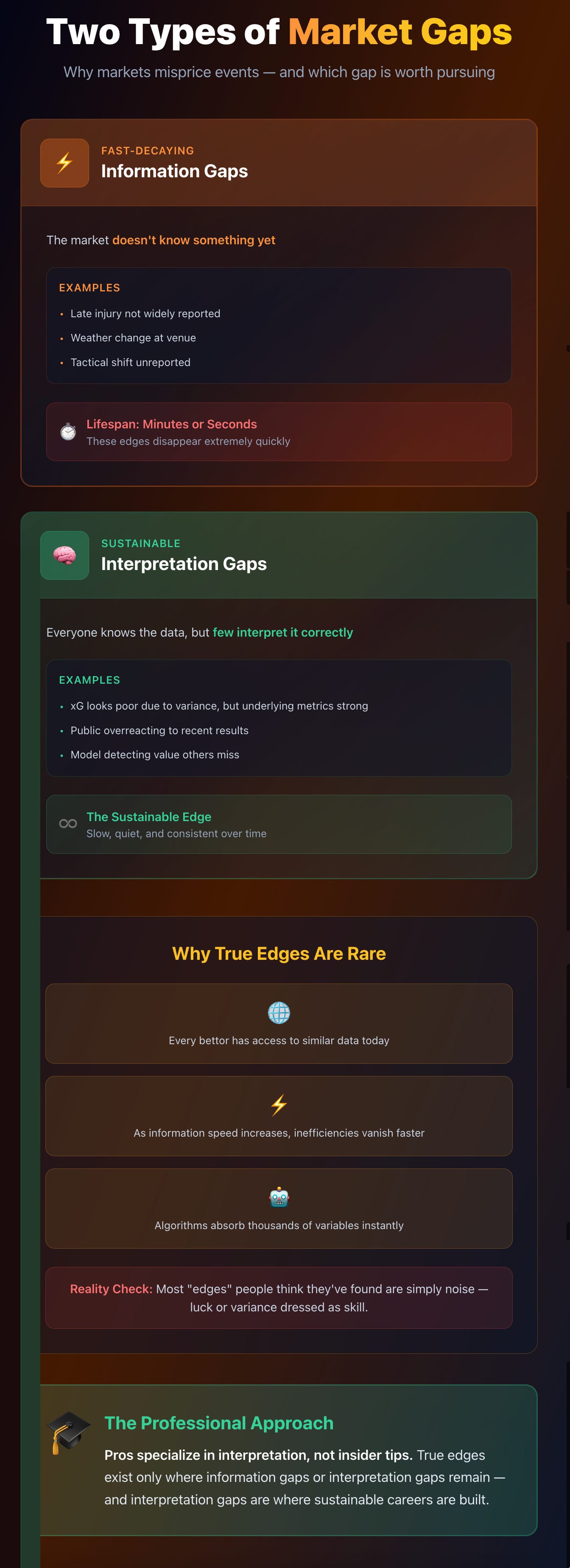
The closing line is a powerful benchmark.
Research consistently shows that beating it (getting better odds than the market’s final price) is the best indicator of real edge.
Example:
You back Over 2.5 at 2.10.
Market closes at 1.95.
The line moved in your favor. The market agreed with your assessment.
Even if that particular bet loses, you made a profitable decision.
Professionals judge success by how often they beat the closing line, not how often they win individual bets.
4. Why True Edges Are Rare
Every bettor, trader, and bookmaker has access to similar data today.
As information speed increases, inefficiencies vanish faster.
In mature markets (like EPL match odds or Champions League totals):
Odds adjust within seconds of major news.
Algorithms absorb thousands of variables instantly.
Liquidity keeps prices stable.
That’s why most “edges” people think they’ve found are simply noise. Luck or variance dressed as skill.
True edges exist only where information gaps or interpretation gaps remain.
5. Information Gaps vs. Interpretation Gaps
There are two reasons a market misprices an event:
Information Gaps: The market doesn’t know something yet.
Example: A late injury, weather change, or tactical shift not widely reported.
These edges disappear quickly. Minutes or even seconds.
Interpretation Gaps: Everyone knows the data, but few interpret it correctly.
Example: A team’s xG looks poor due to variance, but underlying metrics (shot locations, tempo) remain strong.
This is the sustainable edge. Slow, quiet, and consistent.
Pros specialize in interpretation, not insider tips.
6. Where Inefficiency Still Exists
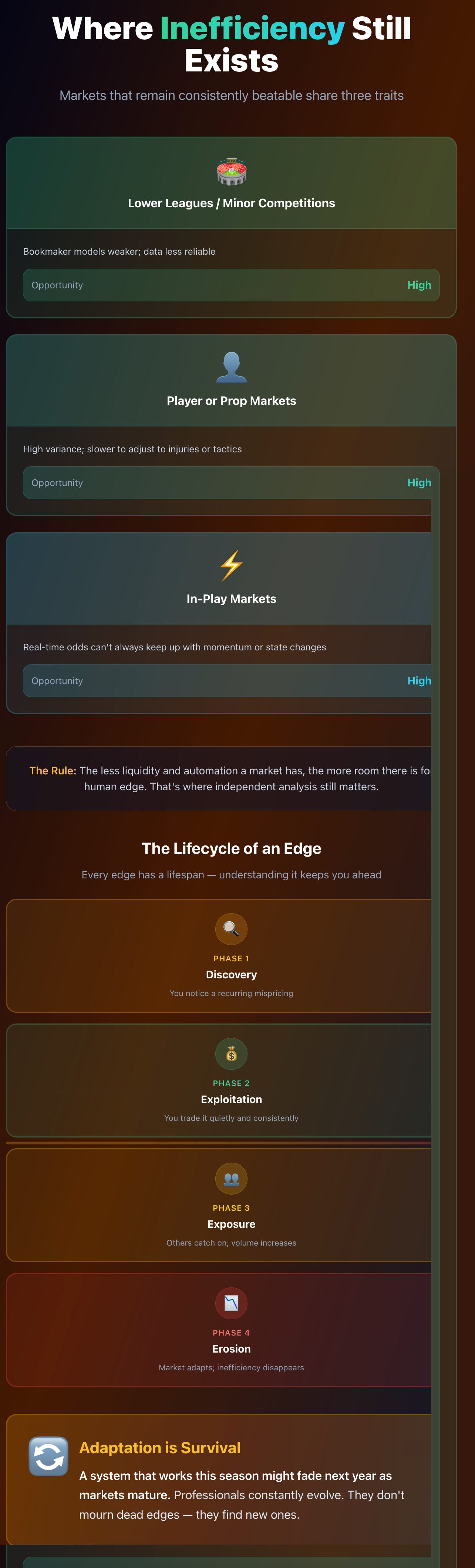
Markets that remain consistently beatable share three traits:
Market Type Why It’s Inefficient Lower Leagues / Minor Competitions Bookmaker models weaker; data less reliable. Player or Prop Markets High variance; slower to adjust to injuries or tactics. In-Play Markets Real-time odds can’t always keep up with momentum, xG spikes, or state changes.
The less liquidity and automation a market has, the more room there is for human edge.
That’s where independent analysis still matters.
7. The Life Cycle of an Edge
Every edge has a lifespan.
Discovery: You notice a recurring mispricing.
Exploitation: You trade it quietly and consistently.
Exposure: Others catch on; volume increases.
Erosion: The market adapts; the inefficiency disappears.
This is why professionals constantly evolve.
A system that works this season might fade next year as markets mature. Adaptation is survival.
8. Why You Shouldn’t Fear Efficiency
Efficient markets are intimidating only if you want easy wins.
For disciplined bettors, they’re useful indicators.
Efficiency tells you where not to waste time.
If your testing shows zero consistent ROI in the Premier League, that’s fine. Move to leagues or data types where you create unique insight.
Efficiency narrows your focus to where you actually have an edge.
9. How to Measure Your Efficiency Impact
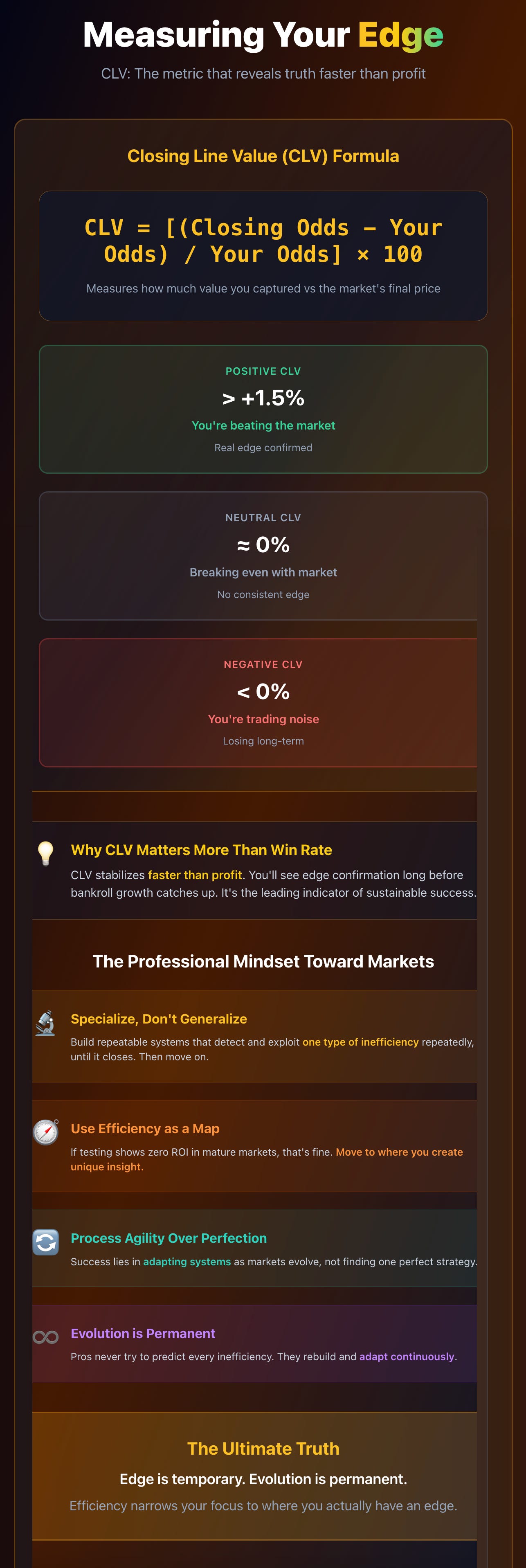
Track your Closing Line Value (CLV):
CLV = [(Closing Odds - Your Odds) / Your Odds] × 100
If CLV is consistently positive (> +1.5%), you’re beating the market.
If it’s neutral or negative, you’re trading noise.
CLV stabilizes faster than profit. You’ll see edge confirmation long before bankroll growth catches up.
10. The Professional Mindset Toward Markets
Pros never try to predict every inefficiency.
They build repeatable systems that detect and exploit one type of inefficiency repeatedly, until it closes.
Then they move on, rebuild, and adapt.
Their success lies in process agility, not static perfection.
Edge is temporary. Evolution is permanent.
Key Takeaways
✅ A market is efficient when all information is priced in.
✅ Beating the closing line = best proof of edge.
✅ True inefficiencies come from information or interpretation gaps.
✅ Lower-liquidity markets often hold the most opportunity.
✅ Every edge has a lifespan. Adapt before it erodes.
✅ Efficiency isn’t the enemy. It’s the map to where value hides.
Next Lesson
📘 Lesson 12: The Evolution of an Edge — How to Adapt When the Market Catches Up
We’ll explore how successful bettors reinvent their systems, evolve with data trends, and stay one step ahead of market correction, ensuring your edge remains alive even in changing environments.