


If you have ever placed a bet and felt like the odds were roughly fair, there is a reasonable chance they were not.
That is not an accusation of dishonesty. It is just how the market works — and understanding the mechanics behind it is probably the most useful thing any bettor can do before placing another bet.
Here is how odds are actually compiled.
Start with the true probability
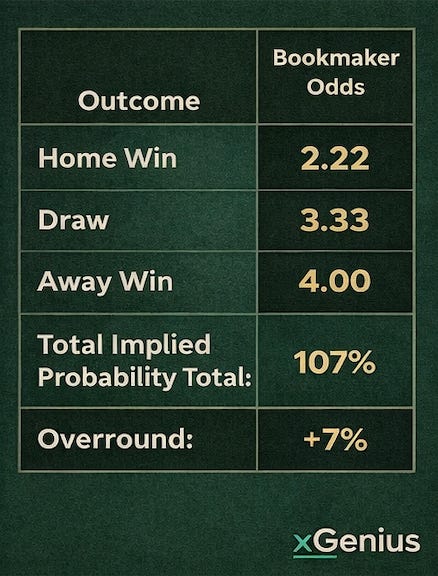
Before any price is set, the odds compiler establishes what they believe the true probability of each outcome is. For a football match with three possible results — home win, draw, away win — those three probabilities need to add up to 100%. That is just simple maths. If the true probability of a home win is 45%, a draw 30%, and an away win 25%, the fair odds for each outcome would be approximately 2.22, 3.33, and 4.00 respectively.
At those prices, the bookmaker would break even over a large enough sample. No margin. No profit. Just a market that accurately reflects the probability of each outcome.
In reality, nobody compiles odds this way.

The overround
What every bookmaker actually does is inflate the implied probability of each outcome so that the total adds up to more than 100%. That excess — typically somewhere between 5% and 12% on a standard football market — is the overround. It is the bookmaker’s built-in margin, the structural edge that ensures that across a large enough sample of bets, the bookmaker profits regardless of results.
Using the same example: if the bookmaker prices the home win at 2.10 instead of 2.22, the draw at 3.20 instead of 3.33, and the away win at 3.75 instead of 4.00, the implied probabilities now add up to roughly 107%. That 7% excess is the margin.
The customer is not paying 7% as a visible fee. They are receiving odds that are slightly shorter than the true probability justifies — in a way that is entirely legal, clearly disclosed in principle, and almost never examined in practice.
Why accumulators amplify the problem
This is where it gets important for anyone who bets on combinations (A.K.A Acca’s)
When you build an accumulator, the overround on each leg compounds. You are not paying the margin once — you are paying it on every leg you add, multiplied together.
The mathematics look like this. On a market with a 7% overround, the bookmaker retains roughly 93% of the fair value on each bet. On a two-leg accumulator, you receive approximately 93% × 93% of the fair combined odds — around 86.5%. On a three-leg accumulator, 86.5% × 93% — around 80.5%. On a five-leg accumulator, the compounding has reduced your share of fair value to around 70%.
By the time you have built a five-leg accumulator on markets with a standard overround, the structural disadvantage you are operating under is approximately 30% before a single result is considered. Your selections need to be genuinely exceptional just to overcome the ground the margin has already taken.
Most selections are not exceptional. Which is why most accumulators lose — not because the picks are wrong, but because the foundation they are built on was already working against the bettor before the first kick-off.
What the marketing is designed to do
Bookmakers are acutely aware of this. The accumulator is one of their highest-margin products precisely because of the compounding effect described above — and their promotional activity around it is structured accordingly.
Bonus legs. Cash Outs. Acca insurance. Consolation payouts when one leg lets you down. All of it is designed to encourage bettors to add more legs, to stay in the market, to treat the near-miss as a reason to try again rather than a signal to examine the structure of the bet. Every additional leg a customer adds is another compounding of a margin that is already working against them. The promotions cost a fraction of what the additional legs return.
None of this means accumulator betting cannot be profitable. It means that profitability requires a different approach — one that starts with the margin rather than ignoring it.
Understanding the overround is the first step. Knowing what to do with it is the second.