


Betting Knowledge Series — Lesson 7
How to Build a Betting System That Actually Works
Introduction
Every successful bettor eventually realizes that intuition isn’t enough.
If you can’t explain why you’re making a bet or what makes it valuable, you’re gambling, not trading.
The difference between a hobbyist and a professional isn’t who they follow or how many stats they read. It’s that professionals run systems.
In this lesson, you’ll learn how to design, test, and refine a betting system that stands up to real data, not just good feelings.
1. What a Betting System Really Is
A system is not a tip sheet or a hunch disguised as structure.
A true betting system is a set of repeatable rules that define:
When you enter a market.
Why that entry offers positive expected value (+EV).
How you size and manage stakes.
When and how you review results.
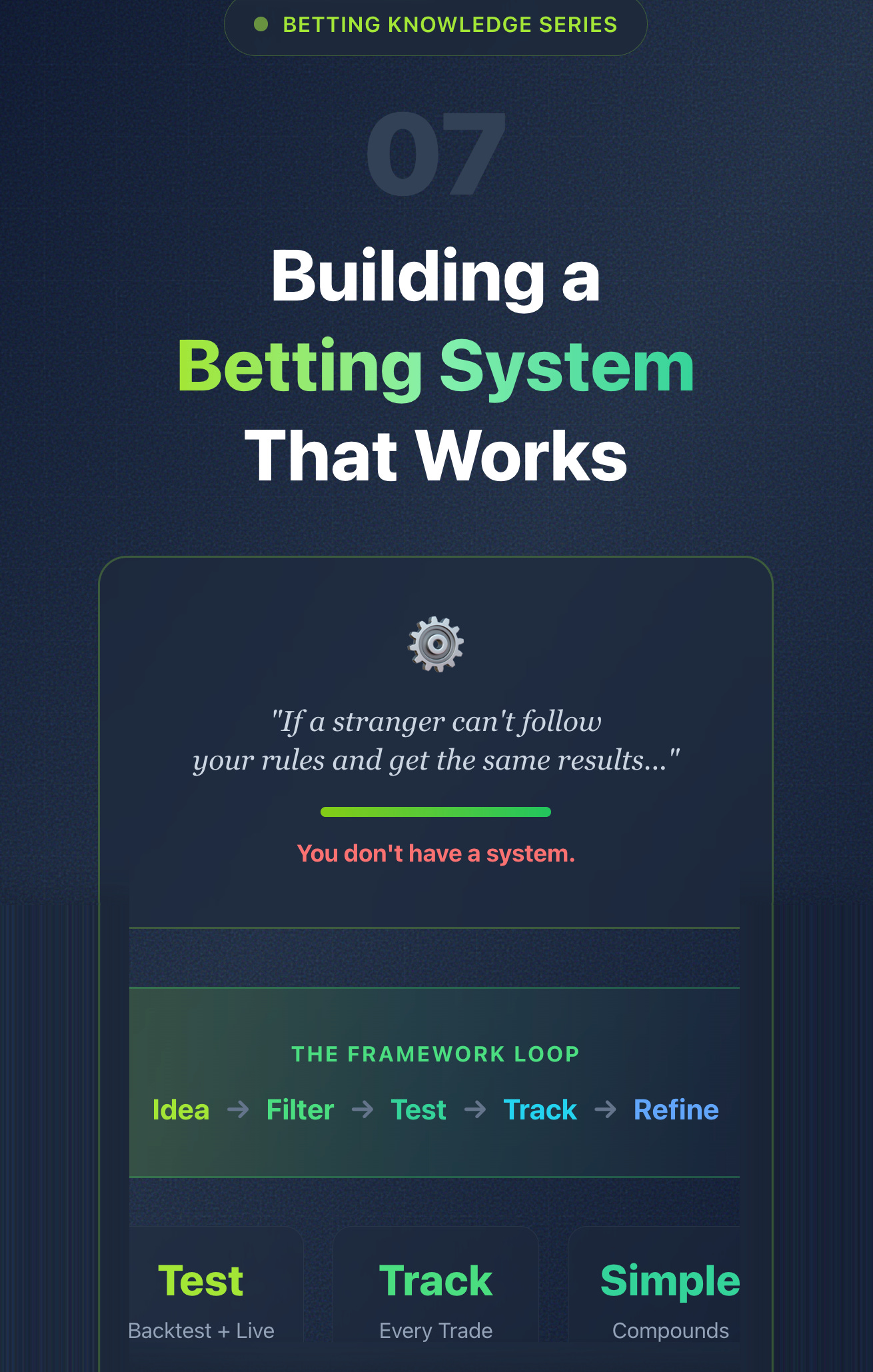
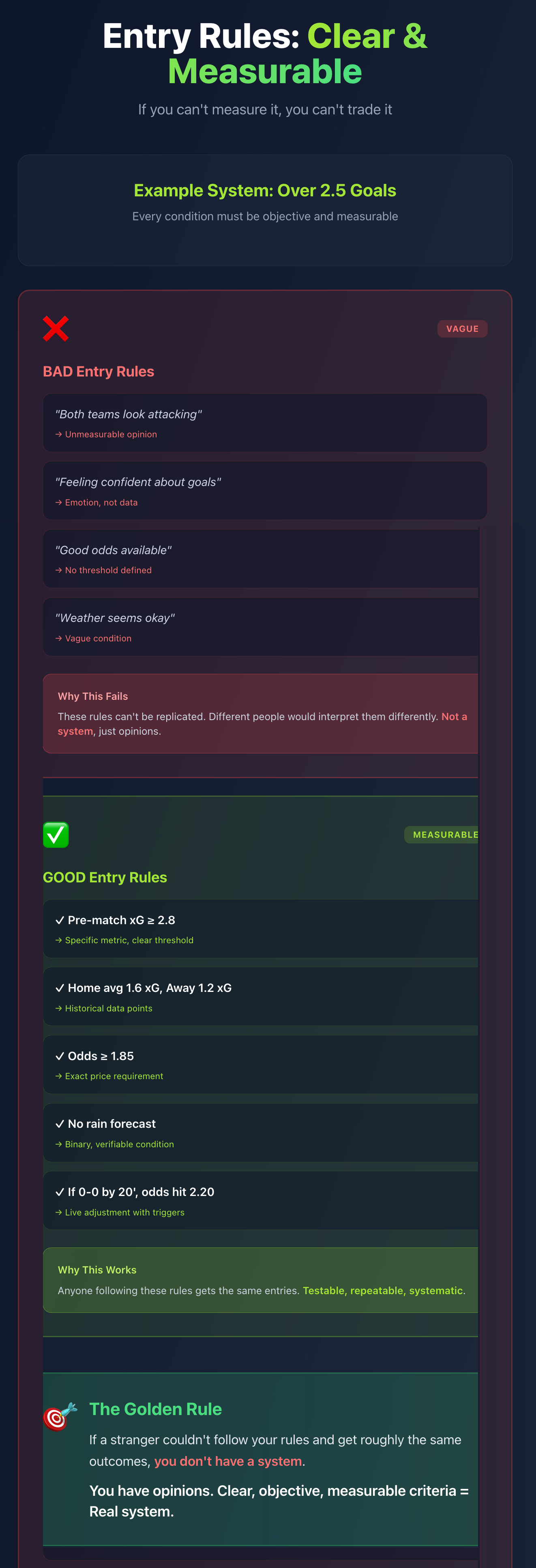
If a stranger couldn’t follow your rules and get roughly the same outcomes, you don’t have a system. You have opinions.
2. Define Your Core Market
Before building, choose a domain you understand.
Spreading across too many markets guarantees mediocrity.
Ask yourself:
Where is my knowledge deepest? (Teams, tactics, data types.)
Where is the market least efficient? (Lower divisions? Player props? In-play?)
Can I access reliable data consistently?
For many, that’s the main markets (1X2, goals, Asian lines), but specialists thrive in corners, cards, or niche leagues.
Focus beats variety. Every time.
3. Build a Hypothesis
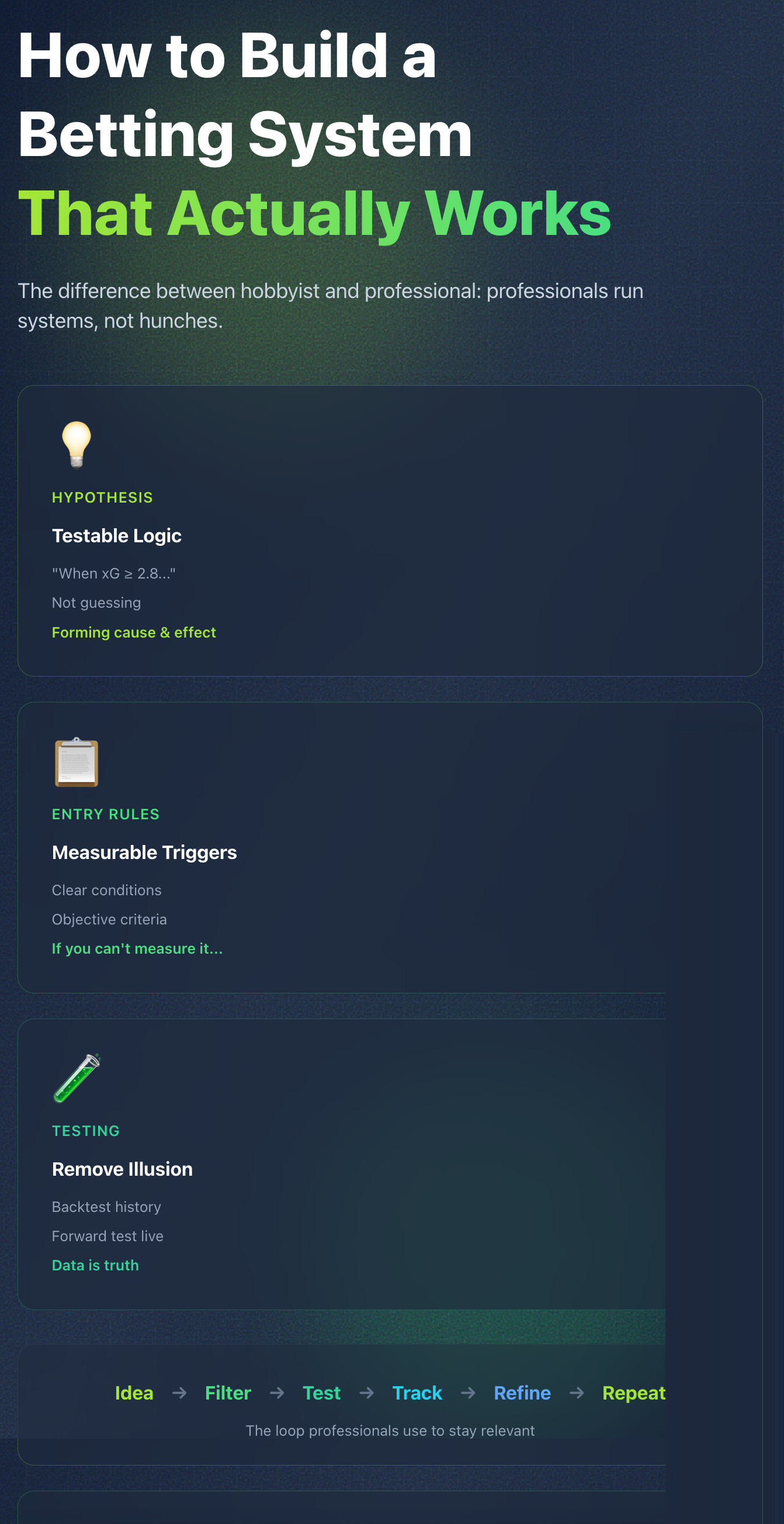
Every system starts with a theory, a hypothesis you test.
Examples:
“Teams with xG ≥ 1.0 by halftime win the 2nd half 65% of the time.”
“When a team’s implied odds drift 10% from opening to live, value improves.”
“When cumulative xG exceeds 0.35 by 25’, the chance of 1H goal > 60%.”
You’re not guessing. You’re forming testable cause-and-effect logic.
This becomes the seed of your model.
4. Define Entry Rules
Once you have your hypothesis, define the exact conditions that trigger a bet.
Example (for Over 2.5 Goals system):
✅ Pre-match total xG projection ≥ 2.8
✅ Home team avg 1.6 xG, away 1.2
✅ Odds ≥ 1.85
✅ No rain / adverse weather
✅ Bet live if score 0–0 by 20’ and live odds hit 2.20
Clear, measurable, objective.
If you can’t measure it, you can’t trade it. Simple as that.
5. Determine Stake and Bank Rules
Your system must include money management from the start.
Base stake = 1–2% of bankroll.
Daily exposure cap = 6%.
Max open trades = 3.
Never increase stake mid-session.
Risk rules are part of your system, not an afterthought.
Without them, even perfect logic collapses under variance.
6. Gather and Test Data
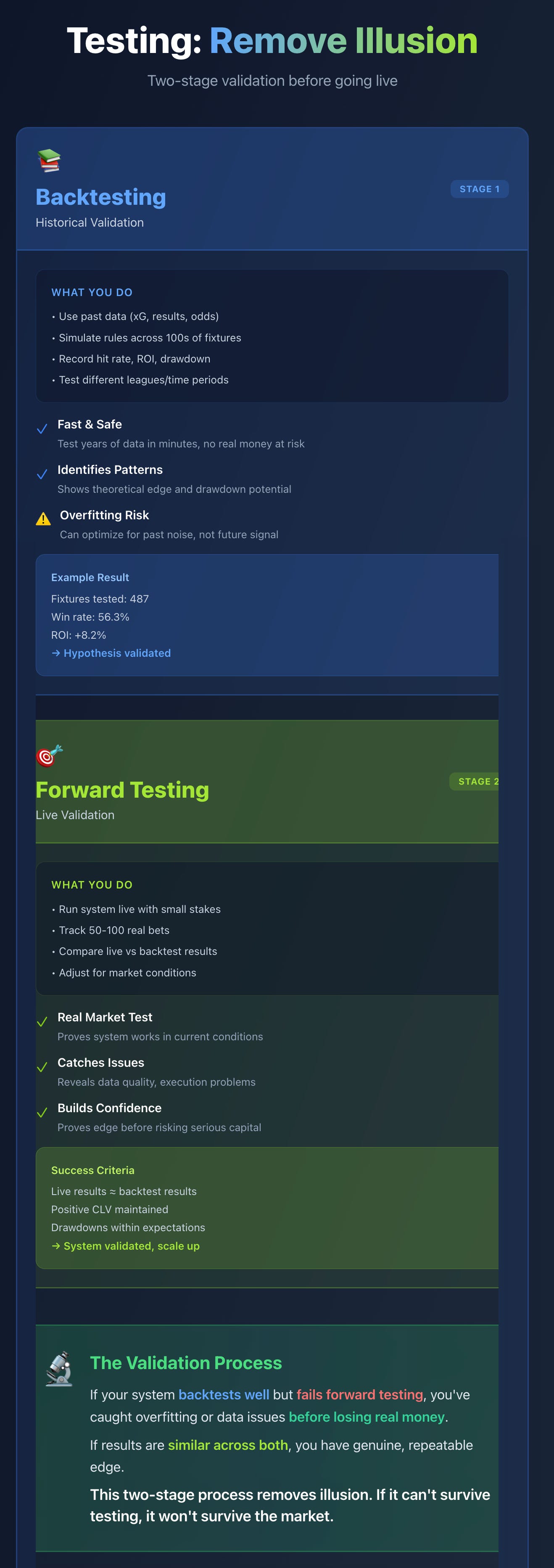
Before going live, test your rules historically.
Two stages:
Backtesting:
Use past data (xG, results, odds).
Simulate your rules across hundreds of fixtures.
Record hit rate, ROI, drawdown.
Forward Testing:
Run live for 50–100 bets using small stakes.
Compare live results with backtest performance.
If similar, system validated.
If drastically different, reassess filters or data quality.
This process removes illusion.
If it can’t survive testing, it won’t survive the market. I’ve learned that one the hard way.
7. Track Everything
Professional systems live and die by tracking.
Minimum data points to log:
Category Example Date / Fixture “Liverpool vs. Brighton” Market Over 2.5 Goals Entry Time / Odds 24’, 2.20 xG or Key Stats 0.38 total Stake £50 Result / P&L +£45 EV % +6 Comments “Steady tempo, early pressure”
Patterns will appear quickly: certain leagues, teams, or odds bands outperform others.
That’s how refinement happens.
8. Measure Results Objectively
Don’t cherry-pick highlights. Measure everything.
Metrics that matter:
Hit Rate (% winning bets).
Average EV.
ROI.
Max Drawdown.
Closing Line Value (CLV): did your entry beat final odds?
If CLV is consistently positive, your system likely has edge even if short-term profit fluctuates. That’s one of the most reliable indicators you’ll find.
9. Review, Refine, Repeat
Systems evolve like living organisms.
Once every 100–200 bets:
Identify strongest filters, double down.
Remove weak filters, simplify.
Test one change at a time.
Avoid the temptation to overhaul everything after a short bad run.
Refinement is surgery, not demolition.
10. Keep It Simple
Complex systems rarely outperform simple ones.
Every rule you add reduces sample size and increases overfitting risk.
A profitable system can often be expressed in one sentence.
“When xG builds early in open fixtures and price drifts, trade goals.”
That’s clean, logical, and measurable.
Complexity impresses the ego. Simplicity compounds capital.
Bonus: The System Framework
If you’re building your first structured approach, use this framework:
1️⃣ Idea: Find a logical inefficiency (what the market underestimates).
2️⃣ Filter: Define measurable entry rules.
3️⃣ Test: Backtest and forward test.
4️⃣ Track: Record every trade and key stats.
5️⃣ Refine: Adjust based on results, not emotion.
Repeat indefinitely.
That loop is how professionals stay relevant while amateurs chase luck.
Key Takeaways
✅ A system = repeatable, data-backed rules.
✅ Define entry, exit, and stake parameters clearly.
✅ Test historically, then forward test live.
✅ Track every trade. Data is truth.
✅ Refine gradually. Simplicity outlasts complexity.
✅ Systems evolve through iteration, not reinvention.
Next Lesson
📘 Lesson 8: The Power of Specialization — Why You Should Master One Market First
We’ll explore how focusing on a single league, data type, or market can multiply your edge, and why trying to trade everything guarantees mediocrity.