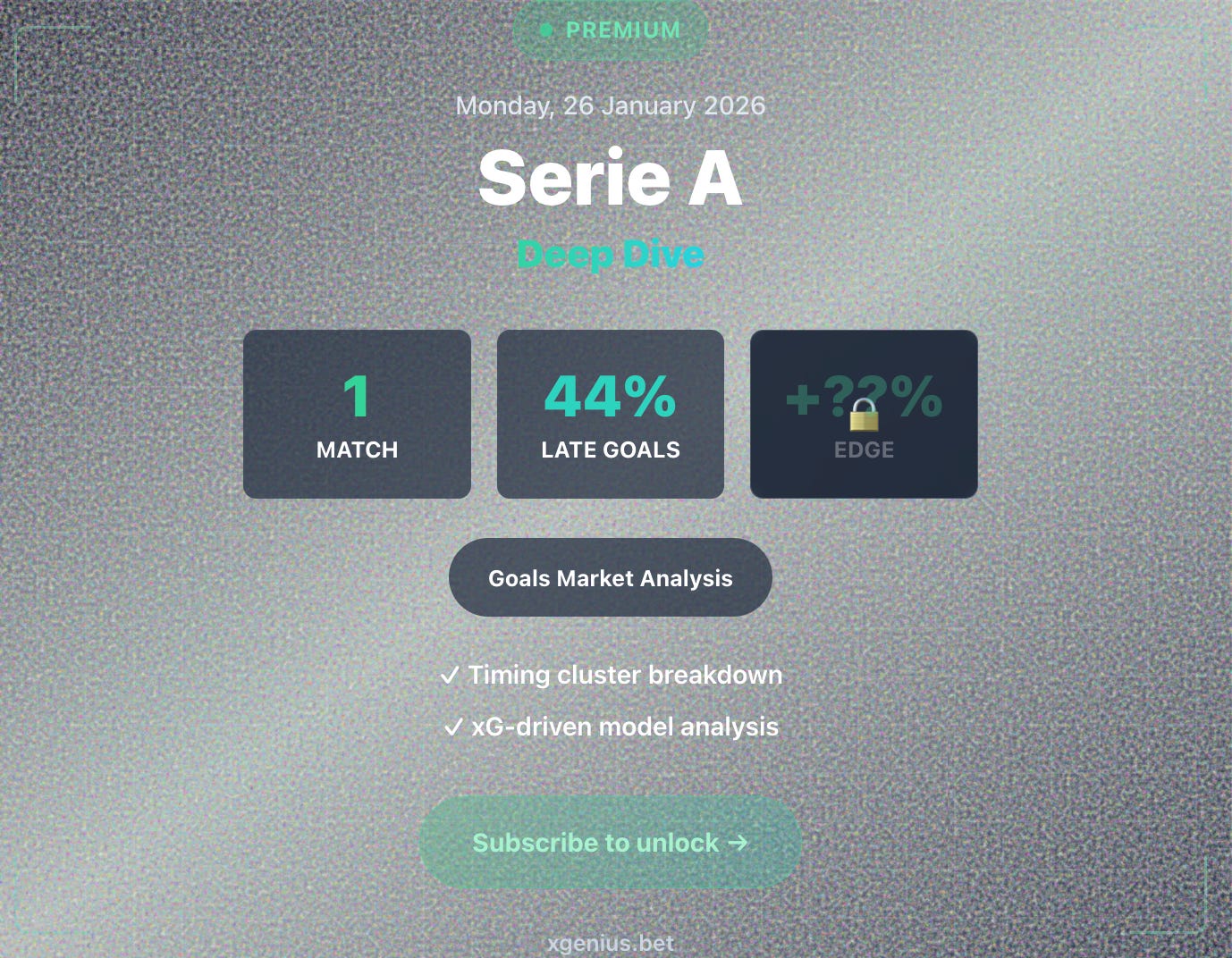
One fixture in Italy this evening presents us with an interesting opportunity, some solid +EV and several angles from which we can profit.
We’ll break all of this down in the analysis below, covering xG projections, 15-minute timing clusters, and the specific windows where both sides tend to concede.
We’ll also reveal our main bet for the day with a very attractive 8.7% +EV.
Match Overview
League: Serie A
Kick-off: 19:45
The Setup
Tonight’s fixture brings together two sides with contrasting profiles but one shared characteristic: they both produce the majority of their goals in the second half.
The home side has been involved in low-scoring affairs recently — 2.2 goals per game at home with modest xG numbers on both sides. The visitors tell a different story on the road, with 5.0 goals per game in their away matches, though much of that comes from defensive fragility rather than attacking prowess.
The model sees value where the market doesn’t — specifically in the goals markets where timing patterns create opportunity.
Goal Frequency Analysis (Last 10)
The raw goal averages suggest entertainment, but the xG figures paint a more measured picture. Combined xG of 2.29 sits below the 2.5 threshold — yet the timing of when these goals arrive creates the edge.
First-Half vs Second-Half Split
Key insight: Both sides produce over 70% of their goals and concessions after half-time.
This creates a specific profile: matches involving these teams tend to be cagey in the first period before opening up. The model accounts for this, but the market pricing suggests it may not be fully reflected in all lines.
15-Minute Timing Clusters
The late-goal pattern is pronounced.
The 76-90’ window accounts for 11 of the 25 total goals in the combined sample — 44% of all goals arriving in the final 15 minutes. The home side scores 6 in this period; the visitors concede 7.
This timing skew is the foundation of the value case.
xG-Driven Model Projections
Expected Goals:
Home xG: 1.37
Away xG: 0.92
Combined: 2.29
The Poisson model (5,000 simulations with Bayesian Gamma priors) produces the following scoreline distribution:
Scoreline Probability
1-0 17.4%
1-1 16.2%
0-0 13.8%
2-0 10.1%
0-1 9.7%
2-1 8.9%
1-2 5.4%
3-0 4.1%
The 1-0 and 1-1 score-lines account for over 33% of simulated outcomes. Low-scoring results dominate — but the question is whether enough goals arrive to clear specific thresholds.
Market Analysis: Goals Lines
Over 2.5 Goals (Full Match)
Odds 2.58
Implied Probability 38.8%
Model Probability 42.1%
Expected Value +8.7%
The primary recommendation.
The case rests on the late-goal pattern: both sides produce over 70% of their goals after half-time, with the 76-90’ window accounting for 44% of all goals in the combined sample. If the match is 1-0 or 1-1 entering the final 15 minutes, historical data suggests further goals are likely.
Combined xG of 2.29 sits just below the threshold, but the timing skew creates an edge the market may not fully price.
Stake recommendation: 1% bankroll flat
Over 1.5 Goals (Full Match)
Odds 1.49
Implied Probability 67.1%
Model Probability 71.2%
Expected Value +6.1%
The lower-variance alternative. With combined xG of 2.29, the model expects at least two goals in 71.2% of simulations.
Both sides have scored in 80% of the home team’s recent matches and 60% of the visitors’ away games. The 1-0 and 1-1 score-lines alone account for 33% of model probability — both clearing this threshold.
Stake recommendation: 1% bankroll flat
First-Half Over 0.5 Goals
Odds 1.54
Implied Probability 64.9%
Model Probability 70%
Expected Value +7.8%
Empirical data shows 7 of 10 recent home matches and 6 of 10 away matches produced at least one first-half goal. Combined first-half xG of 1.41 supports the case — above the league average of 1.25.
Stake recommendation: 0.5% bankroll flat
Summary: Recommendations
Primary recommendation: Over 2.5 Goals @ 2.58
The late-goal pattern — 44% of all goals in the 76-90’ window — creates an edge the market may not fully price.
Secondary recommendation: Over 1.5 Goals @ 1.36 for lower-variance exposure to the same thesis.
In-Play Setups
If 0-0 at 22’
Consider adding to FH Over 0.5 position if shot count exceeds 7 and odds have drifted above 1.70.
If 0-0 at 28’
FH Over 0.5 odds typically drift to 4.0+ at this point. If xG build-up is ≥0.9, this becomes an attractive late first-half entry.
If 0-0 or 1-0/0-1 at 65’
Back Over 1.5 (in-play) at ≥1.60. Model implies 55% true probability given the late-goal patterns of both sides.
Key Considerations
Late-goal dependency — The Over 2.5 case relies heavily on the 76-90’ pattern. If the match is 0-0 at 75’, the probability of clearing 2.5 drops significantly.
xG modesty — Combined xG of 2.29 sits below the Over 2.5 threshold. The edge comes from timing patterns, not raw attacking output.
Over 1.5 as insurance — At 1.49 with 71.2% model probability, Over 1.5 provides steady returns if the late-goal pattern delivers even one goal.
Final Summary
One fixture, multiple edges. The Over 2.5 market at 2.58 offers the primary value — timing patterns show 44% of goals arrive in the final 15 minutes, creating opportunity the market may underprice.
Over 1.5 at 1.49 provides lower-variance exposure to the same thesis. First-half markets offer supplementary plays for those seeking additional angles.
Confidence Score: 7/10
All odds quoted were available at time of analysis. Prices may have moved.


Great analysis, all three recommended bets came in 👌