


Betting Knowledge Series — Lesson 1
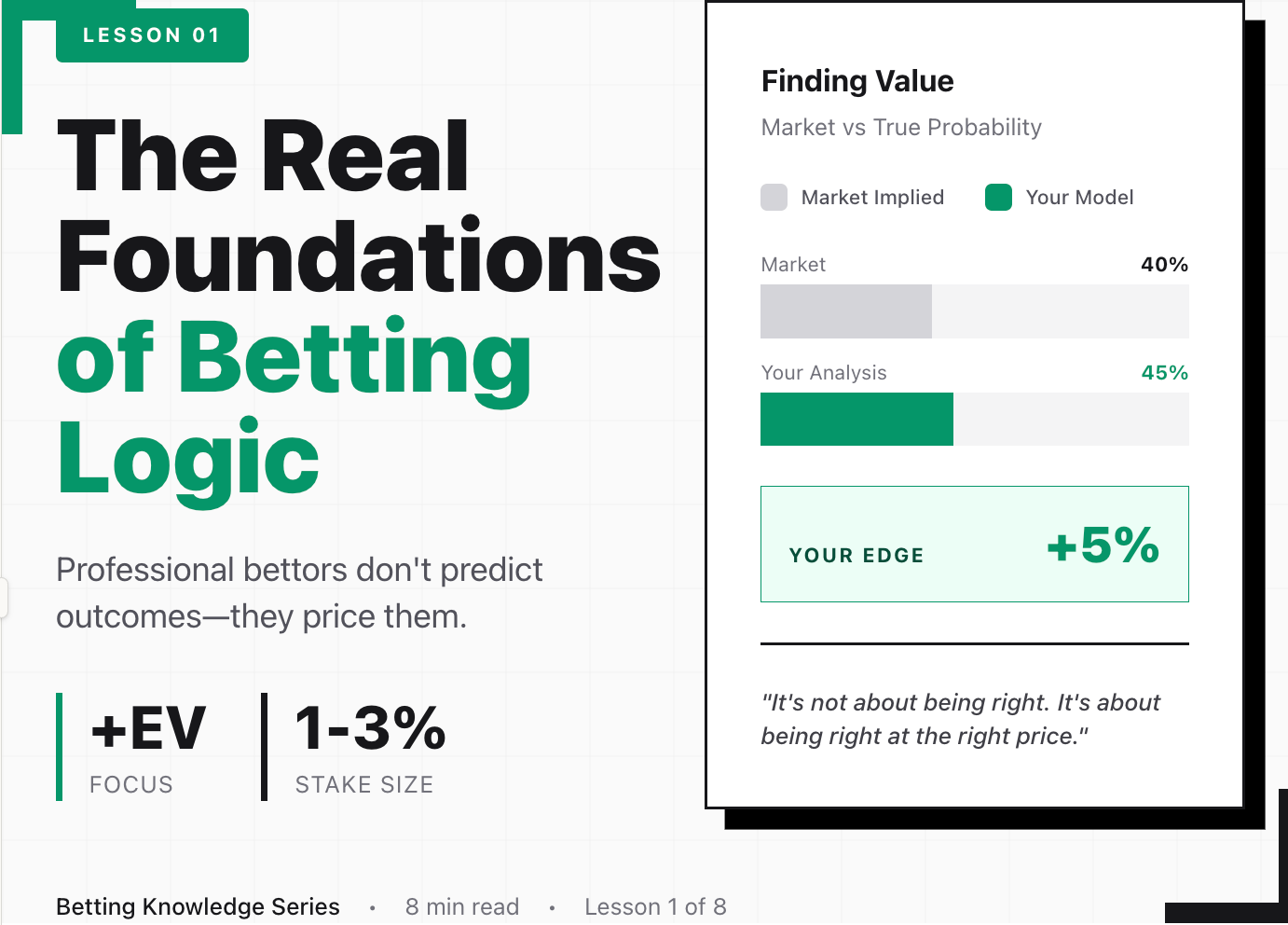
The Real Foundations of Betting Logic
Introduction
Most people approach betting as predictions.
They think the goal is to guess who wins.
That mindset keeps most bettors losing long term. I’ve seen it play out hundreds of times.
Professionals, traders, and genuinely consistent bettors think differently.
They’re not trying to predict the future. They’re trying to price it.
This first lesson sets the tone for your journey. Before we talk about models, staking, or strategies, we need to rebuild how you think about betting. Mindset is the foundation of every profitable system, though perhaps not in the way you’d expect.
1. Betting Isn’t About Being Right
The majority of punters believe success is about accuracy: picking more winners than losers.
A profitable bettor can win only 45% of their bets and still grow their bank, while another can win 60% and lose money.
The difference is price. More specifically, value.
Every set of odds contains an implied probability. If a bookmaker prices a team at 2.00 (even money), they’re saying that outcome has a 50% chance of happening.
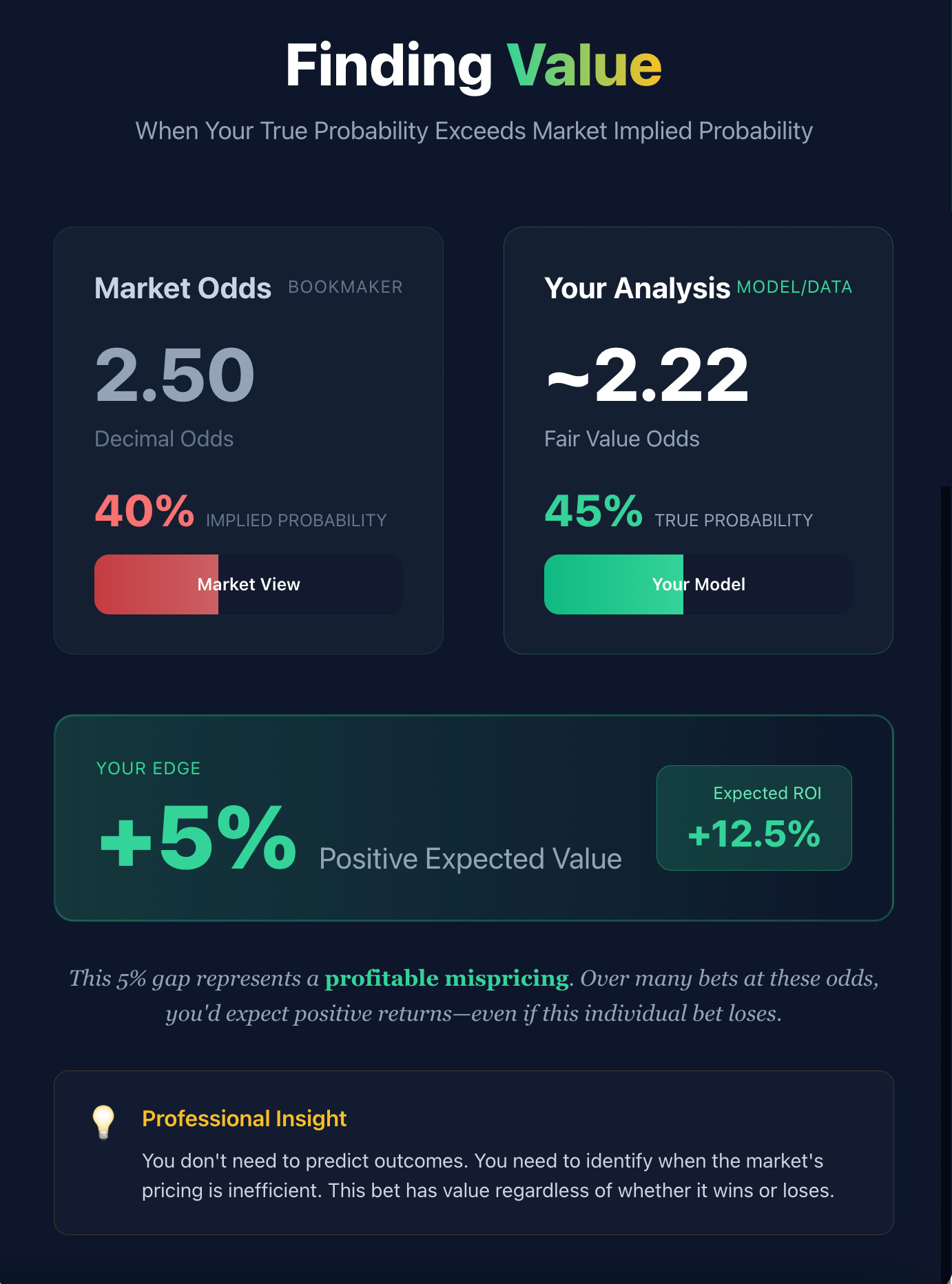
If you believe the true chance is closer to 55% (through research or data), then you have what we call positive expected value (+EV).
You’re not betting on the team. You’re betting on the miss-pricing.
Key Principle:
You don’t need to predict outcomes. You need to identify when the odds are wrong.
2. Probability and Implied Odds
Bookmakers translate probability into odds so we can interact with it.
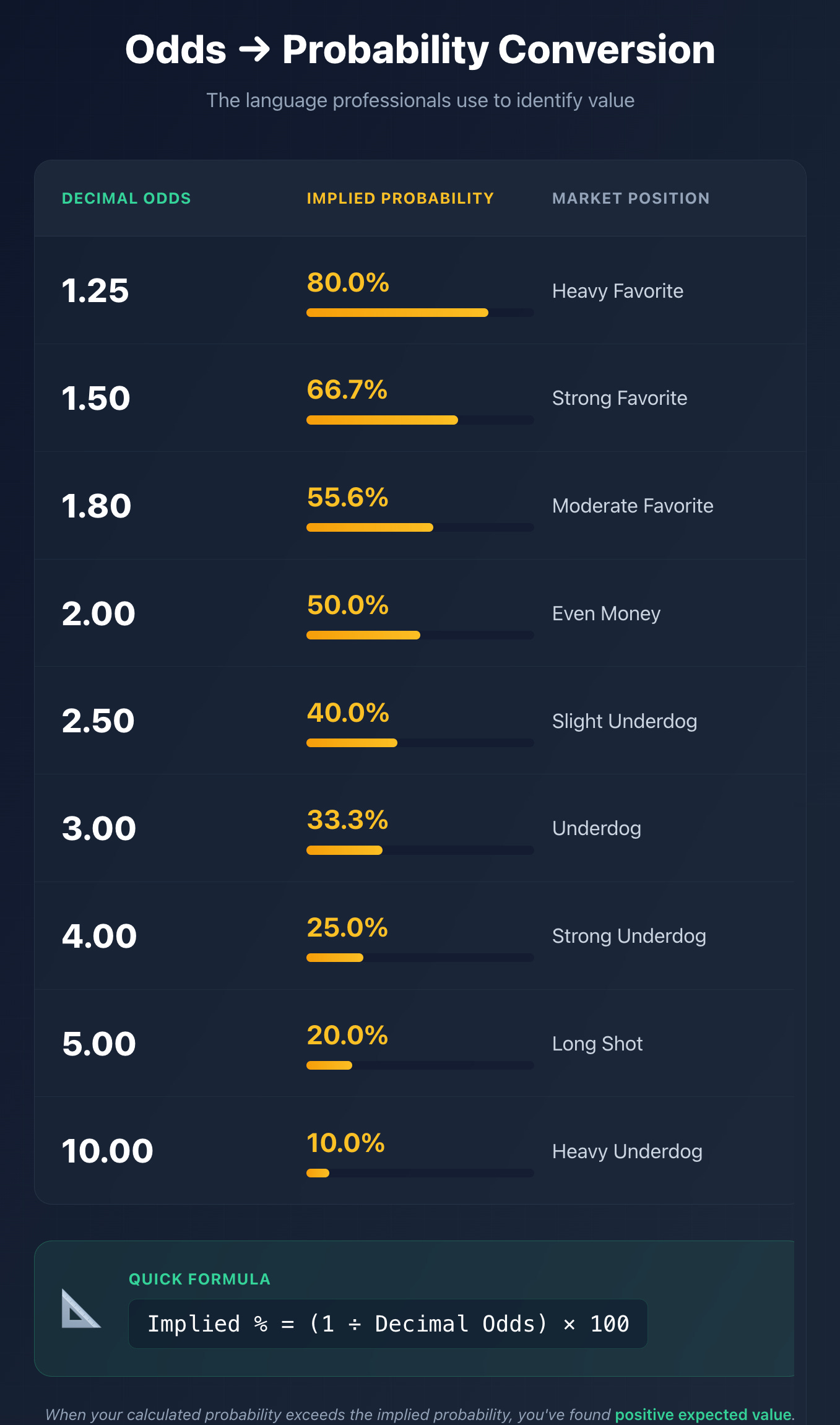
To beat them, you need to translate odds back into probability. That’s the language of logic and value.
Here’s a quick reference:
Odds (Decimal) Implied Probability 1.50 66.7% 2.00 50.0% 3.00 33.3% 4.00 25.0%
When you start thinking in probabilities rather than prices, you strip emotion from decisions.
It’s no longer “I think this team will win”.
It becomes “The market gives them a 40% chance, but my model says 48%. That’s my edge.”
Every professional bettor you’ll ever meet thinks this exact way. No exceptions.
3. The Bookmaker’s Advantage
Bookmakers don’t need to “know more” than you.
Their advantage comes from the margin, not from superior insight.
If the true odds of an event are 2.00 (50%), a bookmaker might offer you 1.91 (52.3% implied probability).
That 2.3% gap is their built-in profit, known as the overround or vigorish.
Your goal isn’t to beat the bookie once. It’s to beat the margin repeatedly.
That’s only possible by finding lines where the true probability (from all your research and modelling) is slightly better than the implied odds suggest.
Professional bettors live inside that 1–5% edge. They don’t need miracles. Just math and consistency.
4. Market Psychology and the Herd Effect
Odds aren’t static. They move with money.
When thousands of bettors pile onto one side of a market, the odds shift, sometimes beyond fair value. That’s where opportunity hides.
Public sentiment inflates favourites and undervalues outsiders, especially in televised matches or big derbies where emotion replaces logic.
Professionals call this herd bias, and they use it to find value against public behaviour.
Example:
When 80% of the money sits on a popular team, the market over-adjusts. The favourite’s true chance might still be 60%, but the odds suggest 70%. The other side, not the hype, carries value.
Your mission is to think independently, not emotionally. Easier said than done, I know.
5. Why Models Beat Memory
Humans are emotional. Data isn’t.
You can watch 100 matches and still overrate the one team that “looked sharp” last weekend. Your brain is built to remember highlights, not probabilities.
That’s why consistent bettors rely on frameworks (models, databases, or structured logic) to evaluate opportunities objectively.
A simple model can outperform years of “experience” if it measures what really matters: xG, shot conversion, tempo, team strength, and market price.
Emotion belongs in sport. Logic belongs in betting.
6. Bankroll Management
You can’t win long term without controlling risk. I think this gets glossed over too much in most betting education.
Every professional bettor protects their bankroll first, because capital equals opportunity.
If you risk too much per bet, variance (natural randomness) will wipe you out, even if you’re right in the long run.
That’s why most pros stake 1–3% of total bankroll per position.
Your goal isn’t to win fast. It’s to stay in the game long enough for your edge to compound.
This series will cover multiple staking systems later (including the Best Staking Plans lessons), but the mindset starts here: treat your bankroll like inventory, not gambling money.
7. Why Losing Bets Can Still Be Good Bets
This one takes time to absorb. Perhaps longer than you’d like.
A losing bet can still be a good decision if it carried positive expected value.
Think of betting like poker. You can play a hand perfectly and still lose. What matters is that you made the right play based on probability, not emotion.
If you placed a bet at 2.50 (40% implied) and your data showed a 45% true chance, you made a smart trade. The outcome doesn’t change that.
The key is to measure decision quality, not just results.
8. Turning Knowledge Into a System
The best bettors don’t reinvent the wheel each weekend.
They use a process. A consistent loop of:
Identify markets with liquidity and structure.
Calculate true probabilities using data or models.
Compare with bookmaker odds.
Execute when +EV appears.
Review weekly performance. Refine, repeat.
The aim of this series is to help you build that exact loop from the ground up. From probability to staking, psychology, and performance review.
Key Takeaways
✅ Betting is about value, not accuracy.
✅ Think in probabilities, not predictions.
✅ Bookmakers profit from margin. You profit from mispricing.
✅ Follow logic, not public emotion.
✅ Losing bets can still be good bets if they carry value.
✅ Protect your bankroll. It’s your trading capital.
✅ Build a repeatable process and trust it over instinct.
Next Lesson
📘 Lesson 2: The Mathematics of Value and Expected Return
We’ll go deeper into expected value (+EV), show you how to calculate it quickly, and explain how tiny edges become compounding profit over time.