


Betting Knowledge Series — Lesson 6
Separating Luck from Skill: How to Tell Variance from Edge
Introduction
If you’ve ever had a hot streak, you’ve probably wondered:
“Am I improving, or just getting lucky?”
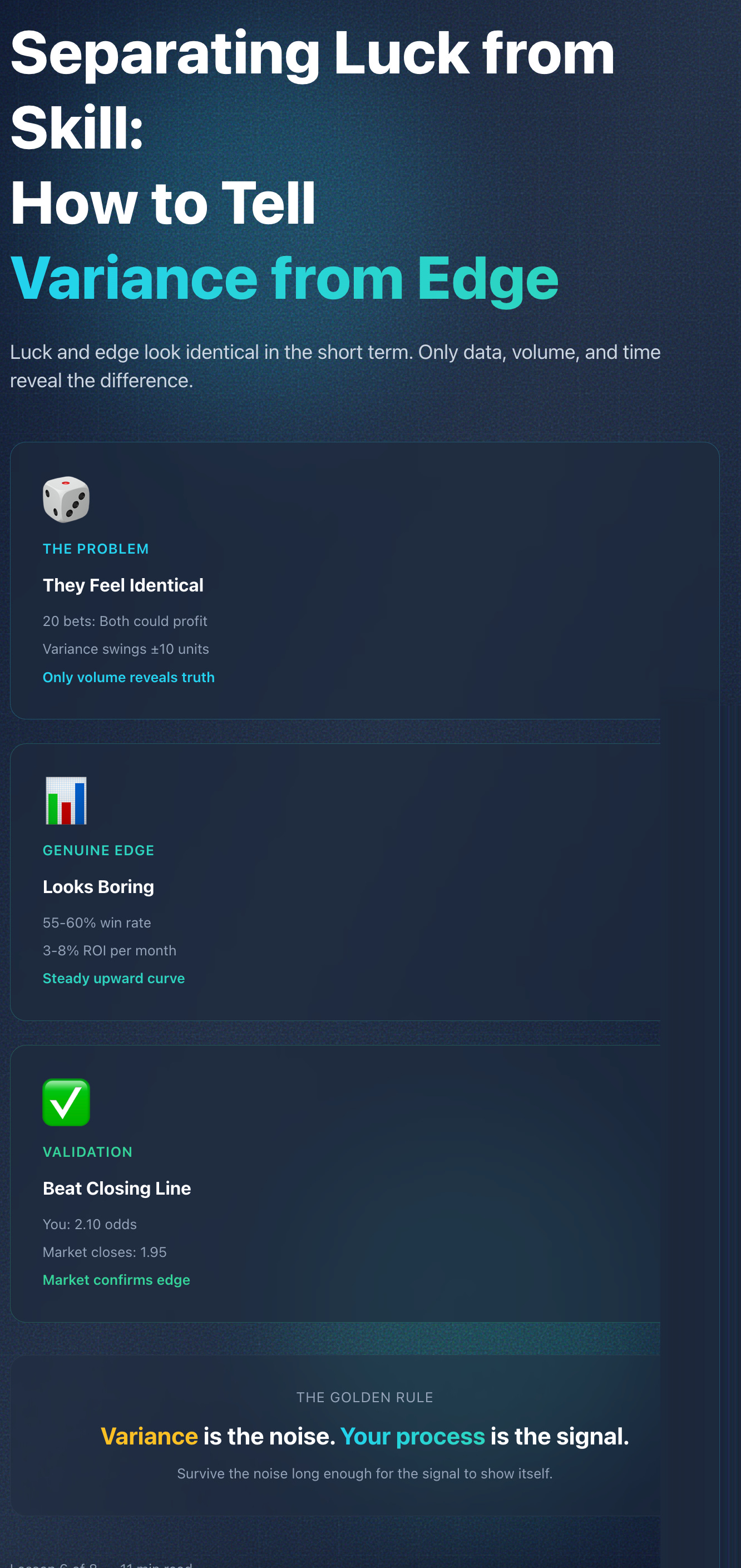
It’s one of the hardest questions in betting, because luck and edge look identical in the short term.
Both can make you profitable over a few weeks or even months.
But one is sustainable. The other eventually collapses.
This lesson will show you how to tell the difference using logic, data, and discipline.
1. The Problem: Luck and Edge Feel the Same
When you’re winning, everything confirms your confidence.
When you’re losing, everything feels unfair.
That’s the paradox: both emotions distort your perception of skill.
In betting, variance can easily disguise itself as talent or incompetence.
The only way to separate them is through sample size and consistency of decision-making.
You can’t control luck, but you can control how you measure it.
2. Defining Edge
Your edge is the measurable gap between the true probability of an event and the odds you take.
It’s not about being right. It’s about being priced right.
If your model says a team has a 55% chance and the market implies 50%, you have a +5% edge.
If you keep finding and executing those discrepancies, that’s skill.
Edge is repeatable value created by process, not emotion.
Luck is random positive deviation from expected results.
3. The Short-Term Illusion
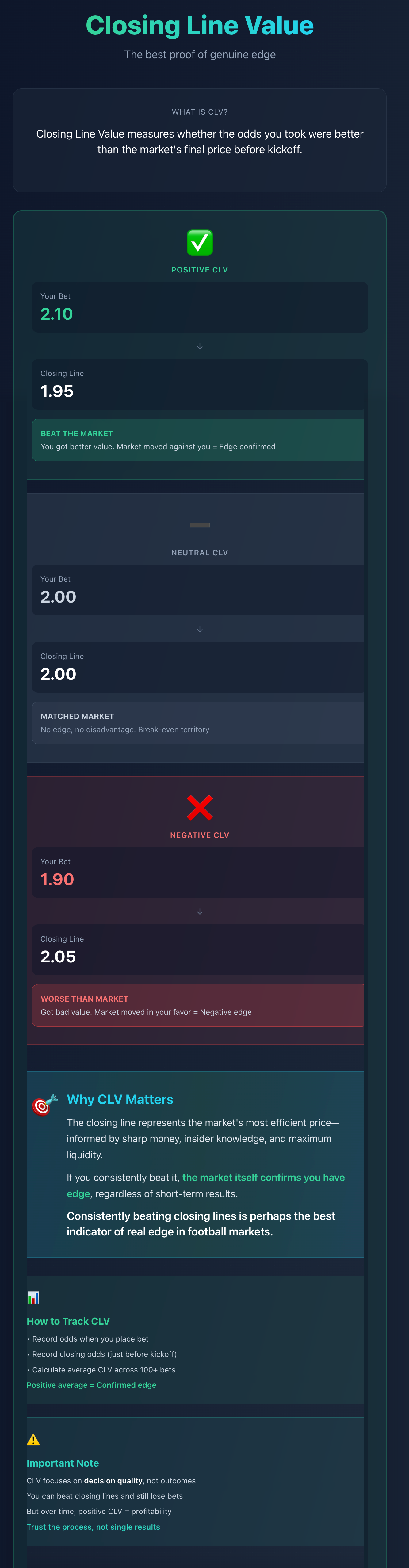
Imagine two traders, both staking £100 per bet at odds of 2.0.
Trader A has genuine +5% EV (true probability = 52.5%).
Trader B has zero edge (true probability = 50%).
After 20 bets, both could easily show profit or loss.
Variance can swing results ±5–10 units in either direction just by chance.
It’s only after hundreds of bets that the pattern emerges:
Trader A trends upward. Trader B drifts flat or negative.
Results mean nothing without volume. I think that’s the hardest lesson for most people to accept.
4. Measuring Whether You’re Beating Luck
To know if you’re outperforming randomness, track three metrics:
Expected Value (EV) of each bet.
Calculate using your true probability estimates.
Average EV across all bets gives your theoretical edge.
Actual ROI (Return on Investment) over time.
Profit ÷ Total Staked × 100.
If ROI consistently aligns with or exceeds your expected EV → genuine edge.
Sample Size Stability.
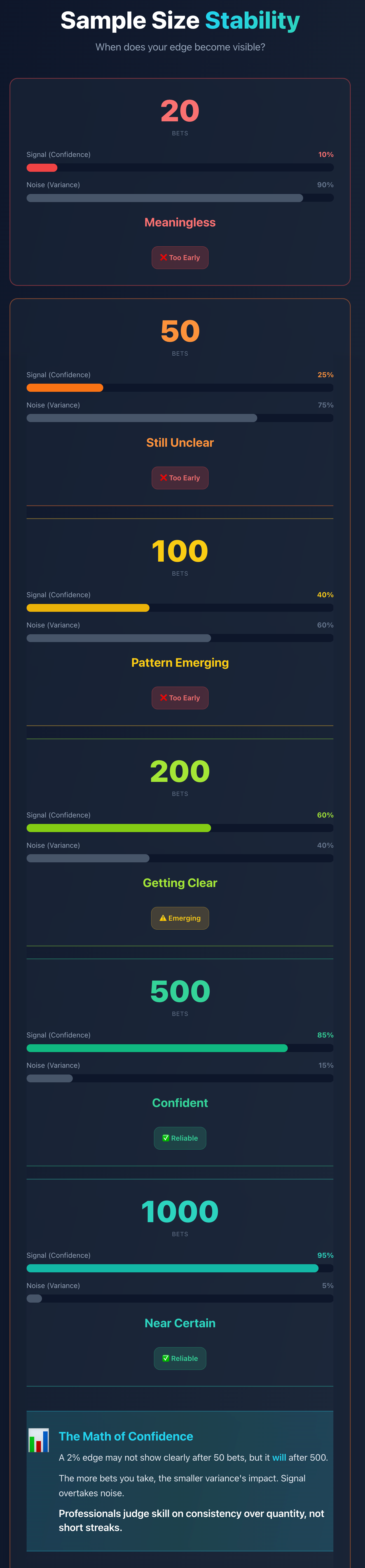
The more bets you take, the smaller the variance impact.
A 2% edge may not show clearly after 50 bets, but it will after 500.
Professionals judge skill on consistency over quantity, not short streaks.
5. How to Know If You’re Just Running Hot
Signs you might be winning on luck rather than logic:
You can’t clearly explain why your bets have value.
Your ROI is abnormally high compared to expected edge (>15% on mainstream markets).
Your profits are concentrated in a handful of big wins, not a steady upward slope.
You’re overconfident and raising stakes aggressively.
Your performance drops sharply when sample size grows.
These are classic hallmarks of variance disguised as genius. Seen it dozens of times.
6. The Reality of Genuine Edge
A true, proven edge often looks boring:
Win rate around 55–60%.
ROI 3–8% per month.
Small, consistent upward curve.
Rare drawdowns but quick recoveries.
It doesn’t feel exciting. It feels stable.
That’s how you know it’s skill, not streak.
Luck produces fireworks. Edge builds quiet wealth.
7. How Professionals Validate Their Edge
Professionals backtest and forward test every hypothesis:
Backtest: Apply your strategy retrospectively to historical data (like xG, odds closing lines).
Forward Test: Run the system live, tracking expected vs. actual performance.
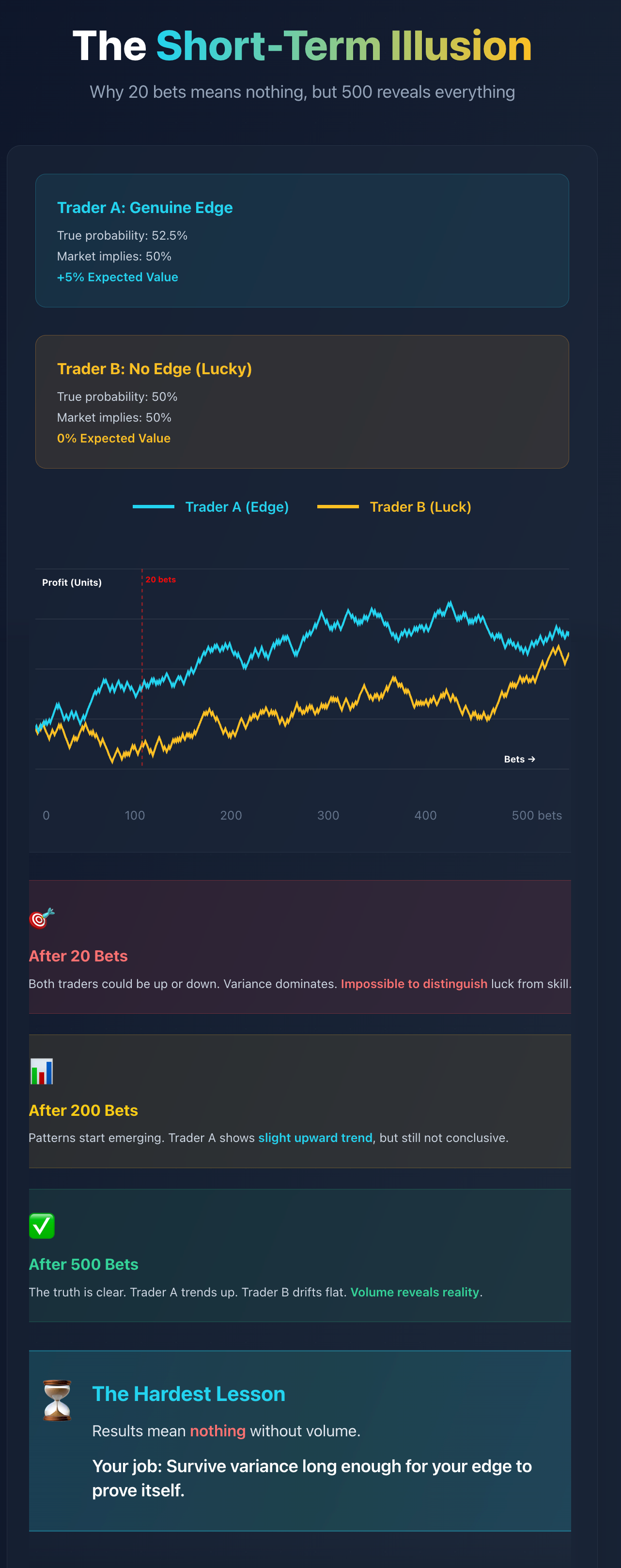
Compare to Closing Line: If your average taken odds beat the market’s final (closing) odds, you likely have edge.
Example:
You bet at 2.10, closing line = 1.95 → your price was better → market agrees with you.
Consistently beating the closing line is one of the best indicators of real edge in football markets. Perhaps the best, actually.
8. Variance Explained with Coin Flips
Even with fair odds, variance creates short-term chaos.
Flip a coin 10 times: it might land 7 heads, 3 tails.
Flip it 1000 times: results approach 50/50.
That’s how betting works.
Variance hides truth in the short term and reveals it in the long term.
Your job is to survive the noise long enough for the signal (your edge) to show itself.
9. How to Protect Yourself During Lucky Runs
Ironically, good runs can be more dangerous than bad ones.
They breed overconfidence and sloppy execution.
Use these rules:
Keep stake size fixed for at least 200 bets.
Record why you made each decision, not just the result.
Review EV vs ROI monthly to check for drift.
Don’t loosen filters or widen markets just because you’re winning.
Luck can make you rich temporarily and reckless permanently.
10. Turning Luck Into Leverage
You can’t control luck, but you can use it:
A winning streak gives psychological confidence. Channel it into disciplined volume, not higher risk.
Use profits from good variance to build a buffer fund for future drawdowns.
Treat every “lucky win” as borrowed capital, not proof of perfection.
Professionals respect luck. They just never mistake it for talent.
Key Takeaways
✅ Luck and edge feel identical short term. Only data separates them.
✅ True skill = consistent positive EV executed over volume.
✅ Beat the closing line. That’s market confirmation of edge.
✅ Variance is the noise. Your process is the signal.
✅ Luck can’t be controlled, but discipline can neutralize its damage.
✅ Sustainable success is steady, not spectacular.
Next Lesson
📘 Lesson 7: Building and Testing a Personal Betting System
We’ll move from theory to structure, teaching you how to design your own repeatable betting model, test it against data, and transform insights into a fully functioning strategy that you can refine over time.