


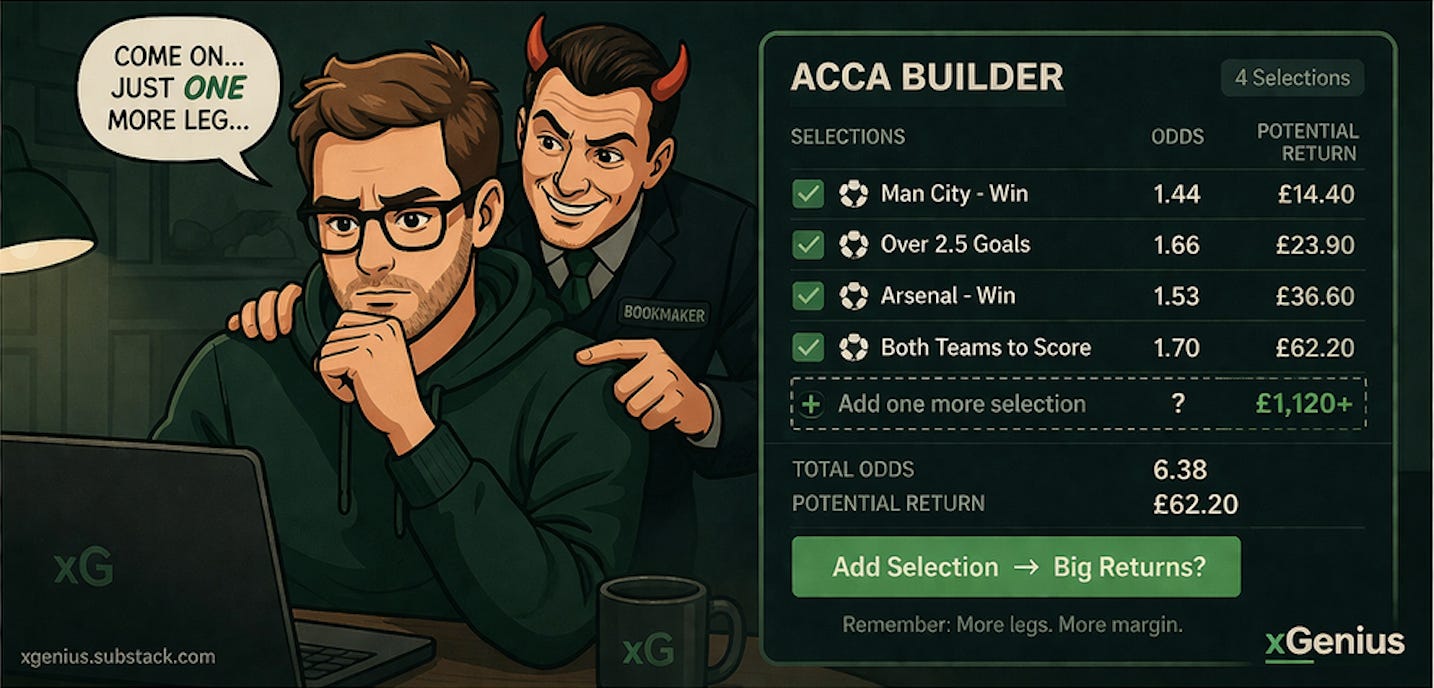
Be honest for a second.
The last time you built an accumulator, what were you actually thinking about?
If you are like most people, you were not thinking about probability. You were not thinking about the bookmaker’s margin or the compounding overround or whether each leg carried enough expected value to justify its inclusion.
You were thinking about the number in the bottom right corner of the betslip.
The one that keeps going up every time you add another game. The one that turns a £10 stake into £180, then £420, then £1,200 as the fifth and sixth selections go in. The one that makes Saturday morning feel briefly like it might be the day everything changes.
That feeling is real. It is also, from the bookmaker’s perspective, entirely by design.
The shop window
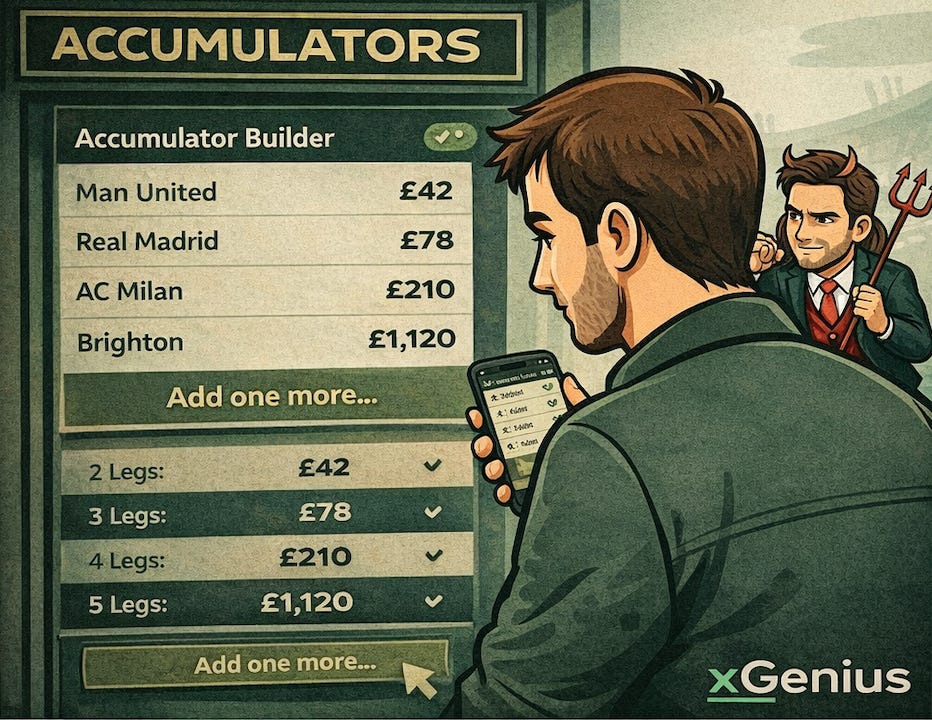
Walk past any high street bookmaker on a Saturday morning and the window tells you one thing: look how much you could win.
Odds boosts. Enhanced accas. Suggested combinations with the potential return displayed prominently. The bet365 Acca Edge, which adds a percentage back on your winnings for every leg you include above a certain number. The message is consistent and deliberate - more legs, bigger return, more reasons to keep adding.
This is the shop window effect. The bookmaker is not selling you a bet. They are selling you an outcome. Specifically, they are selling you the image of the outcome — the £2,400 return, the five-fold that pays for a weekend away, the feeling of having turned a tenner into something worth having.
It is effective because it works with a very human tendency: we are much better at imagining a specific, vivid positive outcome than we are at accurately assessing the probability of it happening.
A 1 in 60 chance sounds reasonable. A 1 in 60 chance written out as “this will not happen 59 times out of every 60 you try it” sounds less appealing. The shop window shows you the one time. It does not mention the other 59.
The 50p to £50,000 story
Every so often, a story appears.
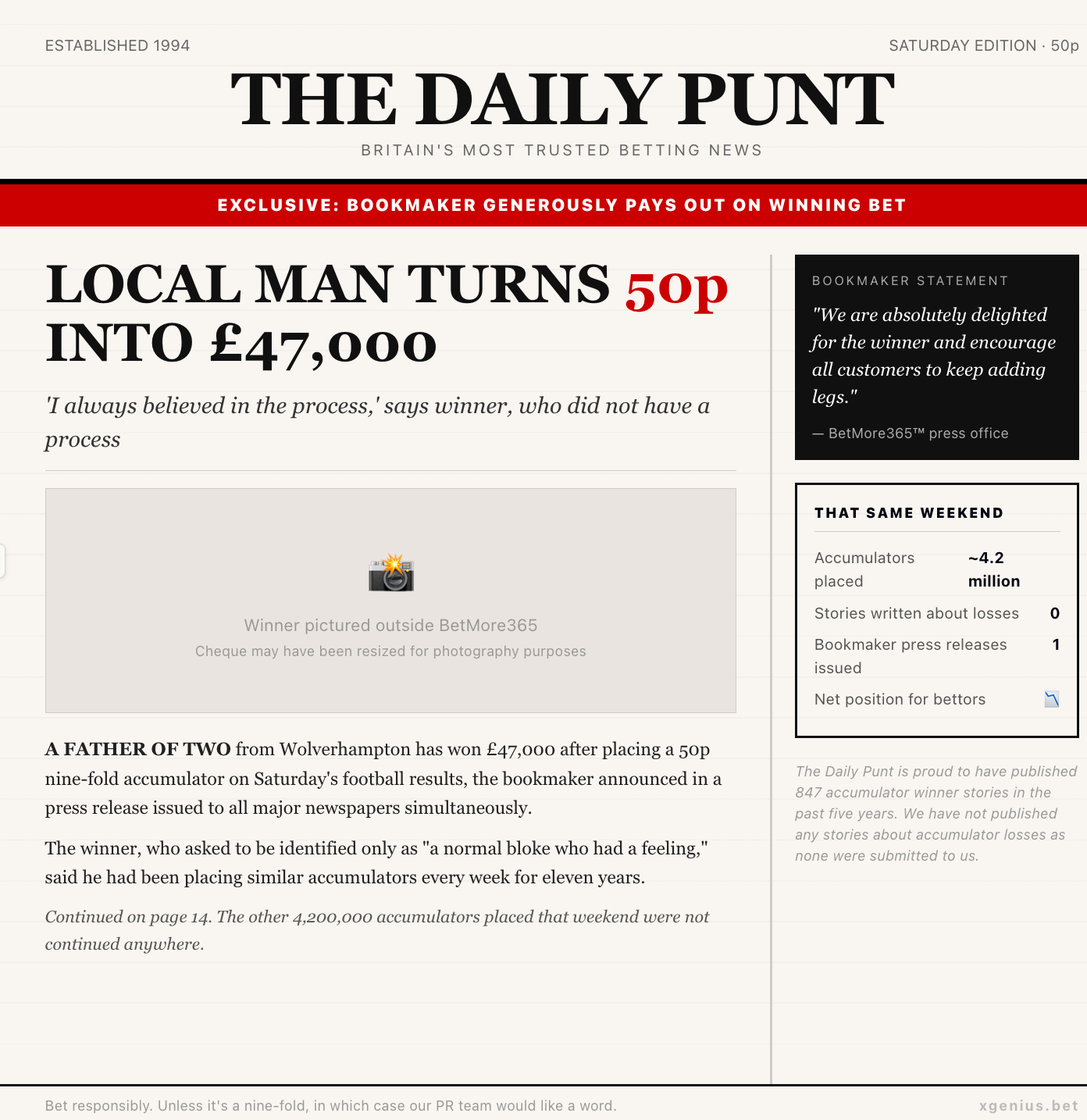
Someone put 50p on a nine-fold accumulator. All nine landed. They have won £47,000 and they are photographed outside the bookmaker’s, cheque in hand, grinning.
The story runs in the Sun, the Mirror, on Twitter, on Reddit. It gets thousands of shares. The comments fill up with people tagging their mates. Someone always replies with their own near-miss - eight legs landed, the ninth lost in the 94th minute, they would have won £23,000.
The bookmaker did not reluctantly hand over that cheque and hope nobody found out. They issued a press release. They tipped off the journalist. They posed for the photograph.
Because that story is worth more to them than the £47,000 it cost.
Here is what the story does. It makes the implausible feel achievable. It takes a 1 in 400,000 outcome and puts a human face on it - a real person, a real amount, a real moment. The brain does not process “1 in 400,000” as a meaningful number. It processes the photograph. It processes the cheque. It processes the thought that this could be me, because it was someone, and that someone is not obviously different from me.
This is survivorship bias weaponised as marketing. The tens of millions of accumulators that lost that same week do not get a press release. The people who put 50p on a nine-fold and got nothing back do not get photographed outside the bookmaker’s. They just quietly add up, week after week, into the revenue line that makes the £47,000 payout a rounding error.
The story is not evidence that the bet is worth placing. It is evidence that the bet occasionally wins - which is a completely different thing, and a distinction the bookmaker is very happy for you not to make.
The shop window shows you the potential return. The press release shows you someone who received it. Neither one tells you the probability of joining them.
What the Acca Multiplier is actually doing
The bet365 Acca Edge — and equivalent promotions across most major bookmakers — is a particularly elegant piece of product design.
On the surface, it rewards you for adding more legs. The more selections you include, the higher the percentage bonus on your winnings. It feels like the bookmaker giving something back. A small acknowledgement that building a long accumulator is harder, and that the return should reflect the difficulty.
Here is what it is actually doing.
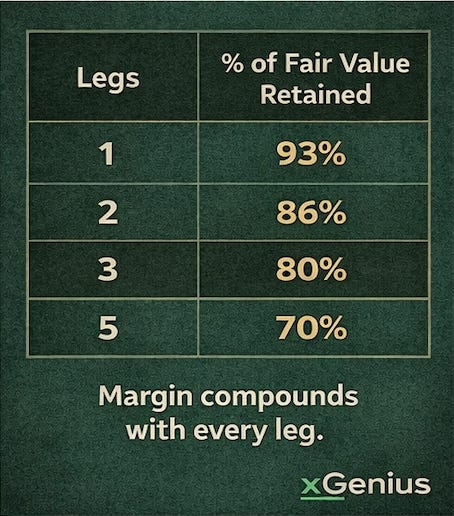
Every additional leg you add compounds the bookmaker’s margin against you. As covered in our earlier posts, a five-leg accumulator carries a structural disadvantage of somewhere around 30% before any individual selection is assessed. The Acca Edge bonus — typically between 5% and 70% depending on leg count — returns a fraction of that compounding margin back to you on winning bets only.
The emphasis on winning bets only is doing a lot of work in that sentence.
You receive the bonus when the accumulator wins. You do not receive anything when it loses - which, given the compounding margin, is most of the time. The promotion is structured so that the bookmaker gives back a small amount on the occasions the bet wins, while retaining the full structural advantage on the occasions it does not.
The net effect is that bettors add more legs to qualify for a bonus that does not come close to covering the additional margin those legs introduce. The promotion costs the bookmaker considerably less than the additional legs return. Everyone involved understands this, but only one party has run the numbers.
Betting on what you could win versus betting on what is likely
This is the real tension at the heart of accumulator betting — and it is worth being straight about it, because both approaches are legitimate depending on what you are actually trying to do.
If you are placing a £10 five-fold because Saturday is more interesting with something riding on it, because the potential return makes the afternoon feel more alive, because you enjoy the process of picking games and watching them land — that is a completely reasonable use of £10. Entertainment has value. The accumulator is doing what you need it to do.
But if you are placing accumulators because you want to profit over time, because you are genuinely trying to build a process that returns more than it costs across a full season — then betting on what you could win is working directly against you.
Because the number in the bottom right corner of the betslip is not a measure of value. It is a measure of what happens if every leg lands. It does not tell you how likely that is. It does not tell you whether each leg is priced fairly. It does not tell you whether the combination you have built has a positive expected return or a negative one.
It tells you what the best case looks like. And the human brain, presented with a vivid best case, consistently overweights the probability of that best case occurring.
The bookmaker knows this. The shop window is there because it works.
The shift
The bettors who build consistent long-term returns from accumulators make one fundamental shift in how they approach the betslip.
They stop starting from the potential return and work backwards. They start from the probability of each outcome and work forwards. The question is not “how many legs do I need to make this worth placing” - it is “how many legs can I justify based on what the data actually supports.”
Most weeks, that is fewer legs than it feels like. Most weeks, the combined odds are less exciting than they could be if you added one more game to push the return up. The filter cuts the selections that look good but do not carry genuine edge.
The result, over a large enough sample, is a return that the betslip’s bottom right corner was never designed to show you — because it comes from consistently placing bets with a positive structural foundation, not from occasionally hitting a six-fold.
The shop window will always be there. The question is whether you are shopping or investing.