



In 1977, the Rebel Alliance destroyed the Death Star using a targeting computer, a single torpedo, and a structural weakness the Empire had built into its own weapon.
The weakness was not a mistake exactly. It was an inevitability — the exhaust port that any reactor of that design would require. The Empire knew it existed. They calculated that it was small enough, and the approach vector difficult enough, that no attacker would ever use it effectively.
They were wrong about that. But the more interesting detail, from a strategic perspective, is this: the weapon that destroyed the Death Star was not something the Rebels built from scratch. It was already there. Built in. The Rebels just knew where to look.
The bookmaker’s margin works the same way.
The weapon
Every bookmaker builds a margin into every market they offer. It is the overround — the structural edge that ensures the implied probabilities across any given market add up to more than 100%, guaranteeing the bookmaker a return across a large enough sample regardless of results.
On accumulators, this margin compounds. Every leg multiplies the existing edge against the bettor. By the time a five-leg accumulator is constructed, the structural disadvantage built into the combination is significant enough that the selections need to be genuinely exceptional just to reach break-even.
This is the weapon. It is built into every price. It runs automatically. It does not require any active effort from the bookmaker once the odds are set — it just works, quietly, on every bet placed by every customer who never thinks to look for it.
For most bettors, most of the time, it works perfectly. The margin is invisible. The losses feel like bad luck, or bad selections, or variance. The weapon fires and the bettor never sees it.
The exhaust port
Here is the flaw the bookmaker built in.
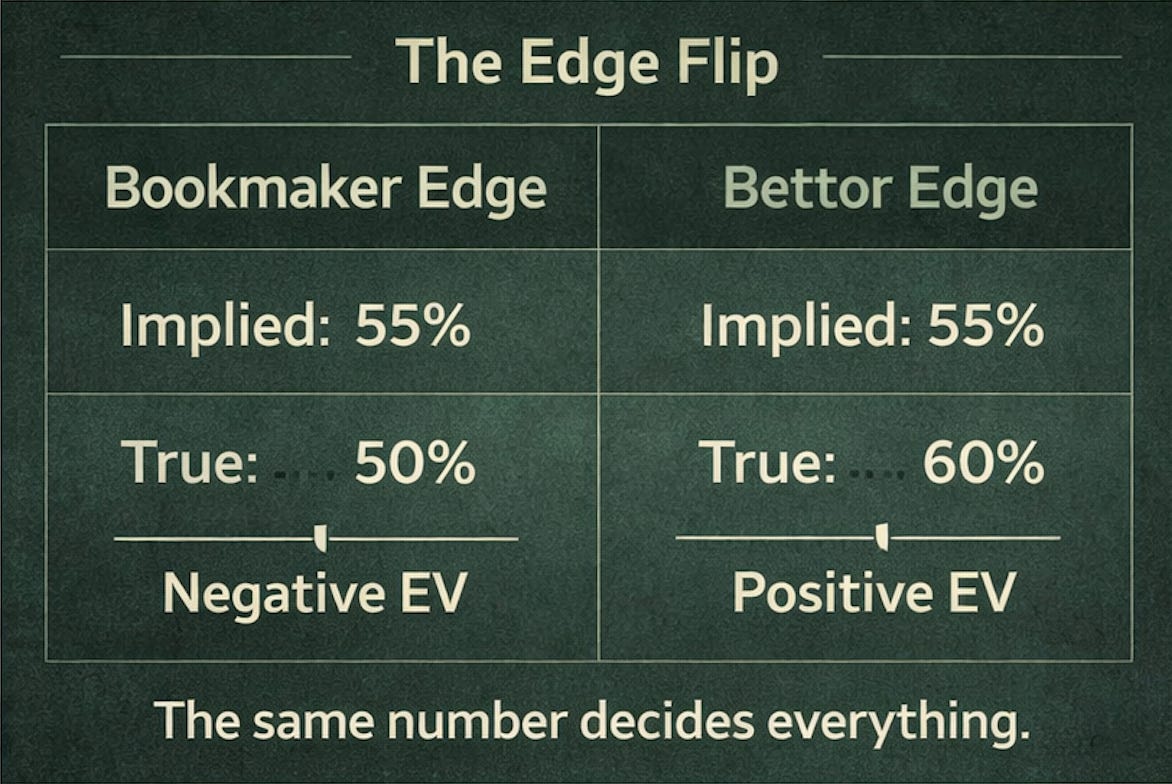
The margin is not hidden. It is calculable. Every price a bookmaker offers contains, encoded within it, the implied probability of the outcome — and the difference between that implied probability and the true probability of the outcome is the margin they are extracting.
That number — the gap between the bookmaker’s implied probability and the genuine probability — is simultaneously the source of the bookmaker’s edge and the only measurement that tells you whether a bet is worth placing.
If the true probability of an outcome is higher than the bookmaker’s implied probability, the odds represent genuine value. The margin is not being extracted on that bet — it is being conceded. The weapon has been turned around.
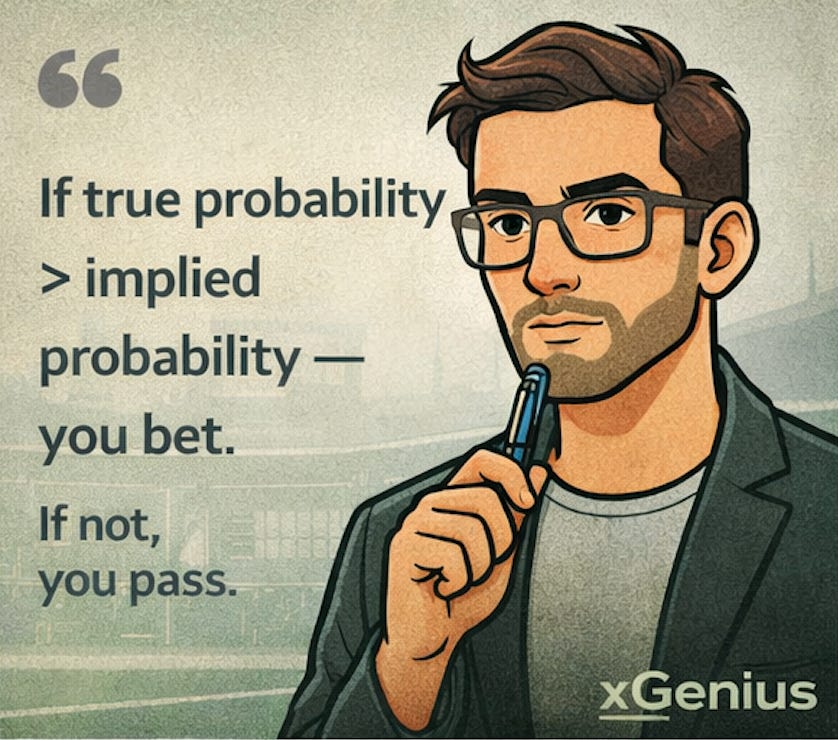
If the true probability is lower than implied, the margin is working against you as intended. That leg does not belong in the combination.
The bookmaker built their entire pricing structure around a single assumption: that the person on the other side of the bet would never calculate this. That they would look at the odds, decide they seemed fair, and place the bet. That the margin would remain invisible.
For the overwhelming majority of bets placed on accumulators, that assumption holds. The margin compounds silently, the losses accumulate, and the bettor adjusts their selections rather than examining the structure.
The targeting computer
Finding the exhaust port is not technically complicated. It requires one calculation per leg — a measurement of whether the true probability of the outcome exceeds the bookmaker’s implied probability by enough to justify inclusion. That calculation, applied consistently to every leg before any combination is built, changes the entire dynamic.
Legs that clear the threshold go in. The margin on those legs is being conceded by the bookmaker, not extracted from the bettor. Legs that do not clear it get cut, regardless of how good the game looks or how much the combined odds improve by including them.
The result is a smaller number of accumulators, with fewer legs, placed less frequently — but built on a foundation where the structural edge is pointing in the right direction rather than against you.
The bookmaker is counting on you not running the calculation. The margin only works invisibly. Once you can see it, it stops being a weapon and starts being a targeting system.
That is the shift. Not better selections. Not more research. A different question asked before any leg is included — one that uses the bookmaker’s own mathematics to tell you whether the bet is worth placing.
The Empire never considered that someone would find the port and know what to do with it.