


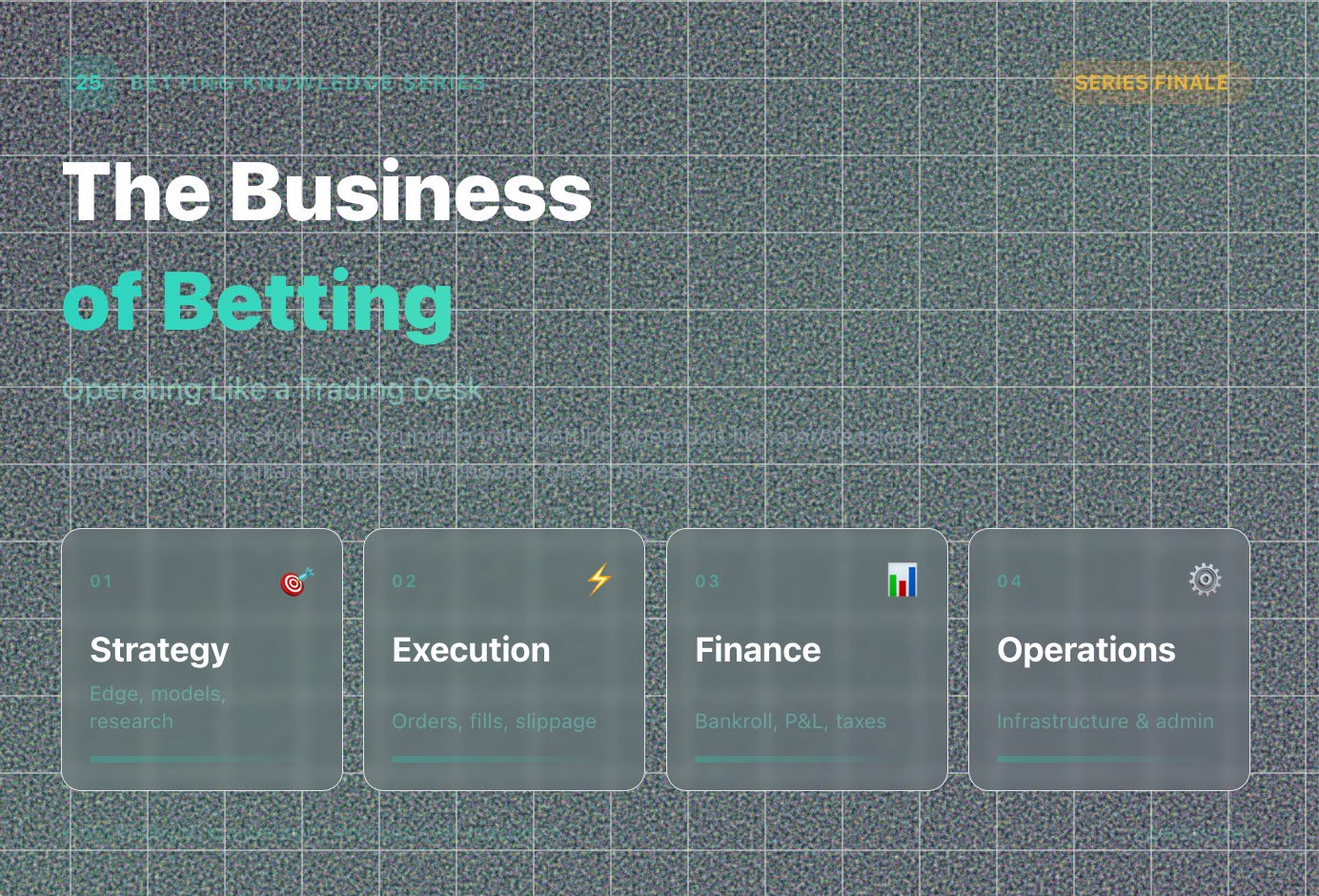
Betting Knowledge Series — Lesson 25
The Business of Betting: Operating Like a Trading Desk
Introduction
At the professional level, betting stops being about finding bets. It starts being about managing a business.
You’re not a gambler. You’re a risk manager, a data analyst, a CFO, and a trader all in one.
Your success depends not just on edge, but on how efficiently you allocate time, capital, and attention. I’ve watched talented traders burn out because they couldn’t organize their operations.
This lesson walks through the mindset and structure of running your betting operation like a trading desk. The same framework used by successful prop traders and hedge funds.
1. The Shift from Hobbyist to Operator
A hobbyist measures success by “how the weekend went.”
An operator measures:
ROI, CLV, and Sharpe ratio.
Capital efficiency across systems.
Compliance, liquidity, and cash flow.
The shift is from outcomes to operations. You manage process, not results.
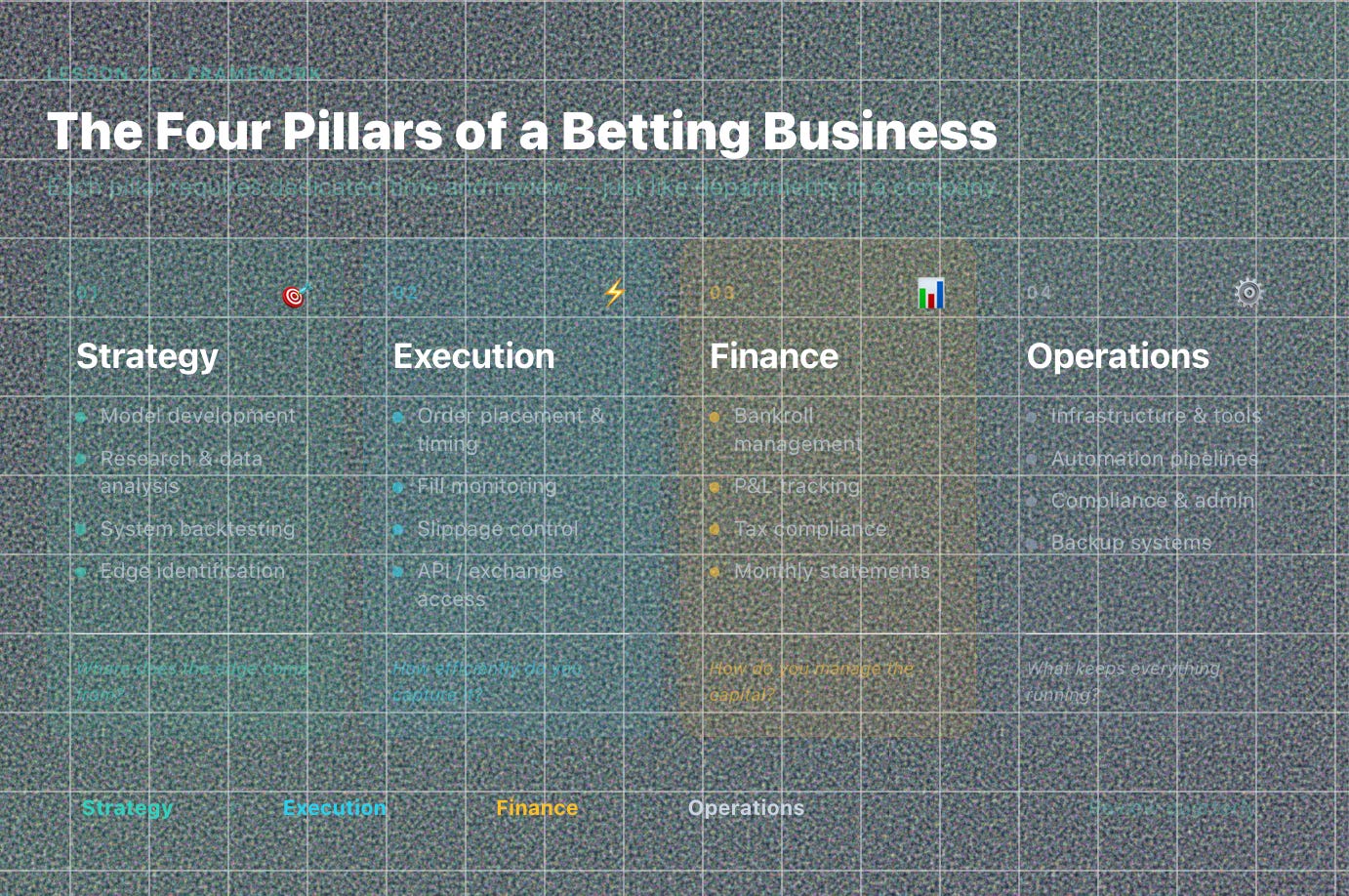
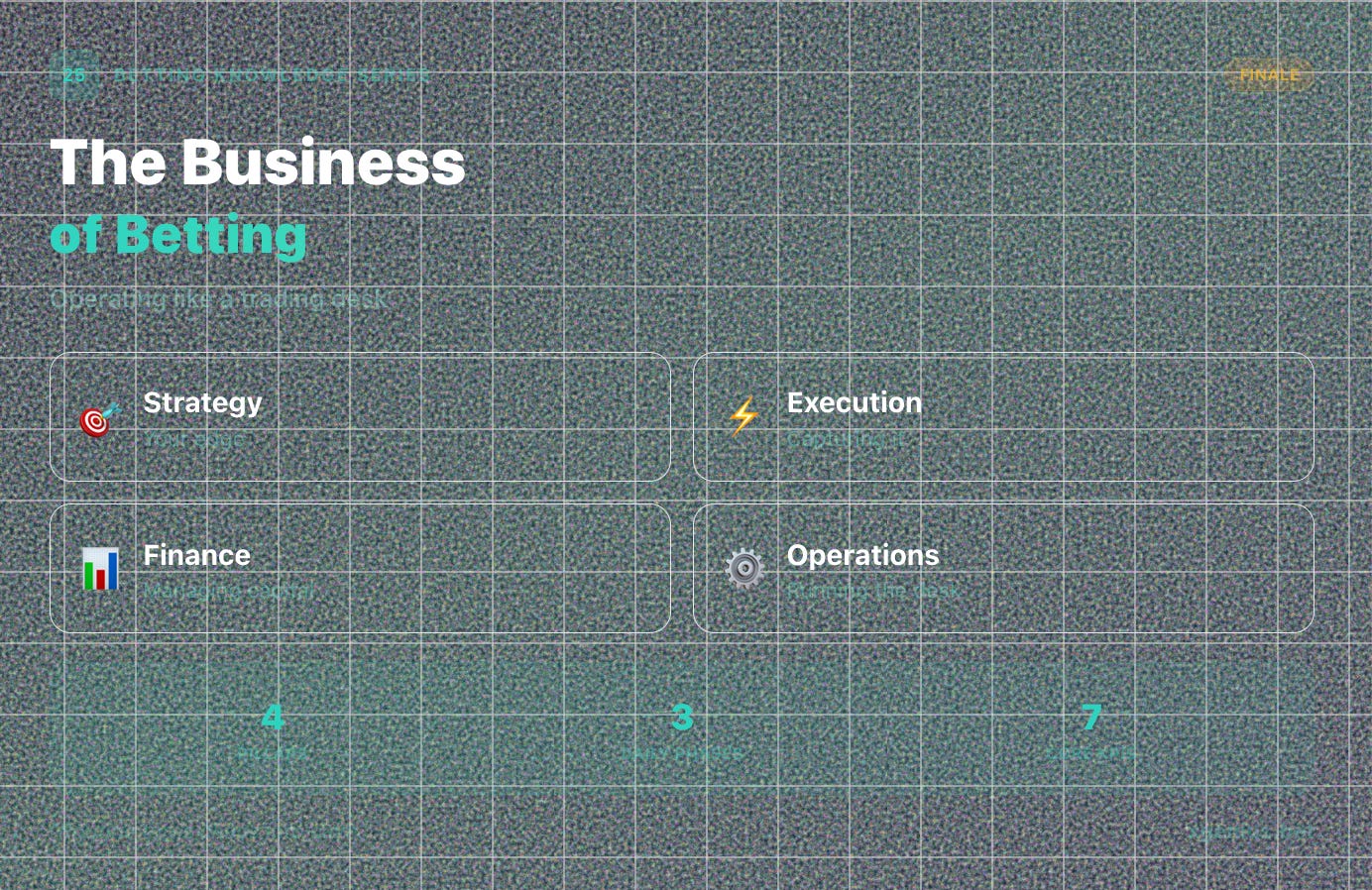
2. The Four Pillars of a Betting Business
Pillar 1: Strategy
Your edge. Models, research, system development.
Pillar 2: Execution
Order placement, fills, slippage control.
Pillar 3: Finance
Bankroll, P&L tracking, accounting, taxes.
Pillar 4: Operations
Infrastructure, automation, compliance, admin.
Each pillar requires dedicated time and review. Just like departments in a company.
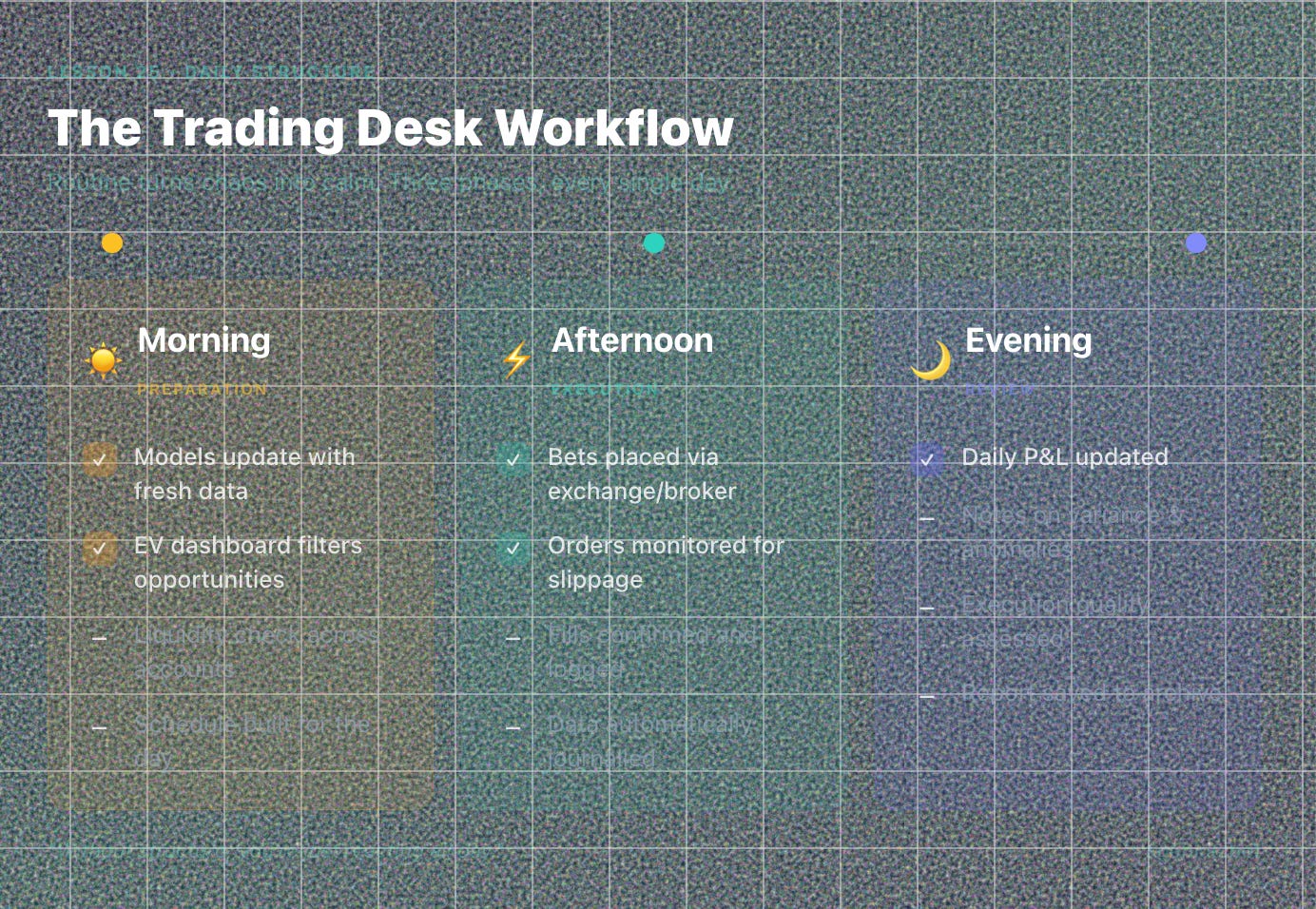
3. Building Your Trading Desk Workflow
A professional desk has three daily phases:
Morning – Preparation
Models update with fresh data.
EV dashboard filters potential opportunities.
Liquidity check and schedule built.
Afternoon – Execution
Bets placed via exchange/broker APIs.
Orders monitored for slippage and fills.
Data automatically logged in journal.
Evening – Review
Daily P&L update.
Notes added on variance, execution, or anomalies.
Quick report emailed or saved to archive.
Routine turns chaos into calm. Without structure, you’re just reacting all day.
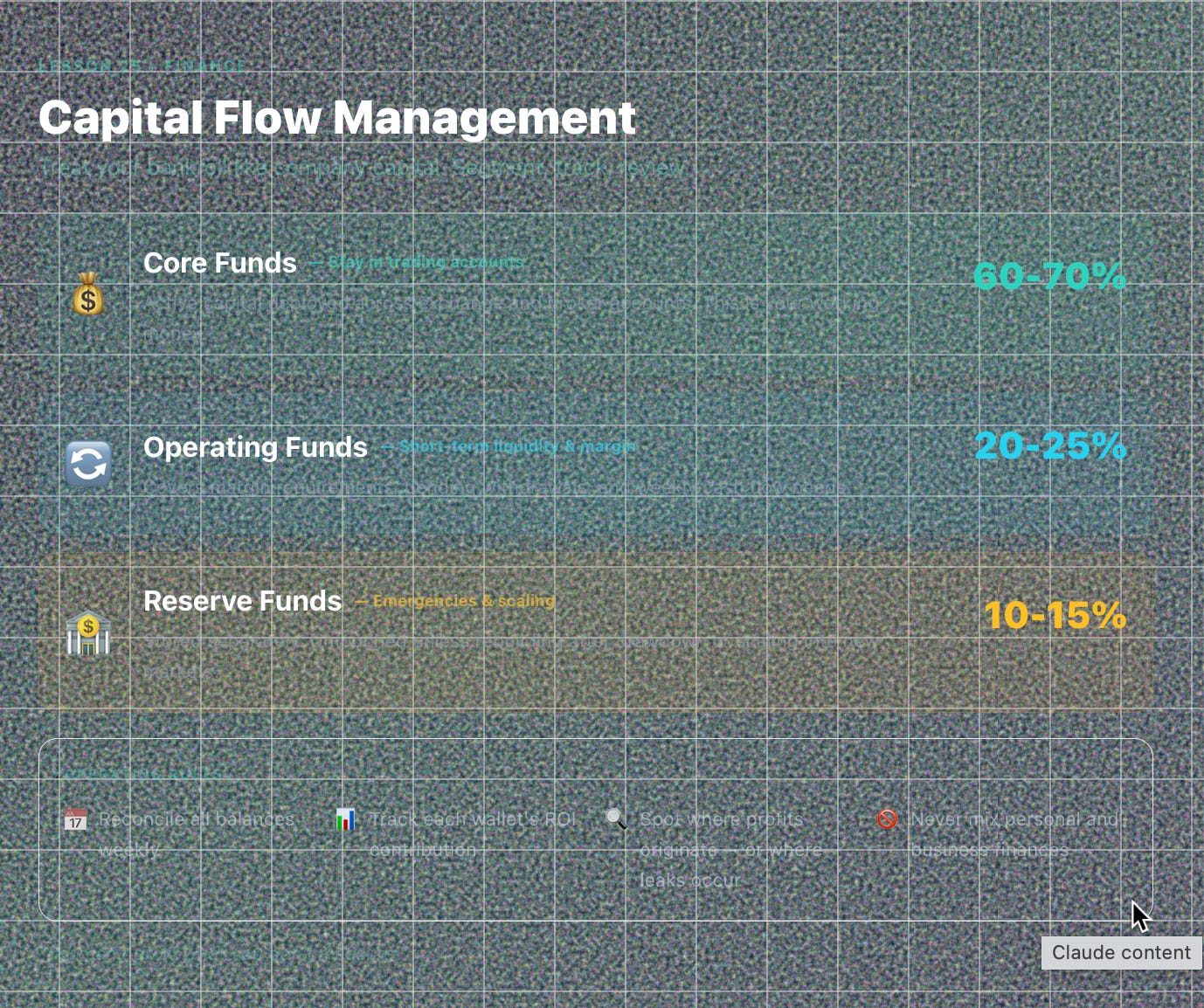
4. Capital Flow Management
Treat your bankroll like company capital:
Core Funds: stay in trading accounts.
Operating Funds: cover short-term liquidity and margin needs.
Reserve Funds: stored separately for emergencies or scaling.
Reconcile all balances weekly.
Keep an internal P&L showing each wallet’s contribution to overall ROI.
This helps you spot where profits originate. Or where leaks occur. You’d be surprised how many people have no idea which system is actually making them money.
5. Accounting and Reporting
Even small operations benefit from basic accounting discipline:
✅ Separate personal and business finances.
✅ Log every deposit, withdrawal, and fee.
✅ Track commissions and taxes.
✅ Create a monthly “statement” summarizing profit, ROI, drawdown, and capital allocation.
These reports aren’t just for compliance. They give you the professional clarity needed to make strategic decisions confidently. You can’t grow what you don’t measure.
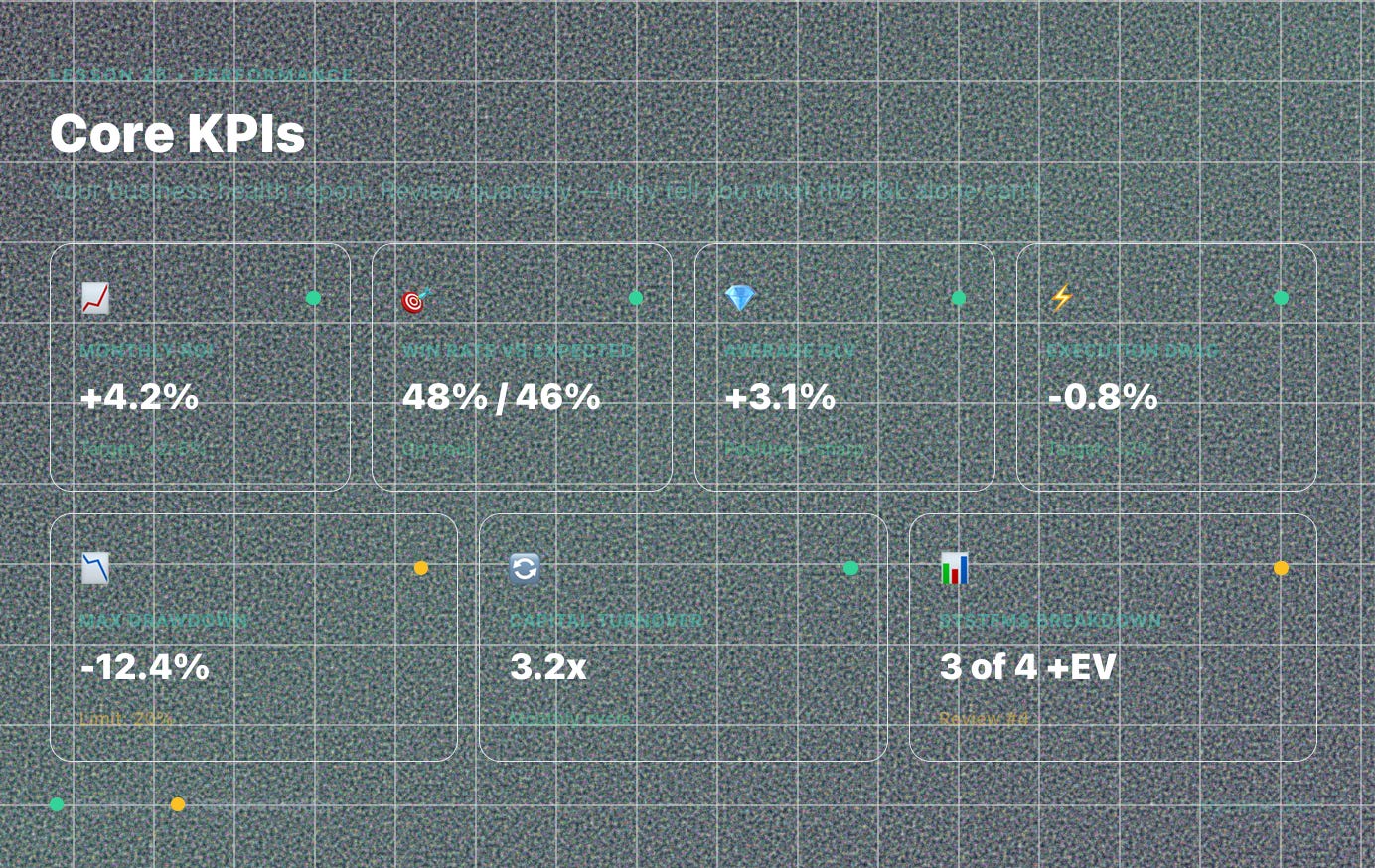
6. Performance KPIs (Key Performance Indicators)
Just like any business, you need metrics that show whether operations are healthy.
Core KPIs:
Monthly ROI (%)
Win rate vs expected win rate
Average CLV per bet
Execution drag (%)
Drawdown depth and duration
Capital turnover ratio
Systems profitability breakdown
Review KPIs quarterly. They are your business health report.
7. Data & Automation Infrastructure
A trading desk runs on clean data pipelines.
Core setup:
Database – stores all historical and live data.
Dashboard – displays live opportunities and performance.
Automation Scripts – fetch odds, trigger trades, log results.
Backup Systems – no single point of failure.
Automation reduces human fatigue. The biggest cost in high-volume environments. I know traders who burned out just from manual data entry.
8. Building Your Support Team
As scale grows, delegation becomes key.
Consider adding:
Analyst / Developer – helps build and maintain models.
Execution Assistant – monitors orders and fills.
Accountant / Compliance Advisor – manages taxes and reporting.
You don’t need a payroll. Freelance or part-time support works.
The goal is freeing your brain for strategy and innovation. Let others handle the repetitive stuff.
9. Professional Ethics & Compliance
Operating like a business also means behaving like one:
Honor data licenses and platform terms.
Comply with jurisdictional betting laws.
Keep transparent records for audits or investor relationships.
Professional integrity builds longevity.
Cut corners and you’ll lose trust with partners, brokers, or data providers. That reputation damage is permanent.
10. Building Long-Term Scalability
As your desk matures, think beyond short-term betting:
Diversify assets: invest a portion of profits in safer instruments.
Develop intellectual property: build proprietary metrics or predictive models.
Create brand equity: publish insights or manage syndicate capital.
At this stage, you’re running a trading enterprise. Not just a system.
That’s how professionals move from successful traders to business owners. Perhaps that sounds ambitious, but it’s the natural progression if you’re good at what you do.
Key Takeaways
✅ A professional operation is built on four pillars: strategy, execution, finance, and operations.
✅ Routine creates stability; review creates growth.
✅ Separate funds and maintain proper accounting.
✅ Track KPIs like any business.
✅ Automate to preserve energy and consistency.
✅ Ethics, structure, and scalability define the professional tier.
Next Lesson
📘 Lesson 26 – Developing a Betting Company Mindset: From Solo Trader to Professional Enterprise
We’ll look at how to treat your operation as an actual company. Covering brand identity, partnerships, capital funding, and how professionals turn trading edges into scalable enterprises.