


Betting Knowledge Series — Lesson 3
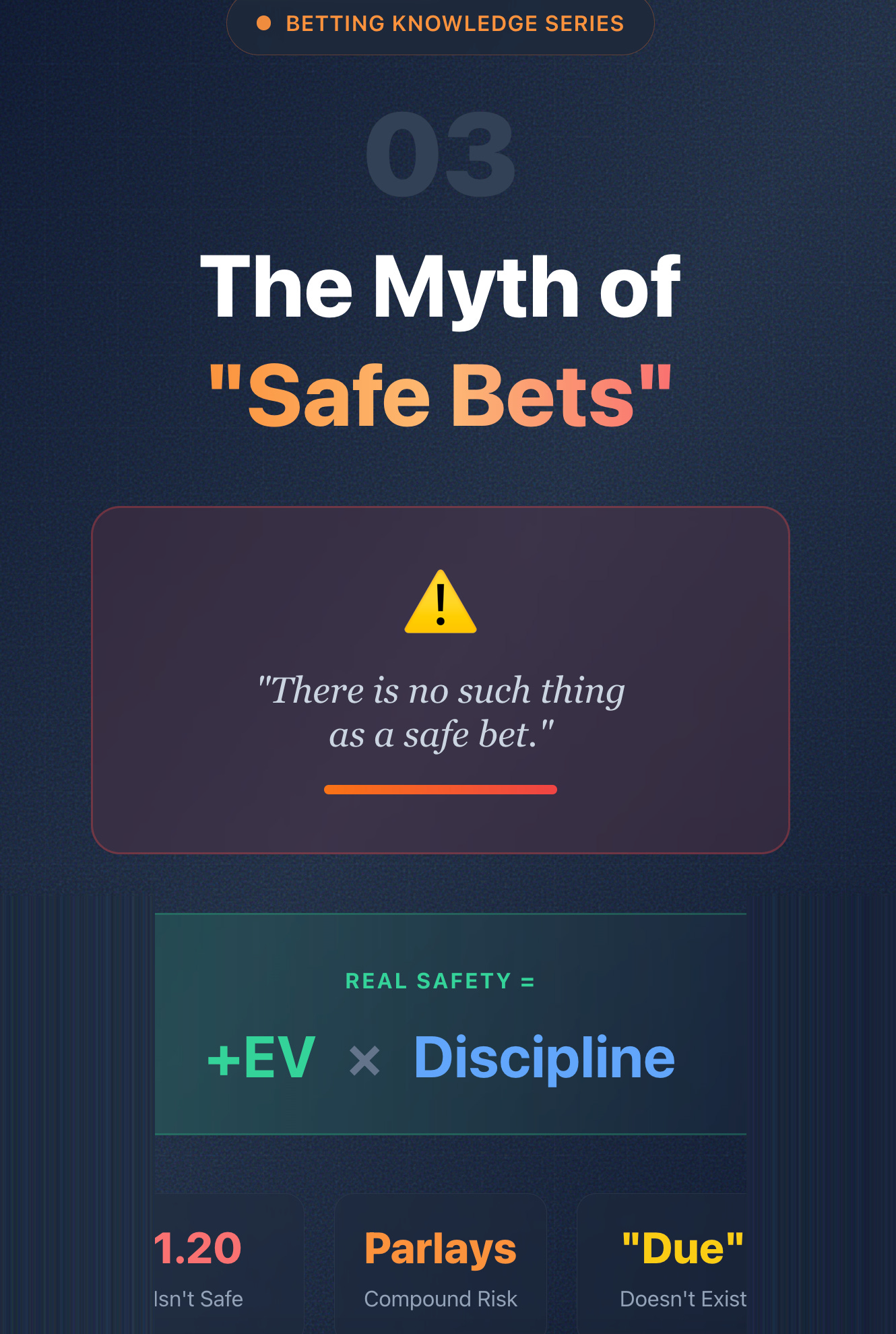
The Myth of “Safe Bets” and Managing Real Risk
Introduction
If Lesson 1 taught you that betting is about value, and Lesson 2 showed you how to calculate that value mathematically, Lesson 3 teaches you how to protect it from illusion.
Every bettor (even sharp ones) craves certainty.
We all want the “guaranteed” winner, the “safe” double, or the “can’t miss” favourite.
The truth is simple: there is no such thing as a safe bet.
There are only bets where the risk is better managed and more fairly priced.
To think like a professional, you must stop chasing safety and start managing probability. Easier to say than to actually do when your bankroll is on the line.
1. The Illusion of Safety
Bookmakers love when bettors chase safety.
That’s why you see endless marketing around “bankers,” “accumulators,” or “risk-free” bets.
They’re not risk-free. They’re margin-heavy comfort blankets.
Low odds don’t mean low risk. They mean low reward for potentially the same risk.
Let’s prove it.
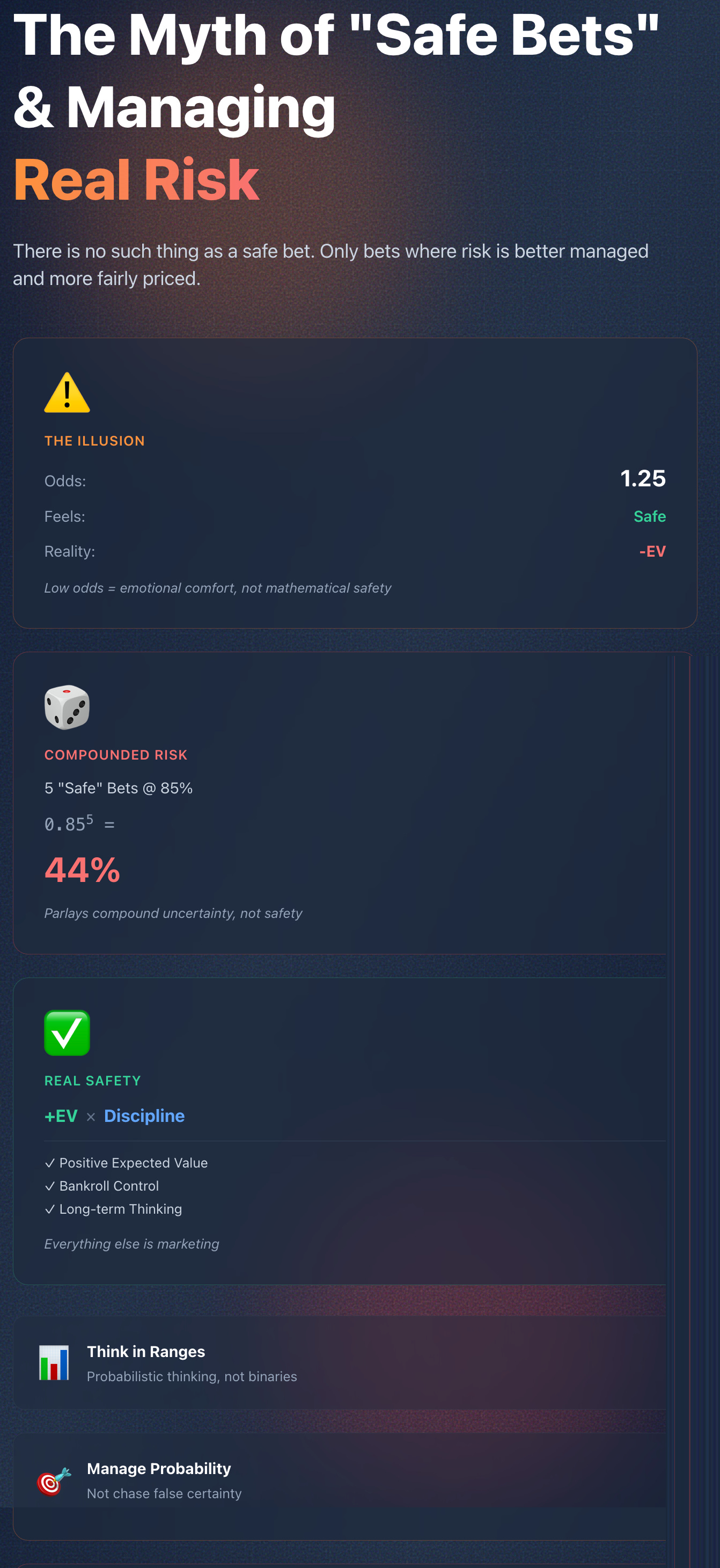
You back a “safe” favourite at 1.25 (80% implied probability).
Your model suggests their true chance is 74%.
That’s negative expected value.
You’re risking £100 to win £25 on a price that should be nearer 1.35. Long-term, that’s a terrible trade, even though it feels comfortable.
Low odds give you emotional comfort, not mathematical safety.
2. The Hidden Risk in Short Odds
When you lose at 5.00 (20% implied), you expect it. You took a risk.
But when you lose at 1.20 (83% implied), it feels wrong, like the universe cheated you.
That emotion blinds most bettors.
They assume favourites “should” win, yet historically, even heavy favourites lose around 10–15% of the time.
The lesson:
Odds can shrink, but risk never disappears.
It just becomes harder to see. Every bet, no matter the price, contains uncertainty.
Your job is to price that uncertainty, not ignore it.

3. The Danger of “Sure Things” and Parlays
Accumulators and parlays sell the fantasy of low-risk, high-reward.
“Five safe selections = one easy win.”
In reality, you’re compounding margin and error.
Each leg of a parlay multiplies implied risk:
If each selection has an 85% chance of winning:
0.85^5 = 0.44
Your “five banker” bet only has a 44% chance of success.
And because each leg carries bookmaker margin, the true probability might be even lower. What felt like safety is actually volatility wrapped in confidence.
4. The Psychology of False Security
Humans crave certainty.
Our brains are wired to overvalue short-term comfort over long-term logic.
When you back 1.20 shots, your dopamine system rewards you every time they win (which is often), but slowly drains your bankroll when variance finally catches up.
That’s why most punters burn out not with one big loss, but with hundreds of small ones that “felt fine” at the time.
Professionals fight this by reframing success:
They don’t measure safety by how often they win, but by how well they controlled probability and edge.
5. Why Past Results Don’t Predict Future Ones
Probability is relentless.
It doesn’t care about your win streak, your gut feeling, or your need for a break.
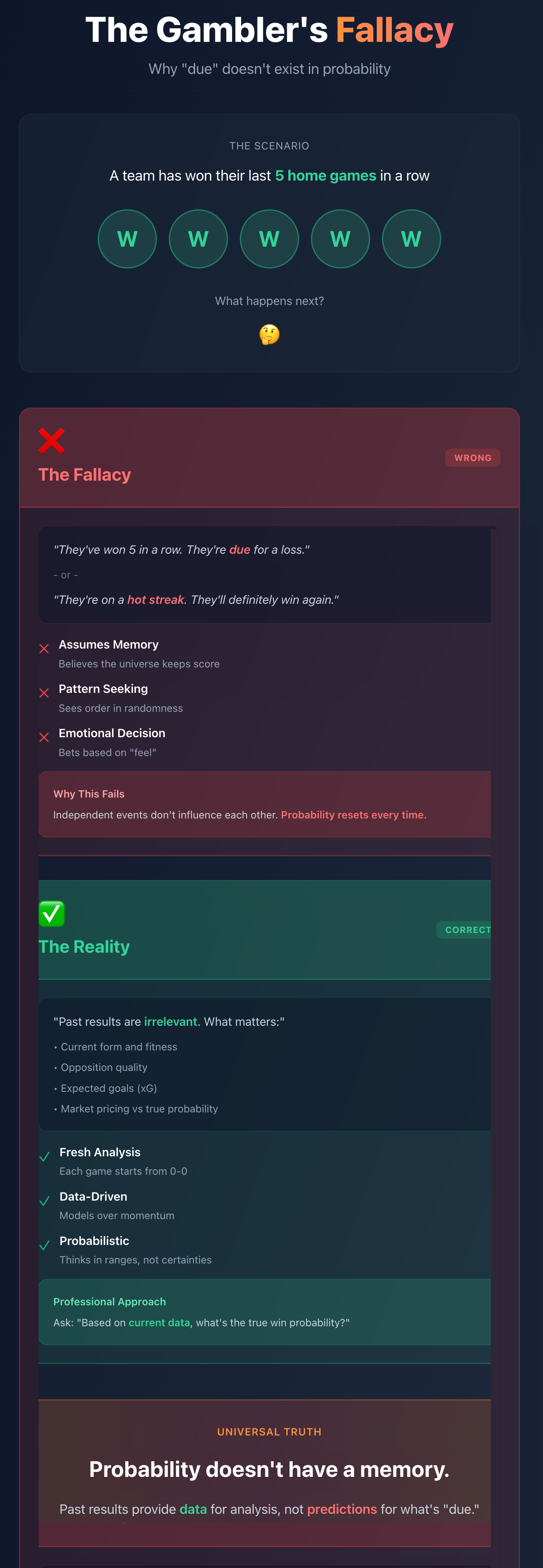
Even after a team wins 10 home games in a row, their next match still starts from 0–0 with fresh variables. Their underlying probabilities reset.
Believing that something is “due” (a goal, a win, a draw) is another illusion.
This is called the Gambler’s Fallacy: assuming past events affect future independent ones.
The universe doesn’t keep score. Only your data does.
6. Thinking in Probabilistic Ranges
Professionals don’t think in binaries (win/lose, safe/unsafe).
They think in ranges:
“How often will this event occur out of 100 trials?”
When you start framing markets this way, you become immune to single results.
You expect your 1.80 value bets to win 56% of the time.
If you lose 4 in a row, it’s variance, not a broken system.
If after 200 trades you’re still near 56%, your model is working.
Probability is a long game. The sooner you detach from individual results, the calmer and more profitable you become.
7. The Only Real Safety: Edge and Discipline
There are only two “safety nets” that actually exist in betting:
Positive Expected Value (+EV): You consistently find prices better than the true probability.
Discipline and Staking Control: You stake small enough that losing runs can’t break your bank.
That’s it.
Everything else (favourites, parlays, tips, intuition) is theatre.
Safety = mathematics + risk control, not emotions + optimism.
8. The Professional Mindset Shift
The pros understand one uncomfortable truth:
They will lose a lot, but still win overall.
If you can’t handle short-term losses, you’ll never experience long-term growth. They’re not signs of failure. They’re evidence that you’re letting probability play out.
Professionals don’t need certainty. They need repetition.
By placing hundreds of +EV bets with controlled staking, they let the math do the work.
That’s the mindset that turns theory into profit, though it takes longer than most people think to truly internalize.
9. Practical Framework: Reframing “Safety”
Next time you’re tempted by a “safe” bet, ask these five questions:
What’s the implied probability?
What’s my estimated true probability?
Is there a measurable edge?
What happens to my bankroll if this loses?
Does this decision make sense in 100 trials, not just one?
If you can’t confidently answer all five, step away. You’re buying emotional comfort, not long-term value.
10. The Real Safety Equation
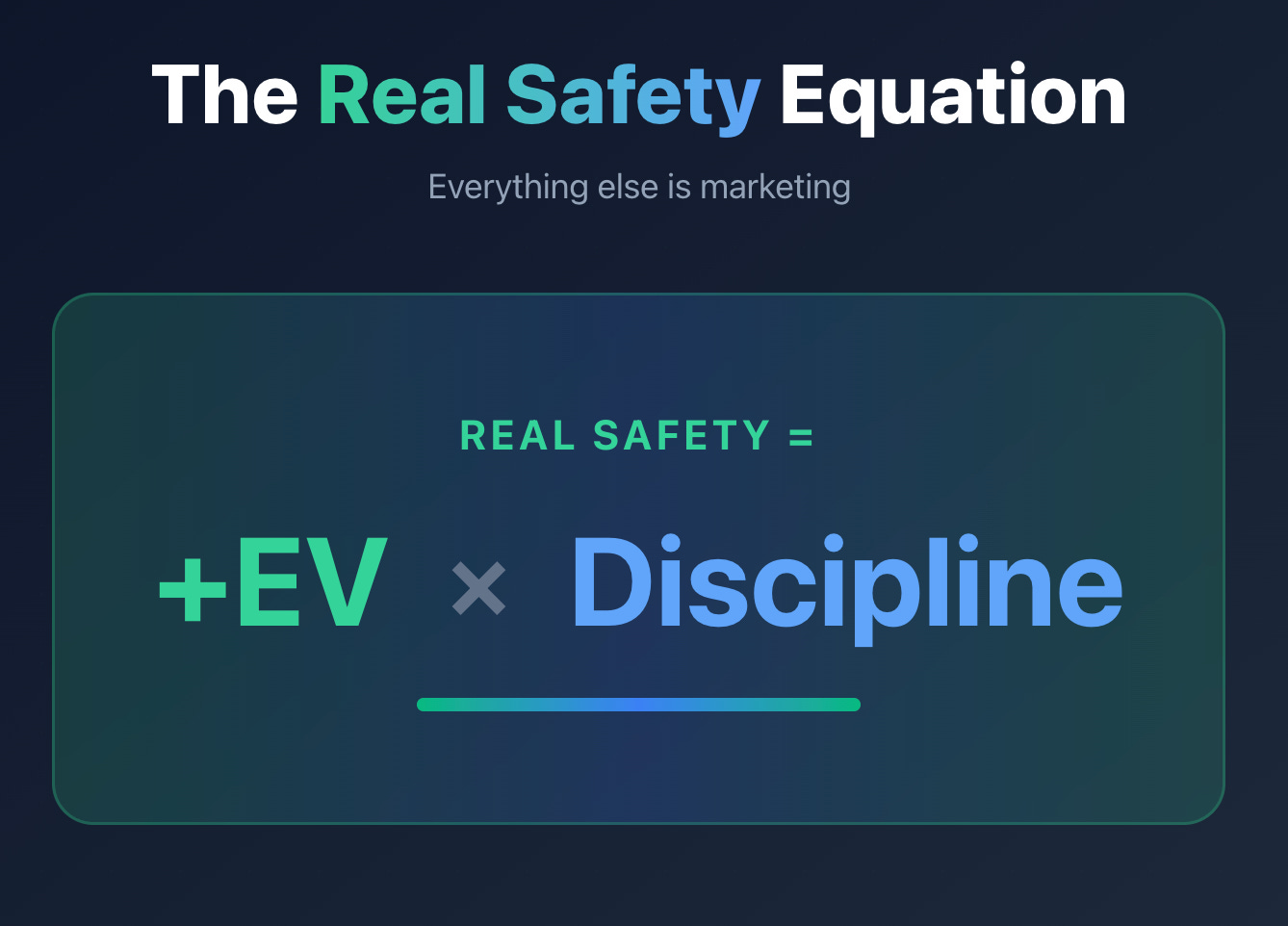
To rewire your mindset completely, remember this formula:
Safety = (Positive EV) × (Bankroll Discipline)
Everything else is marketing.
Real safety is knowing you can survive losing streaks and exploit mispriced markets. Once you internalize this, you’ll stop chasing guaranteed winners and start building a guaranteed process.
Key Takeaways
✅ “Safe bets” don’t exist. Only well-managed risk.
✅ Low odds provide comfort, not protection.
✅ Parlays compound uncertainty, not safety.
✅ Probability resets every match. Variance is constant.
✅ The only safety is positive EV + staking discipline.
✅ Think in long-term frequencies, not single outcomes.
Next Lesson
📘 Lesson 4: Bankroll Psychology — The Silent Killer of Good Strategies
We’ll explore why even intelligent bettors destroy profitable systems with poor staking discipline, emotional tilt, and inconsistent exposure, and how to build the mindset of a disciplined trader who plays the long game.