


Betting Knowledge Series — Lesson 4
Bankroll Psychology: The Silent Killer of Good Strategies
Introduction
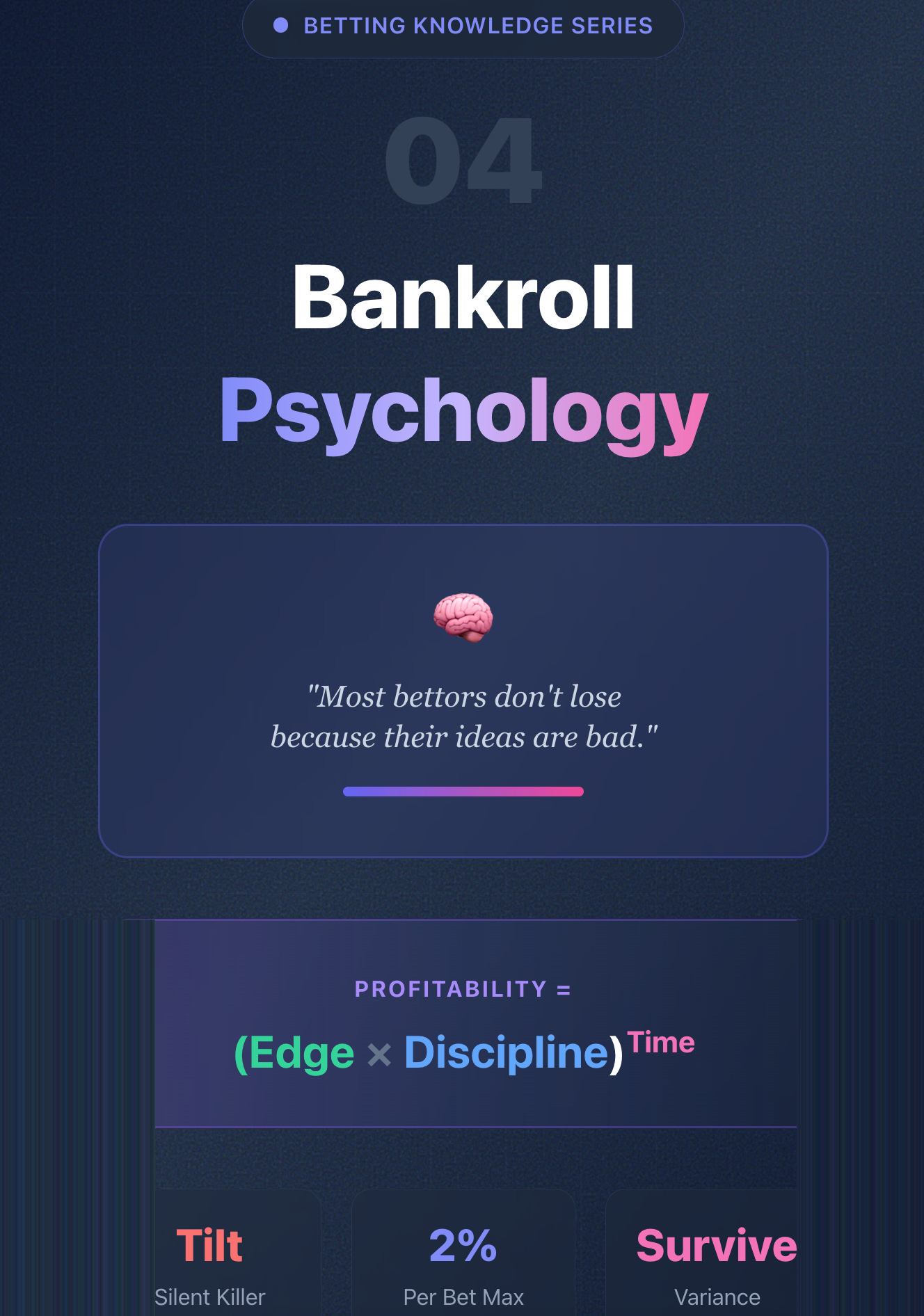
You can understand value, calculate expected return, and find good prices, but none of it matters if your mind and money aren’t aligned.
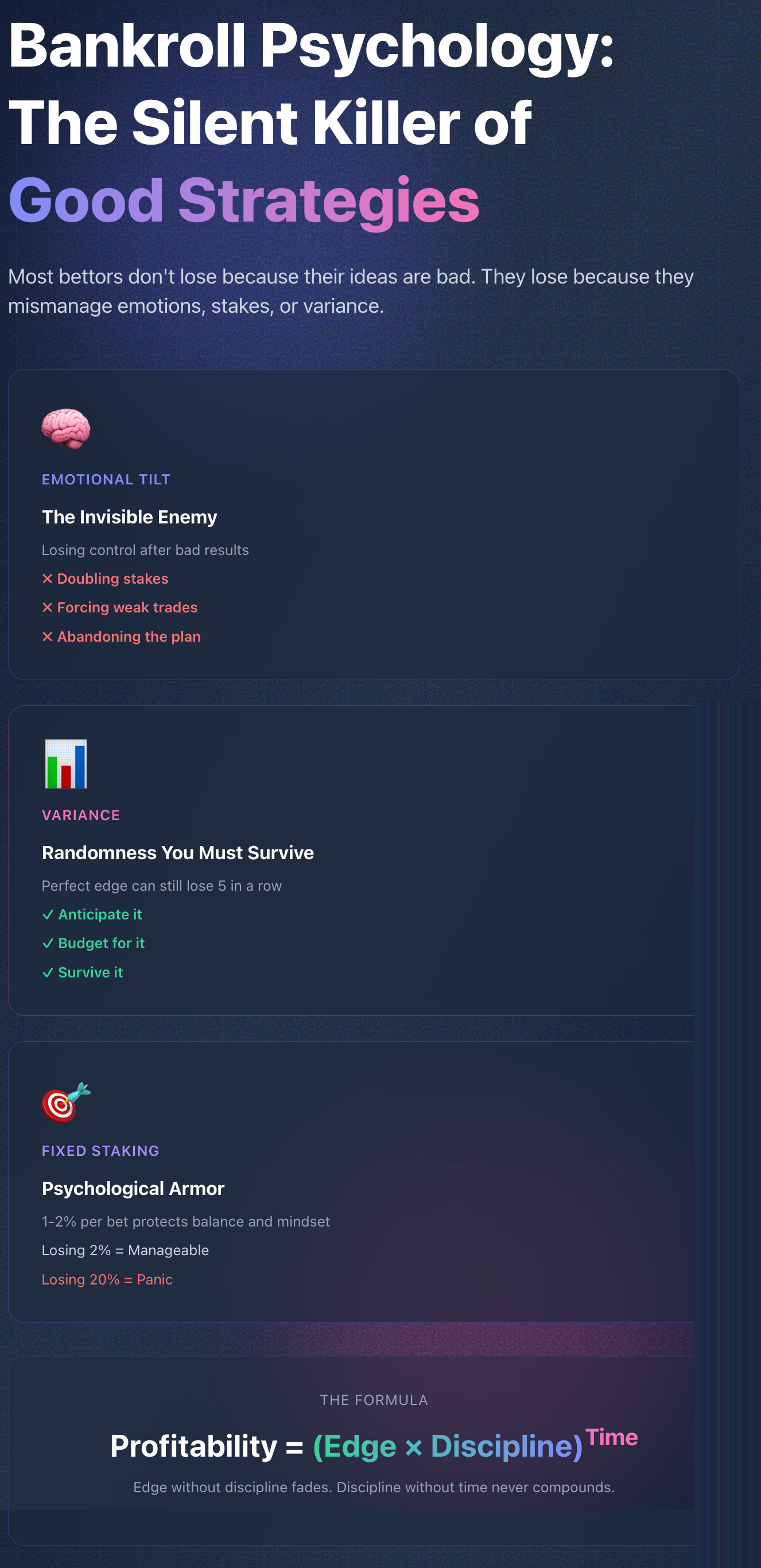
Most bettors don’t lose because their ideas are bad.
They lose because they mismanage emotions, stakes, or variance.
This lesson explains why bankroll psychology is the real battle in betting, and how mastering it turns ordinary traders into professionals.
1. The Bankroll Is Your Business Capital
Think of your bankroll as the fuel that powers your engine.
When you burn too much, too fast, you can’t finish the race.
Amateurs see their balance as gambling money. Professionals treat it like business inventory.
Your bankroll is not there to “win big.” It’s there to generate steady returns from controlled exposure.
That shift in mindset alone separates entertainment from enterprise. Sounds simple, but most people never make the switch.
2. Emotional Tilt: The Invisible Enemy
“Tilt” is a term borrowed from poker.
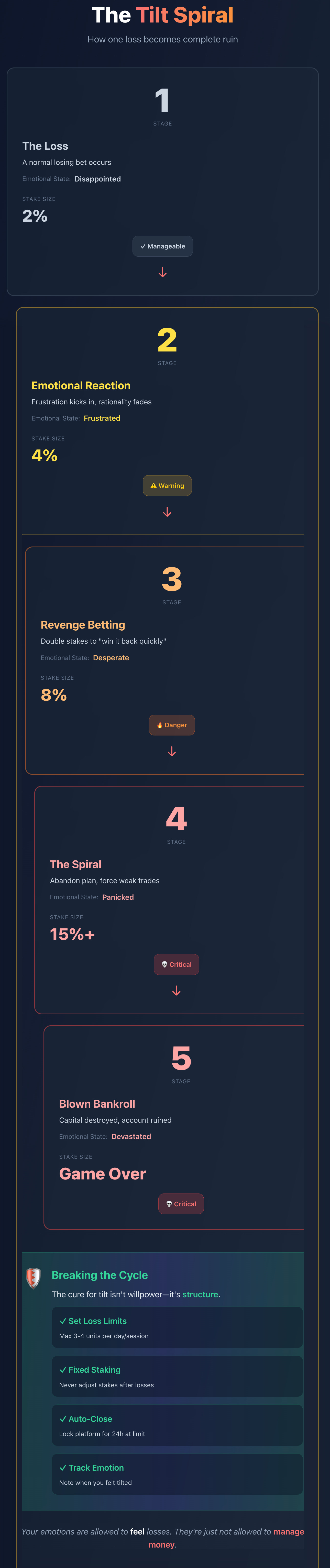
It means losing control after a bad result and making irrational decisions to “win it back.”
Examples of tilt in betting:
Doubling stake size after a loss.
Forcing trades on weak fixtures to recover quickly.
Abandoning your plan mid-session because “you deserve one.”
Tilt isn’t about anger. It’s about impatience.
The cure is structure: if your system limits daily losses to 3–4 units, you can’t spiral.
Rule: Your emotions are allowed to feel losses. They’re just not allowed to manage money.
3. Why Variance Breaks the Undisciplined
Variance is randomness. The coin-flip streaks that make short-term results unpredictable.
A trader can lose five bets in a row even with perfect logic and +EV edge.
Without discipline, that streak triggers panic or overconfidence. Both are fatal.
Professionals anticipate variance. They budget for it.
Their stake size and risk limits already assume losing runs will happen.
The question isn’t “Will I have bad runs?” It’s “Am I built to survive them?”
4. Staking as Psychological Armor
Fixed-percentage staking (1–2% of bank per bet) protects capital and mindset.
Why? Because your emotional brain interprets losses in relative terms, not absolute ones.
Losing 2% feels manageable. Losing 20% triggers fight-or-flight.
If you keep every decision inside a narrow emotional band, you stay rational long enough for mathematics to do its work.
Professional calm = consistent stake sizing.
5. Bankroll Growth Is a Marathon, Not a Jackpot
Most bettors think exponential growth means winning bigger.
In reality, it means not shrinking during drawdowns.
When you avoid blow-ups, you let compounding quietly work.
A 5% monthly return may sound modest, but sustained for 12 months it grows a bank by over 80%.
The impatient bettor chasing 50% weeks rarely survives one bad month. I’ve watched it happen more times than I care to count.
Consistency compounds. Chaos collapses.
6. The Illusion of the “Hot Hand”
After a few wins, confidence morphs into arrogance.
You raise stakes, relax filters, and assume you’re “in form.”
That’s when the market humbles you.
Winning streaks and losing streaks both tempt emotional overreaction.
The cure is to treat every bet as independent, just another sample in a long series of probability trials.
Win rate doesn’t define success. Adherence to edge and process does.
7. The Professional Detachment Technique
To stay objective, detach identity from outcome.
You are not your last result. You are the average of your last 500 decisions.
Practical ways to maintain detachment:
Use automation or pre-set staking so emotion can’t interfere.
Track results weekly, not daily.
Close platforms for 24 hours after hitting loss limits.
The less time you spend reacting, the more time you spend analyzing. Simple math, really.
8. Build Rituals, Not Reactions
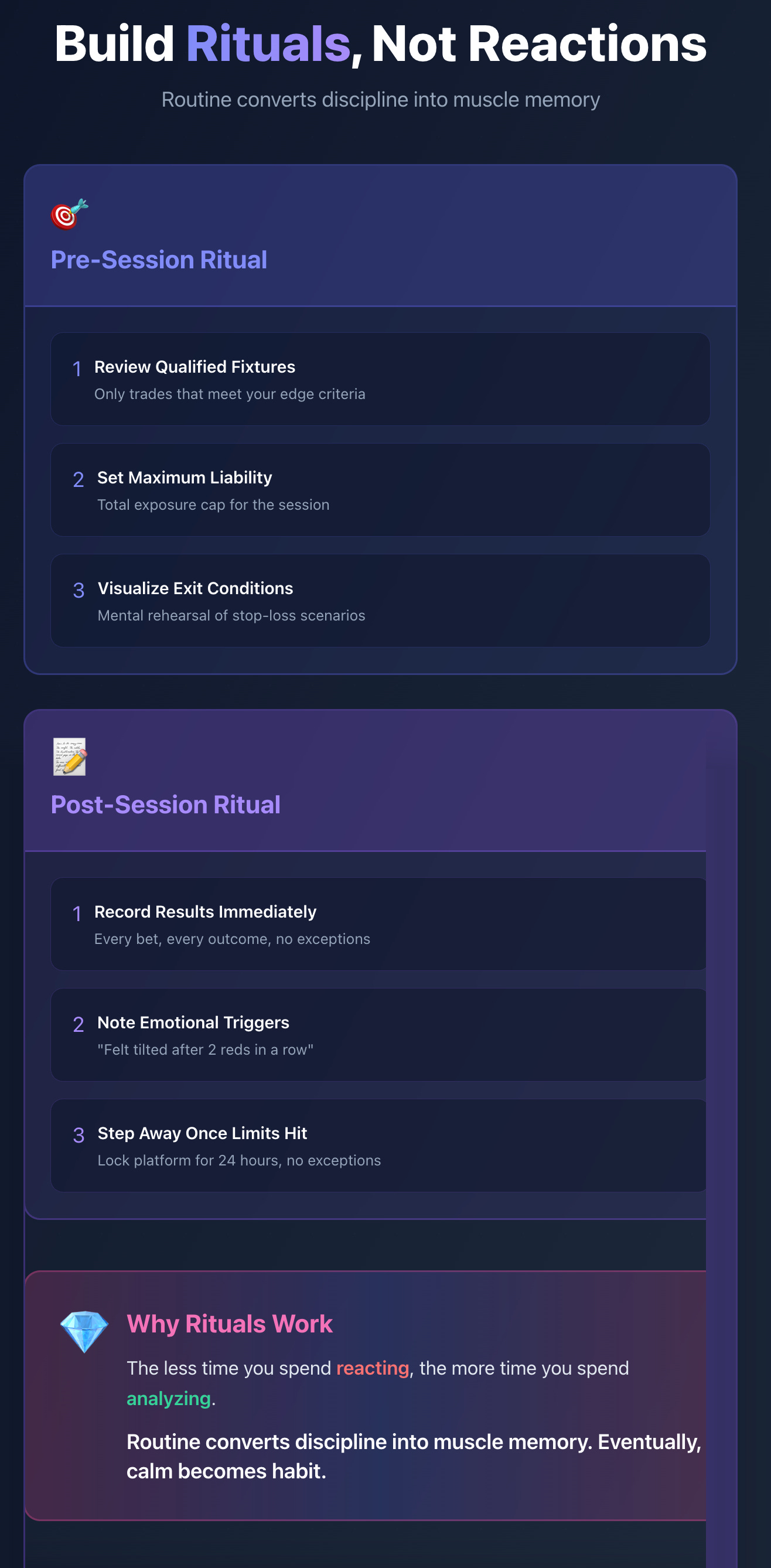
Professionals run routines that create automatic discipline:
Pre-session:
Review qualified fixtures.
Set maximum liability.
Visualize exit conditions.
Post-session:
Record results immediately.
Note emotional triggers (”felt tilted after 2 reds”).
Step away once limits hit.
Routine converts discipline into muscle memory. Eventually, calm becomes habit.
9. Measuring Psychological Edge
You can measure emotional control just like expected value.
Key indicators:
You rarely adjust stakes impulsively.
You never increase exposure after losses.
You review data before reacting to variance.
Your drawdowns are shallow and recover predictably.
If those metrics hold, your psychological EV is positive. You’re mentally profitable even before money is counted.
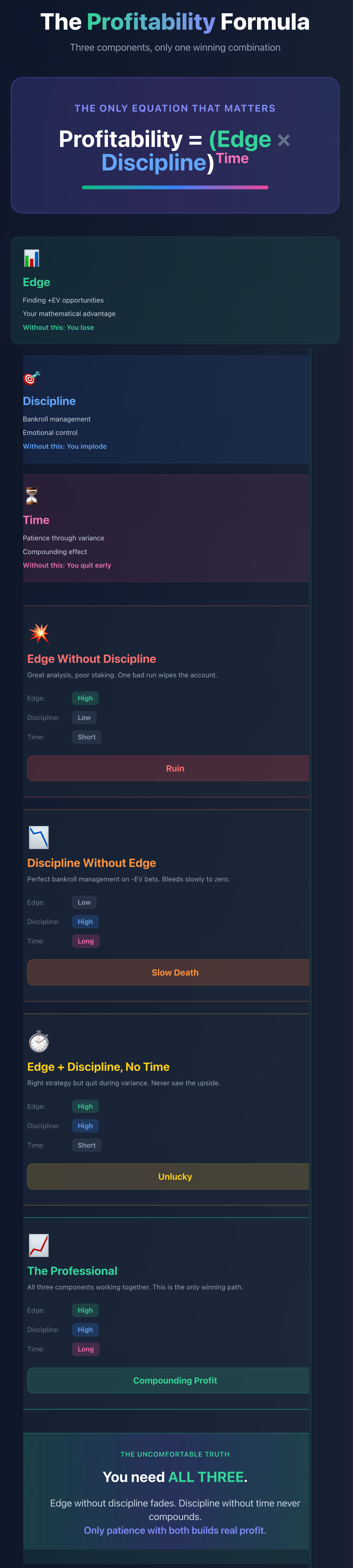
10. The Bankroll Mindset Formula
Remember this equation:
Profitability = (Edge × Discipline)^Time
Edge without discipline fades. Discipline without time never compounds.
Only both, sustained patiently, build real profit.
Key Takeaways
✅ Your bankroll is business capital, not gambling money.
✅ Emotional tilt destroys more banks than bad analysis.
✅ Anticipate variance. Design around it.
✅ Fixed-percentage staking protects balance and psychology.
✅ Detachment and routine create professional calm.
✅ True growth comes from survival, not speed.
Next Lesson
📘 Lesson 5: Understanding Variance, Downswings & Recovery
We’ll break down how variance works statistically, why losing streaks happen even with perfect edge, and how to build recovery protocols that keep your bank (and your confidence) intact.