



There is a version of accumulator betting that most people are doing, and a version that works. They look almost identical from the outside. The difference is entirely in the foundation. How the bets are created.
Most accumulators are built the same way. You identify the games you fancy, check that the combined odds look appealing, and place the bet. If your selections are good - if you genuinely know football, follow the form, understand the teams - you would expect to profit over time. Better information should produce better results. It stands to reason.
In practice, it often does not. And the reason has nothing to do with the quality of the selections.
The foundation problem
Every accumulator sits on a mathematical foundation that most bettors never examine. That foundation is the bookmaker’s margin — the overround built into every price that ensures the implied probabilities across any given market adds up to more than 100%.
A bettor with genuinely good information and disciplined selection can identify bets where the true probability of an outcome exceeds what the bookmaker’s price implies — and over a large enough sample, those bets return a profit.
The problem with accumulators is that this challenge does not stay constant as you add legs. It compounds.
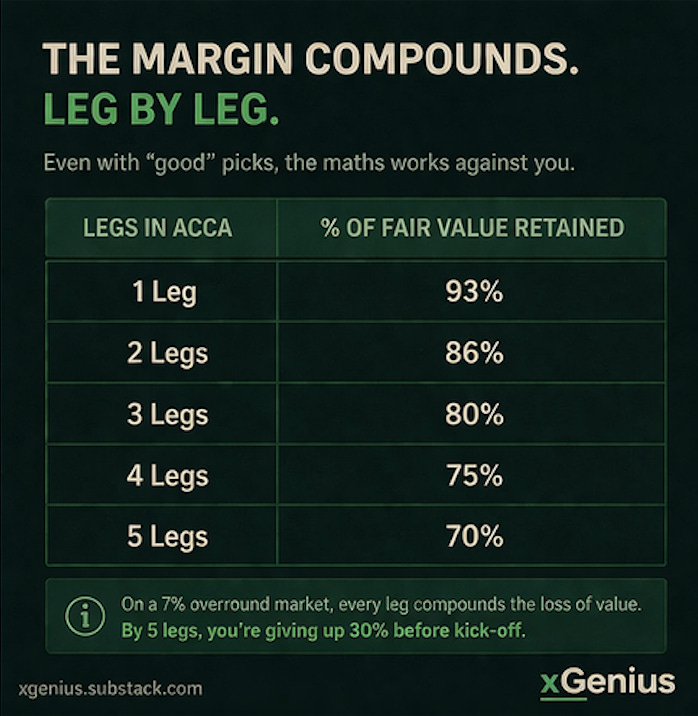
Every leg you add multiplies the existing margin works against you. The mathematics are straightforward: if each leg carries an overround of approximately 7%, a three-leg accumulator leaves you operating with a structural disadvantage of around 20% before any individual selection is assessed. A five-leg accumulator pushes that figure towards 30%.
That is the gap your selections need to overcome just to reach break-even. Not to profit. Simply just to avoid losing.
Why better picks are not enough
This is the part most bettors find uncomfortable.
The natural response to consistent accumulator losses is to blame bad luck or try to improve the selections - more research, better sources, tighter criteria for what counts as a good pick. And improving selections is genuinely useful. But it addresses the wrong problem if the foundation is broken.
A bettor placing five-leg accumulators with no regard for the compounding margin is trying to solve a structural problem with better judgement. It occasionally works. Over a large enough sample, it does not.
The bettors who build consistent long-term returns from accumulators do something different. They start with the margin — the overround on each potential leg — and measure their selections against it. Not “do I fancy this game” but “do I fancy this game enough to overcome the structural disadvantage this leg adds to the combination.”
That is a harder filter. Most legs do not clear it. Which is exactly the point.

What a sound accumulator process actually looks like
It starts before the selections.
Before any game is assessed, a positive-expectation accumulator requires a clear answer to one question: does this leg carry enough genuine edge to justify its inclusion, accounting for the compounding margin it adds? That means having a view on the true probability of the outcome — independent of the bookmaker’s implied probability — and measuring the odds on offer against it.
Legs that clear the threshold go in. Legs that do not get cut, regardless of how confident the assessment is, how good the team looks, or how much the combined odds improve by including them.
This is not a complicated calculation. But it is a different starting point from the one most bettors use - and that difference is what separates a process from a series of informed guesses.
It also means placing fewer accumulators, with fewer legs, than most bettors are comfortable with. The filter is restrictive by design. A week where only two legs genuinely clear the threshold is a week where the accumulator has two legs — not a week where you find a third game to make the odds more “interesting”.
Discipline on leg count is one of the most consistently overlooked components of profitable accumulator betting. It is also one of the most directly within a bettor’s control.

The bottom line
Better selections improve your chances. They do not fix a broken structure. The foundation of any accumulator — the compounding margin across every leg — needs to be understood and accounted for before the selections are even assessed.
The bettors who get this right are not necessarily better at reading football than everyone else. They are asking a different question before they place the bet.