


Betting Knowledge Series — Lesson 8
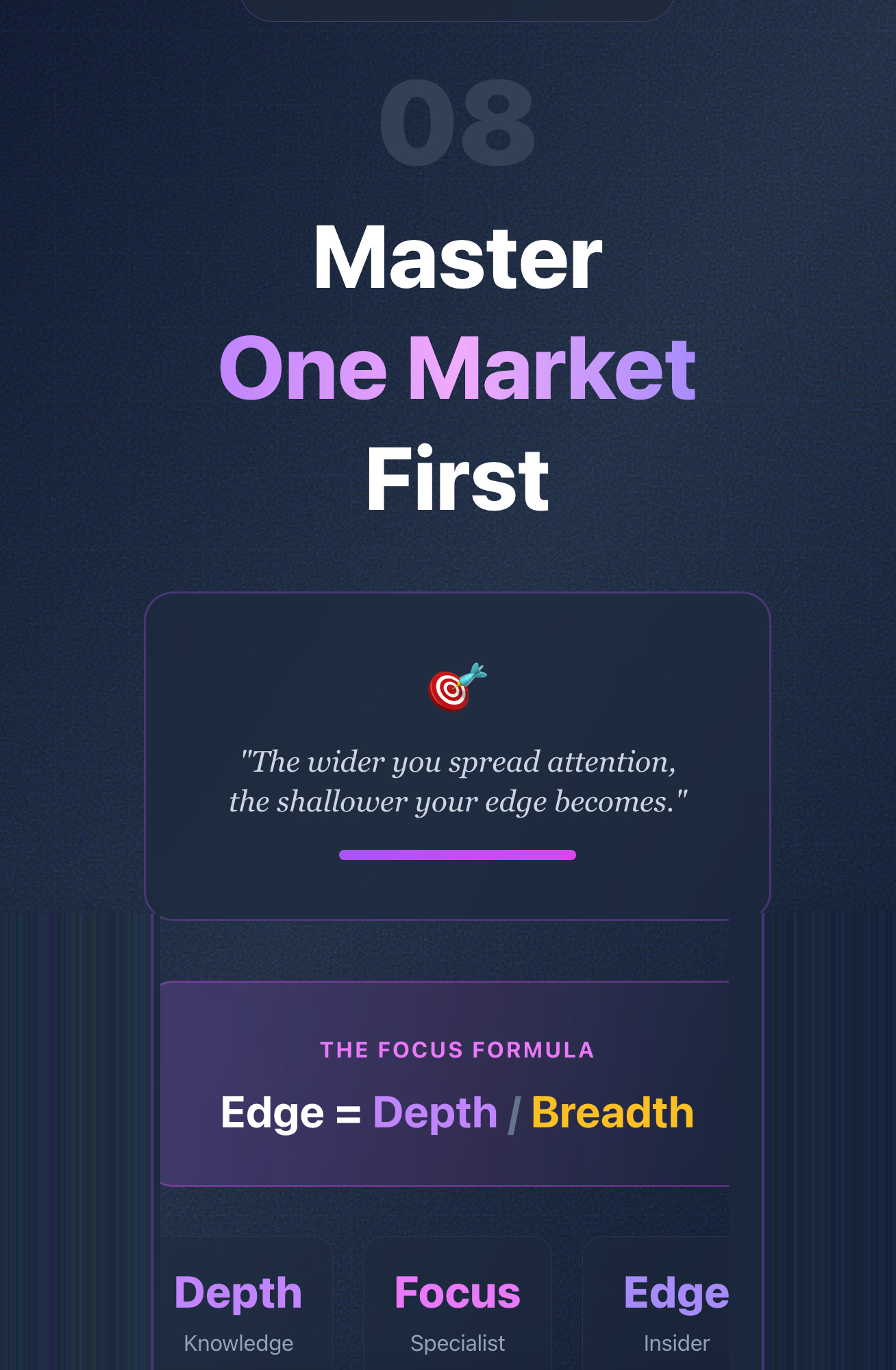
Why You Should Master One Market First
Introduction
It’s natural to believe that more markets mean more opportunity.
If you analyse 10 leagues, surely you’ll find more value than someone who focuses on just one, right?
In reality, the opposite is true.
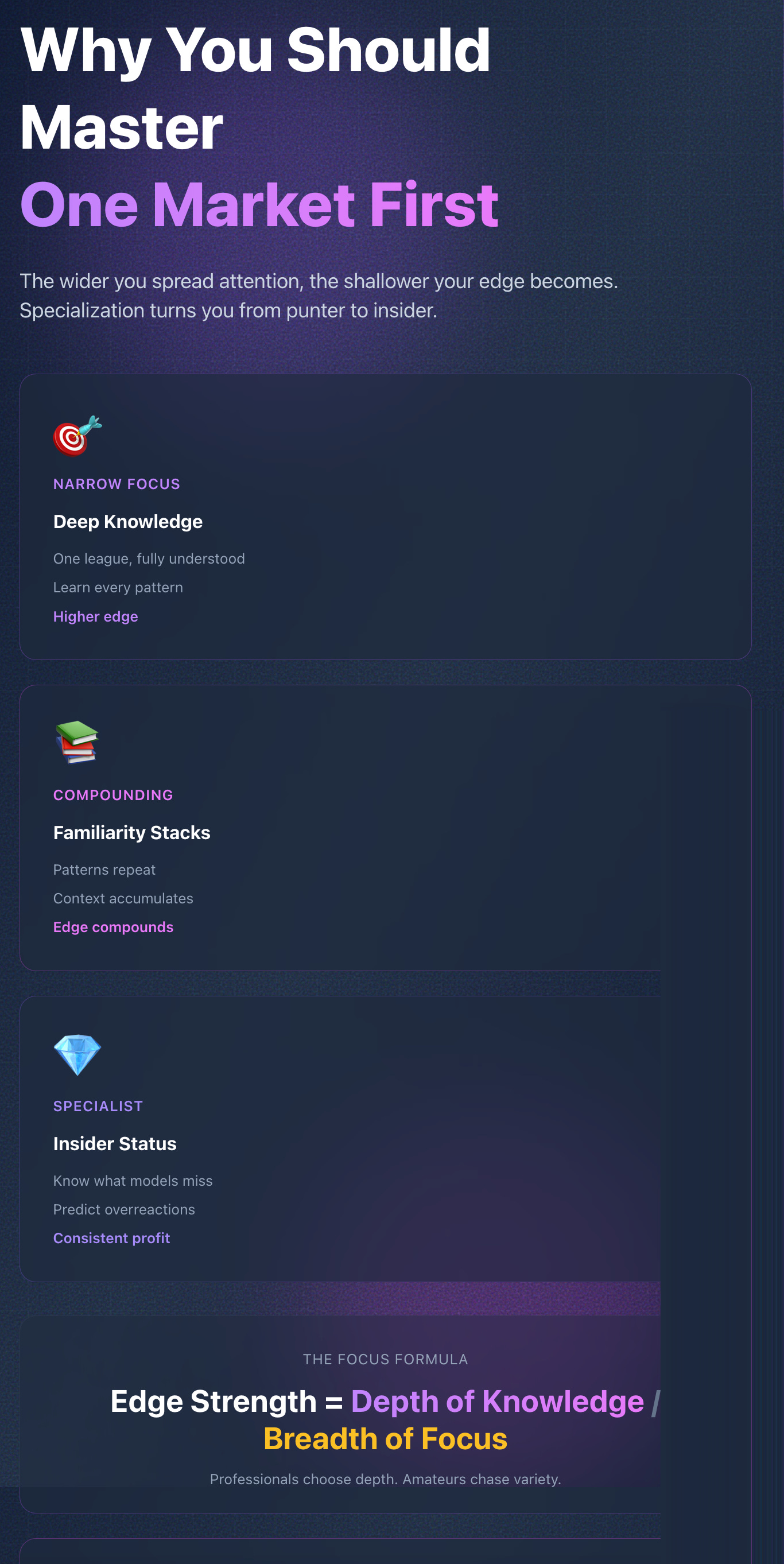
The wider you spread your attention, the shallower your edge becomes.
Specialisation turns you from a general punter into a market insider, and insiders consistently beat inefficiencies.
This lesson shows why mastery of one area pays more than surface knowledge of many.
1. Why Focus Beats Variety
Every betting market is a unique ecosystem with its own pricing structure, liquidity, data quality, and behavioural bias.
The Premier League doesn’t behave like the Danish Superliga. Player-card markets move differently than goal lines.
When you hop between them, you’re constantly relearning context.
Specialists thrive because they know:
How a particular market reacts to news.
When prices move.
Which data points actually matter.
Where bookmakers or models consistently misprice probability.
You can’t notice those patterns when you’re scanning 40 matches a day.
Professional mantra: Narrow focus → Deep knowledge → Higher edge.
2. The Depth Advantage
Bookmakers use automation, not intuition.
Their models crunch global data, but they still rely on assumptions.
When you specialise, you learn the specific situations that those models miss. The human patterns inside the algorithmic averages.
For example:
A trader specialising in Spanish La Liga might know which teams maintain tempo after scoring first (impacting in-play goal odds).
Another focusing on the Asian handicap might spot how early-week price drifts often overcorrect.
That kind of insight isn’t visible in raw data. Only through repetition within one environment.
3. Information Quality Over Quantity
Public data is everywhere, but not all data is equal.
Lower leagues may have inconsistent xG tracking. Smaller markets might lack liquidity.
When you choose one focus area, you build cleaner datasets, refine filters, and verify accuracy.
It’s better to have 10,000 data points from one league than 100,000 random stats from everywhere else.
Quality creates confidence. Confidence creates discipline.
4. The Compounding Effect of Familiarity
Every trade you take teaches you something, but only if that lesson is repeatable.
If you’re constantly switching contexts, yesterday’s learning doesn’t apply today.
In a single league or market:
You learn team tendencies.
You feel seasonal rhythm (winter fatigue, cup congestion, etc.).
You anticipate market overreactions.
Those micro-patterns stack like compound interest.
What feels small in week 1 becomes instinctive precision by week 30. I think that’s where the real edge lives.
5. The Myth of Diversification
In investing, diversification spreads risk.
In betting, it spreads attention, and attention is your most limited resource.
Diversification makes sense once you’ve mastered one market and want to scale.
At the start, it’s dilution.
The best traders build edge depth first, then replicate the model elsewhere after proving consistent ROI. Not before.
6. The Specialist’s Toolkit
When you commit to mastering one domain, you invest in better tools:
Custom spreadsheets tailored to that market’s data points.
Focused watchlists.
Historical trend libraries.
Automated alerts based on market movement.
Instead of tracking everything poorly, you track one thing brilliantly.
That’s how pros build repeatable systems.
7. Case Study: The League Specialist
Imagine two traders:
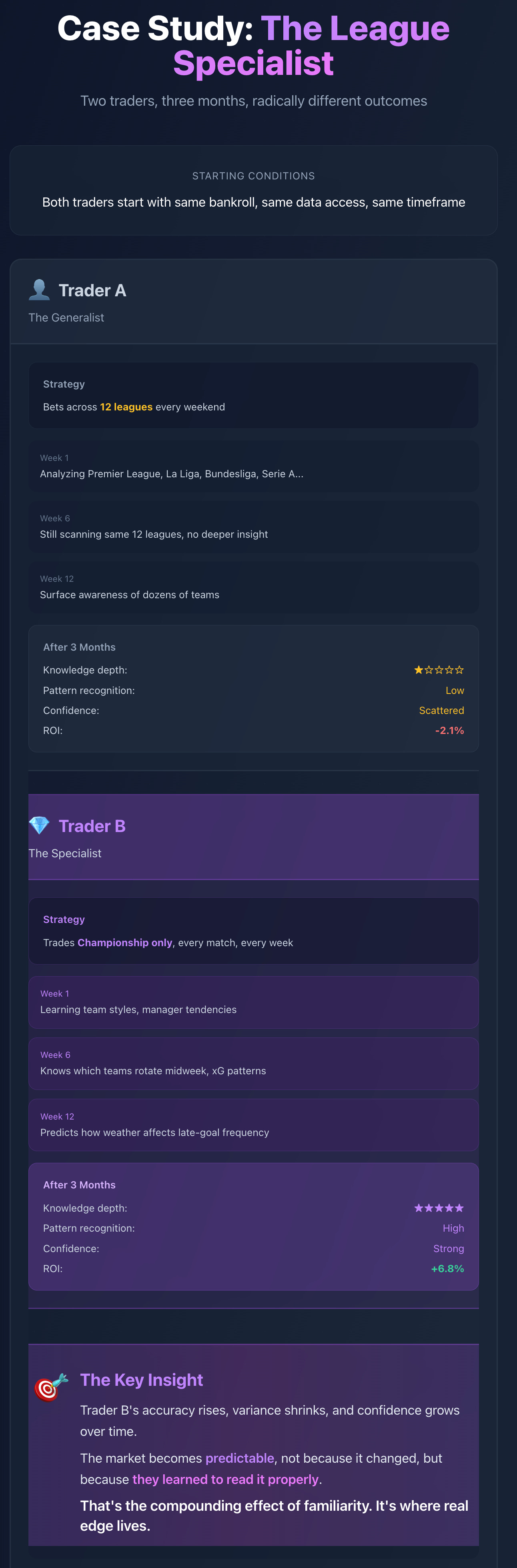
Trader A: Bets across 12 leagues every weekend.
Trader B: Trades only the Championship, every match, every week.
After three months:
Trader A has surface-level awareness of dozens of teams.
Trader B knows which managers rotate midweek, which teams’ xG spikes after 30 minutes, and how weather affects late-goal frequency.
Trader B’s accuracy rises, variance shrinks, and confidence grows.
The market becomes predictable, not because it changed, but because they learned to read it properly.
8. How to Choose Your Focus Area
Ask yourself four questions:
Interest: Which leagues or markets do you genuinely enjoy analysing?
Data: Where is high-quality data available (xG, shots, odds history)?
Liquidity: Can you get stakes matched easily without distorting price?
Volatility: Does the market move enough to create opportunity?
Pick the overlap. The sweet spot between curiosity and opportunity.
9. When to Expand
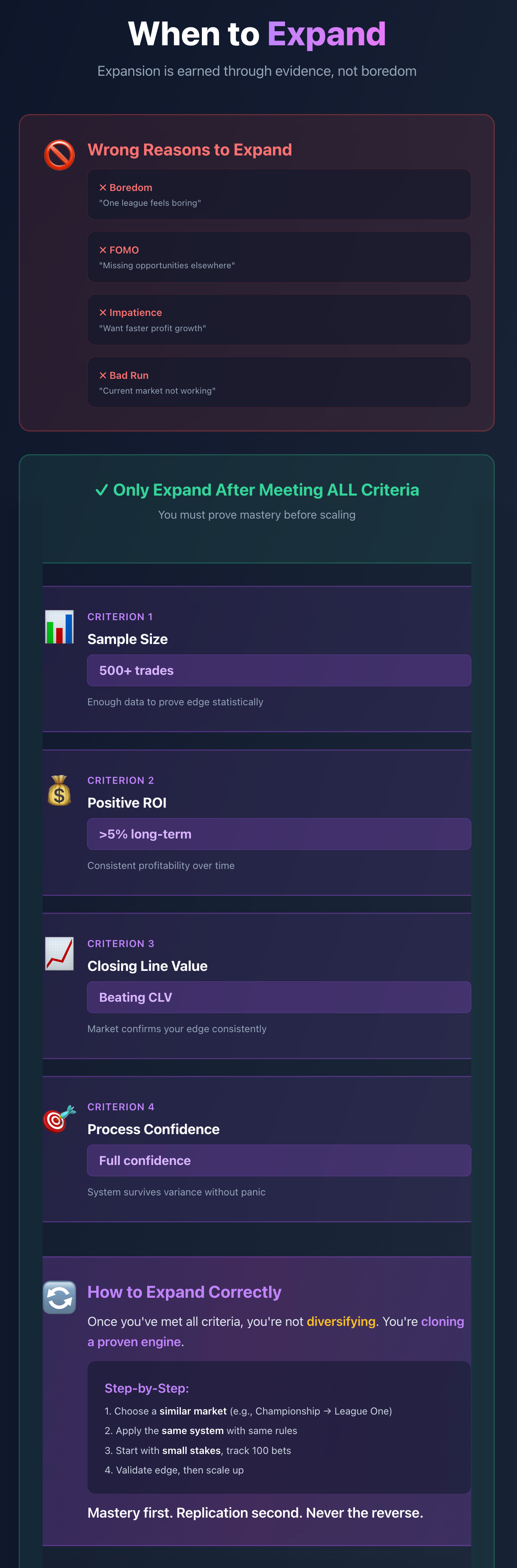
Expansion is earned through evidence, not boredom.
Only scale after you’ve met these criteria:
At least 500 trades in your core market.
Positive long-term ROI (>5%).
Beating the closing line consistently.
Full confidence in your process under variance.
Then, and only then, replicate your model in a similar market.
You’re not diversifying. You’re cloning a proven engine.
10. The Focus Formula
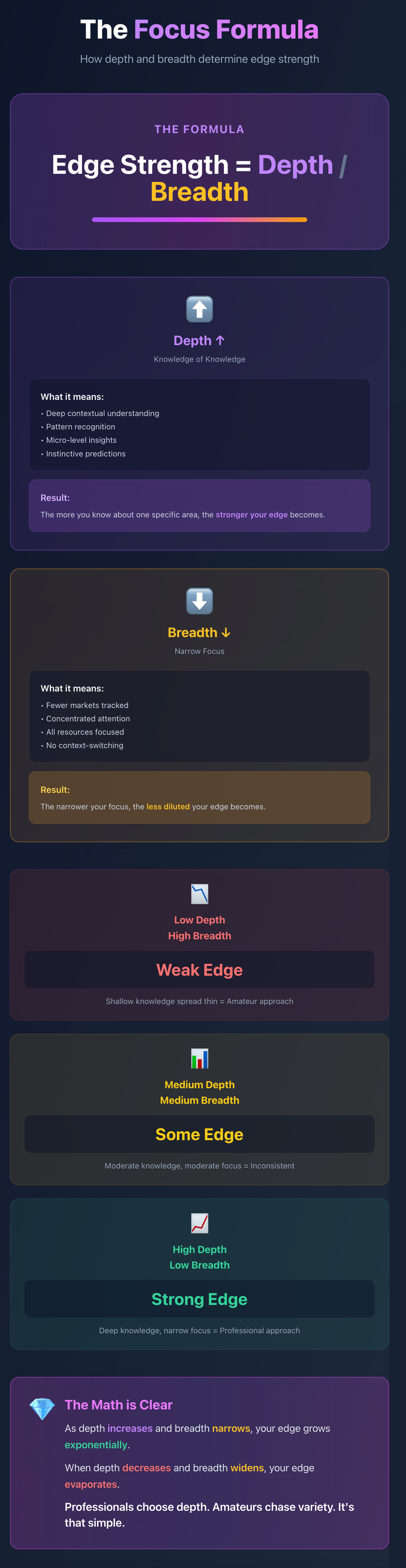
Edge Strength = Depth of Knowledge / Breadth of Focus
As depth increases and breadth narrows, your edge grows exponentially.
When depth decreases and breadth widens, your edge evaporates.
Professionals choose depth. Amateurs chase variety.
Key Takeaways
✅ Specialisation amplifies pattern recognition and data quality.
✅ Focus builds familiarity, which compounds over time.
✅ Diversification before mastery = dilution, not protection.
✅ Pick one market where data, liquidity, and interest intersect.
✅ Expansion comes after proof of consistent ROI.
✅ Depth creates the sustainable edge amateurs never develop.
Next Lesson
📘 Lesson 9: The Role of Data — Turning Numbers Into Narrative
We’ll explore how to interpret statistics like xG, possession, and shot quality, and how to transform raw numbers into insights that actually predict probability, not just describe history.